
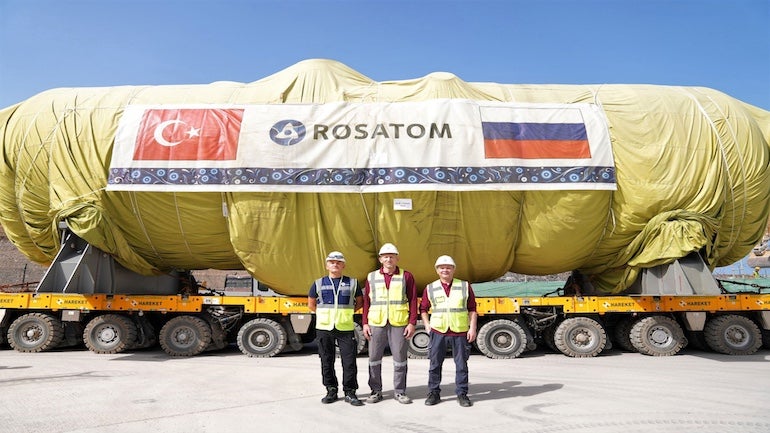
A set of four steam generators for unit 4 of the Akkuyu NPP under construction in Türkiye has been delivered to the construction site. After unloading the vessel, the equipment was loaded onto self-propelled wheeled platforms and transported to a temporary storage site.
The plant will eventually host four Russian-designed VVER-1200 reactors. The pouring of first concrete for unit 1 took place in April 2018, for unit 2 in June 2020, for unit 3 in March 2021, and for unit 4 in July 2022. Rosatom is constructing the reactors according to a build-own-operate model. Work continues at the facilities of all four units and auxiliary structures as well as a new town for plant operators. Unit 1 is scheduled for launch later this year.
The set of steam generators was manufactured at the Atommash plant in Volgodonsk (part of Rosatom’s Machine-Building Division) and delivered to Turkey by sea – a journey of about 3,000 km. In total, Rosatom’s Mechanical Engineering Division has produced more than 7,000 tonnes of equipment for the reactor halls of four Akkuyu units including four VVER-1200 reactor vessels and 16 steam generators.
“Steam generators are among the key components of a reactor plant,” said Sergei Butskikh, Director General of project company Akkuyu Nukleer. “Delivery of a set of equipment for the fourth power unit confirms the sustainable operation of the production and logistics chain of the project. As the building structures are ready, we provide the site with the equipment necessary to carry out subsequent stages of installation. This allows for systematic construction and installation work at all nuclear power plant facilities.”
Atommash Director General Maxim Zhidkov noted: Several years have passed since Atommash began manufacturing equipment for the Akkuyu NPP. This is not just a set of mechanical actions; it is a real contribution to improving the lives of millions of people. Modern nuclear power plants are not only billions of kilowatts of clean energy, but also new jobs, the development of science, improving the quality of education and access to nuclear technologies, which are in demand today in various fields from agriculture to healthcare.”
Earlier in June, an overhead crane with a lifting capacity of 350 tonnes was installed in the turbine hall building of Akkuyu unit 3. Its main purpose is to move equipment and materials during the construction and operation of the unit. Using a crane, elements of the turbogenerator, large pipeline components and other equipment will be installed in the design position. The total weight of the crane is 385 tonnes, and is 56.8 metres long with a lifting height of 43 metres.
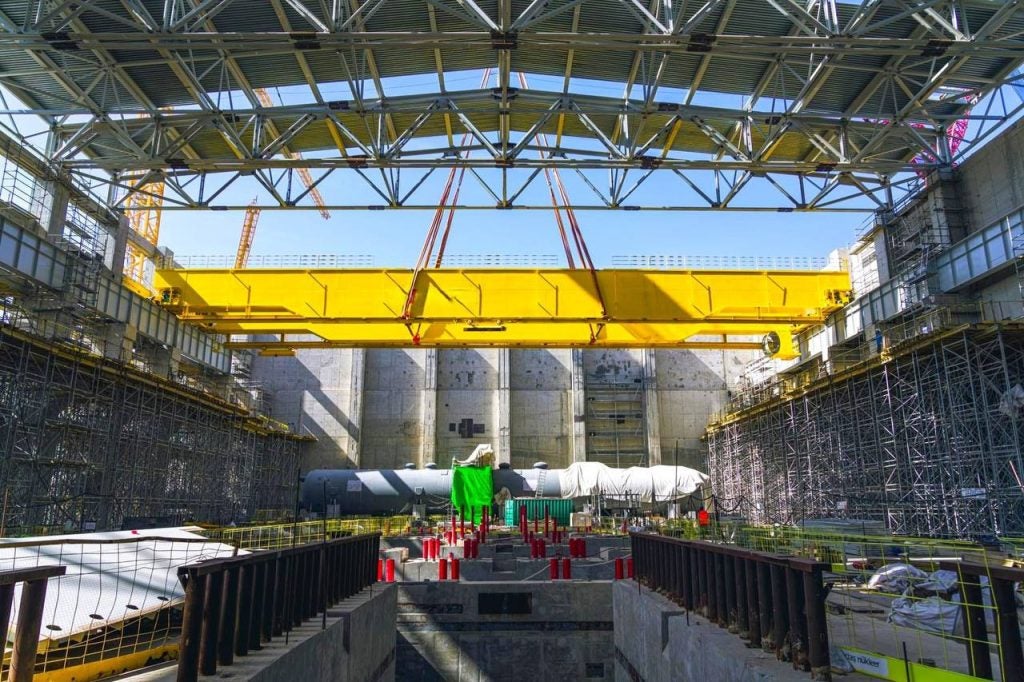
T2IC and TSM Enerji specialists have an important task ahead – installing a cargo trolley, setting up control and safety systems and conducting static and dynamic tests. Only after this will the crane be able to begin performing its main tasks.
“During the installation of the overhead double-beam crane, a non-standard approach to the organisation of work was carried out, providing for complete enlarged assembly of equipment on the ground, which made it possible to significantly reduce installation time and increase production safety, said Oleg Didenko, Deputy Head of the Hermetic Zone & Air Defense Department of TSM Enerji. “A similar technology was previously used in the construction of unit 2, while the accumulated experience and analysis of the work performed made it possible to take into account feedback and optimise the installation sequence.”
He added: “Installation was carried out in three stages using one of the world’s largest crawler cranes – a Liebherr LR 13000. A 320-tonne a crane bridge, a 68-tonne main bogie and a 10-tonne auxiliary bogie were installed in series. This technical solution made it possible to minimise docking operations in the design position, reduce the labour intensity of work at height and increase the overall efficiency of installation of lifting equipment.”


