

During Russian President Vladimir Putin’s recent state visit to Kazakhstan for talks with President Kassym-Jomart Tokayev five inter-governmental agreements were signed including two on NPP construction and financing. In addition, 10 inter-agency agreements were signed including an action plan on regulatory cooperation in nuclear and radiation safety for 2026–2030. Putin was accompanied by a high-level delegation including ministers, government officials and senior executives representing several federal agencies, including Rosatom.
The nuclear deals solidified and strengthened existing agreements relating to the construction of Kazakhstan’s first NPP by Rosatom. In June 2025, the Kazakhstan Atomic Energy Agency (KAEA), with the participation of international experts, had selected Rosatom as general contractor for the project.
The first plant is being developed by Rosatom in the village of Ulken, also in Zhambyl district, on the shore of Lake Balkhash, approximately 400 km northwest of Almaty. The design capacity of the Balkhash NPP is 2.4 GWe, comprising two VVER-1200 reactors. Rosatom has already begun preparatory work on the site. The foundation is scheduled to be poured in 2029, with commissioning planned for 2035.
The two new agreements were signed by KAEA Chairman Almasadam Satkaliyev and Rosatom Director General Alexey Likhachev. The Agreement on Basic Principles and Conditions of Cooperation defines the main parameters of the nuclear power plant construction project. It affirms Rosatom as the general contractor Rosatom will handle the technical design, engineering specifications, and the delivery of heavy equipment.
The agreement specifies localised personnel training, scientific exchange, and educational development to establish a new nuclear sector within Kazakhstan. The document covers key areas of cooperation during the operation of the nuclear power plant, including service and fuel supply.
“We highly value the long-term partnership with Kazakhstan and are convinced that Russian nuclear technologies will become a reliable basis for energy technologies independence and sustainable development of the country,” said Likhachev. “Today our cooperation reaches a qualitatively new level, opening up new opportunities for economic and technological growth.”
The Agreement on the State Export Loan formalises the financial mechanisms required to fund the project. Moscow will extend a state export credit covering roughly 85% of the total project cost. The Government of Kazakhstan will fund the remaining 15% out of the state budget. The credit is structured as a long-term loan. By securing Russian credit, Kazakhstan minimises immediate domestic capital expenditure while planning to pay back the loan using future revenue generated by selling affordable power to businesses and households.
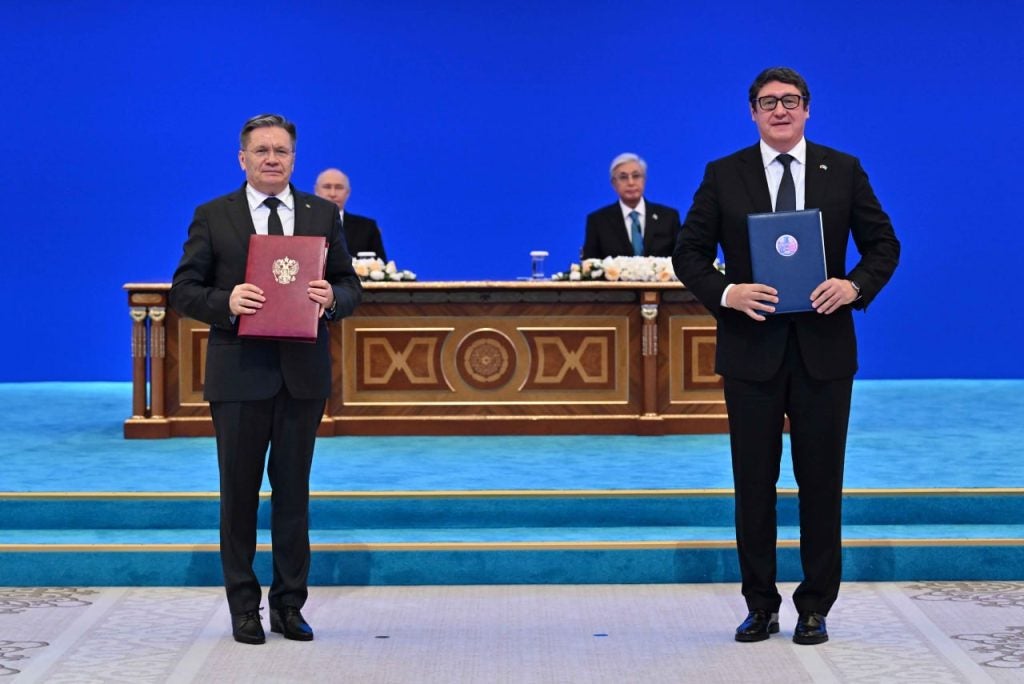
“It is a long-term loan with very favourable terms for Kazakhstan. This matter falls under the responsibility of Kazakhstan’s Ministry of Finance,” Satkaliyev said. According to preliminary estimates, the construction of two power units will require approximately $14.4bn with another $2bn earmarked for physical security systems and social infrastructure. “This is a considerable amount of funding, which, under an agreement involving the Government of Kazakhstan and the Atomic Energy Agency, will be secured through export credit,” he explained.
The Balkhash NPP project is already in the practical implementation phase, with engineering surveys underway. The start of main construction work at the site is scheduled for 2027. “Construction typically takes up to 10 years, but as agreed with our partners, we expect the first unit to be operational by 2034 – seven years after the first concrete pour,” Satkaliyev said. Following the signing of these two documents, the project is officially in its practical implementation phase. Engineering and geological surveys are currently underway at the site.
In addition, during the state visit a memorandum of understanding (MOU) was signed between KAEA and Russia’s Service for Environmental Protection Technological and Nuclear Supervision (Rostechnadzor) on cooperation. This included an Action Plan for interdepartmental cooperation in the field of regulation of nuclear and radiation safety for 2026–2030 aimed at the practical implementation of agreements reached and the development of interaction between the relevant departments of the two countries.
The Plan provides for joint activities, including the exchange of experience in the field of licensing, control and supervisory activities, expert consultations, seminars, internships and other forms of professional interaction on issues of regulating nuclear and radiation safety.
Particular attention will be paid to improving the regulatory framework, developing human resources, as well as issues of adaptation and harmonisation of Kazakhstan legislation necessary for the implementation of the NPP construction project.
KAEA said implementation of the Plan will contribute to the further strengthening of bilateral cooperation, the development of a national system for regulating nuclear and radiation safety, the introduction of international experience and best practices, as well as the formation of an effective regulatory infrastructure to ensure the safe use of nuclear energy for peaceful purposes.
Following the talks and formal signing of the agreements, Presidents Tokayev and Putin made formal statements to the media.
“This visit has served as a vivid demonstration that our bilateral cooperation is evolving in meaningful ways,” said Tokayev. “There are objective indicators to support this claim. In fact, our trade is expected to reach $30bn. In terms of investment in our economy, Russia has outpaced all other countries. There are 177 projects on the list of promising economic cooperation initiatives, and 122 of them have entered their operational cycle, which means that they have been implemented…. Kazakhstan’s investment in the Russian economy has reached $9bn, which is also a good indicator. Over 20,000 companies with Russian participation successfully operate in Kazakhstan.”
He added: “I think the agreements signed today on Balkhash NPP are of strategic importance to the construction of a nuclear power plant. I thank the President of the Russian Federation for his bold support of this large-scale project. This initiative promotes integration in the field of science and education, technology and ensures the development of mixed areas related to energy and industry. For Kazakhstan and Russia, it is important to successfully address the issue of energy resources and electricity generation, transportation, delivery to domestic and foreign markets.”
Putin also commented that Russia is one of the leading investors in Kazakhstan’s economy, confirming Tokayev’s figures. He noted: “As part of this visit, we approved agreements setting forth the parameters for building this NPP and funding the project from a Russian state export loan. Once launched, the NPP will make a significant contribution to powering Kazakhstan’s economy and will help supply businesses and households with inexpensive and clean energy.”
He added: “I would like to note, just as the President of Kazakhstan and I have agreed, that this project cannot be reduced to creating a nuclear power plant. This is more than just a matter of building it. This effort consists of creating an entire sector, including education, personnel training, and all related matters.”
The two Presidents also signed a Joint Statement On the seven foundations of friendship and good neighbourliness between Kazakhstan and the peoples of Russia.


