
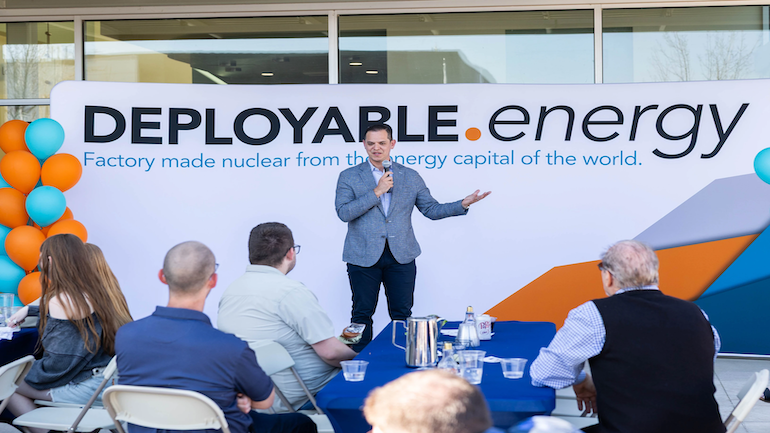
US start-up Deployable Energy has received approval of its Preliminary Documented Safety Analysis (PDSA) for its Unity microreactor criticality test – a key milestone in the US Department of Energy (DOE) safety authorisation process.
Founded in 2025, Deployable Energy is developing the Unity Nuclear Battery (UNB), a 1 MWe gas‑cooled microreactor that uses an actively cooled helium primary loop and standard low-enriched uranium dioxide fuel. It is engineered for factory manufacture and shipment in a standard 20-foot container for deployment in remote, distributed, maritime, and defence applications. It expects to achieve criticality by July 2026.
The PDSA establishes the preliminary safety basis for the Unity reactor criticality test, documenting how the design meets DOE requirements for hazard analysis, accident mitigation, and operational controls. The review, completed in 106 days, reflects extensive engineering and safety evaluation and provides the formal foundation required for its upcoming demonstration, including commissioning and startup activities under DOE oversight.
“The PDSA approval is an important step in bringing a new reactor to life,” said Deployable Energy CEO Bobby Gallagher. “Completing this review in 106 days since programme kick-off demonstrates both the strength of our safety approach and the urgency with which our team is executing toward demonstration.”
Supporting this progress, the company recently delivered its criticality test rig to Idaho National Laboratory (INL) following a cross-country road trip in a Ford F-150 truck, underscoring the compact and deployable nature of the Unity system. The manufacturing of the fuel that will be used during the initial criticality test has also been completed. These milestones enable on-site integration and testing ahead of the planned initial criticality later this summer.
In April, Deployable Energy was for into DOE’s Nuclear Energy Launch Pad programme, led by the National Reactor Innovation Center (NRIC) at INL, which provides access to national laboratory expertise and infrastructure to support advanced reactor demonstrations.
Deployable Energy says it was founded on a simple idea: nuclear energy should be a product, not a project. “The modern US industrial base is built to manufacture products – repeatable, scalable systems that can be deployed quickly and affordably. We build aircraft at scale, not airports. Energy should be no different.


