
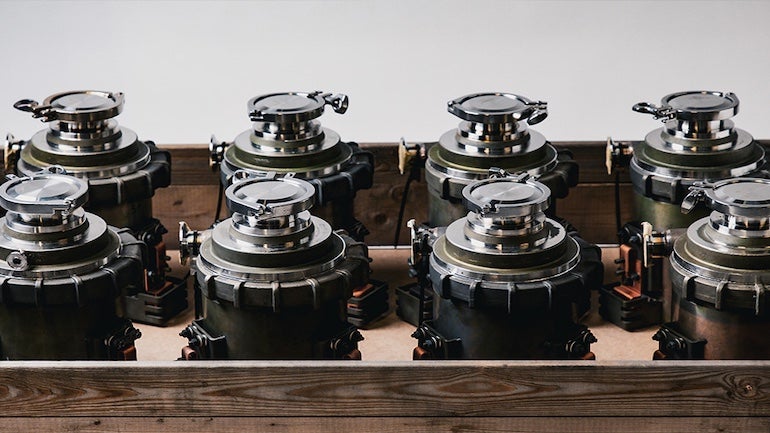
Widely regarded as one of the more promising of the next-generation small modular reactor technologies, molten salt reactors (MSRs) have nonetheless been persistently constrained by unresolved materials challenges. Two recent developments from Copenhagen Atomics aim to bridge that credibility gap by demonstrating the long-term performance of systems and materials. The results point to both technical feasibility and a broader strategy centred on reliability, cost reduction and industrial scalability. Taken together, these are the critical factors that will ultimately determine whether MSRs can compete.
Proving durability where it matters
In MSR designs pump reliability is a fundamental characteristic and presents particular challenges. Molten salt systems depend on continuous circulation of a liquid fuel and coolant material which is both corrosive and at a high temperature. While in contrast to many light water designs any failure in pumping systems may not affect safety, it does directly compromise reactor operation and therefore becomes a critical path system for plant economics.
“Component reliability is not something you prove once, it has to be proven repeatedly over long periods and under realistic conditions,” Copenhagen Atomics CEO and co-founder, Thomas Jam Pedersen, tells NEI, adding: “Running a molten salt pump continuously for two years is a major technical milestone, and it confirms that our approach to design, materials, salt purity and testing works as intended.”
Indeed, operating a molten salt pump continuously for two years under conditions exceeding 600°C represents one of the longest continuous demonstrations of its kind globally. However, the import lies less in the face value operational duration than in what it represents for licensing and commercial deployment. Regulators do not approve reactors based on theoretical performance; they require extensive empirical data demonstrating that critical components can operate reliably over timescales comparable to operational lifetimes. Pedersen emphasises the significance of this point: “For regulators, data matters – not optimism or simulations. Long-duration component testing dramatically reduces risk later in the development process. Finding and fixing issues in a test loop is orders of magnitude cheaper than discovering them in a prototype reactor.”
Necessity as the mother of invention
Copenhagen Atomics’ approach focuses on high-volume, low-cost experimentation. Rather than relying on a small number of expensive prototypes, the company has built a vertically integrated testing platform capable of running multiple molten salt loops in parallel. To date, the company reports more than 100,000 hours of combined pump runtime, with over 120 pumps tested and many exceeding one year of operation. This scale of testing is unusual in a field where individual test systems can cost millions of dollars. The rationale is both technical and economic, as Pedersen explains: “When you start combining temperature, flow rate and salt chemistry, you get a very large solution space that you need to explore and regulators don’t just want one result, they want to see variation across repeated tests.”
Cost reduction is therefore critical. “If each test costs a million dollars, there’s a limit to how many you can run. But if you can get that down to maybe $10,000, then suddenly you can run many more tests and build statistically meaningful data.”
This strategy has led to a level of experimental throughput that Pedersen argues is unmatched: “We have more molten salt pumps here in Copenhagen than all the other teams testing molten salt reactors or equipment around the world combined.”
The company’s decision to develop its own pump technology also illustrates how practical constraints have shaped its engineering approach. Early in its development, Copenhagen Atomics found that no existing supplier could provide a suitable high-temperature pump for molten salt applications. After contacting approximately 20 manufacturers, the only viable proposal involved a multi-year development effort costing around $1m and even then there were no guarantees of success. For Pedersen and the other co-founders this was untenable. The result was an in-house design based on a canned rotor configuration, in which the motor and impeller are integrated and enclosed, eliminating the need for long shafts and reducing leakage risks. This canned rotor pump model also contrasts with the cantilever designs more commonly proposed for molten salt systems.
“It was really because we couldn’t find anything on the market, but that forced us to develop something different and it turned out to work quite well,” Pedersen says.
The design has since been patented and refined through successive generations of testing. Crucially, the ability to manufacture pumps internally at relatively low cost has enabled the company’s high-volume testing model.
Curing the corrosion issue
Among the most persistent technical concerns in MSR development is corrosion. High-temperature fluoride and chloride salts are inherently reactive and are associated with significant material degradation. However, new research conducted jointly with the University of Liverpool and Copenhagen Atomics suggests that this issue may be far more manageable than previously assumed provided that salt chemistry is properly controlled.
The study, published in the Journal of Nuclear Materials, examined corrosion behaviour in standard 316L stainless steel exposed to molten salts at temperatures up to 700°C. The results found that salts containing moisture and oxides caused severe corrosion within 1000 hours. Conversely, purified salts resulted in negligible corrosion even after 3000 hours, with only a thin protective layer forming on the exposed surface of the steel.
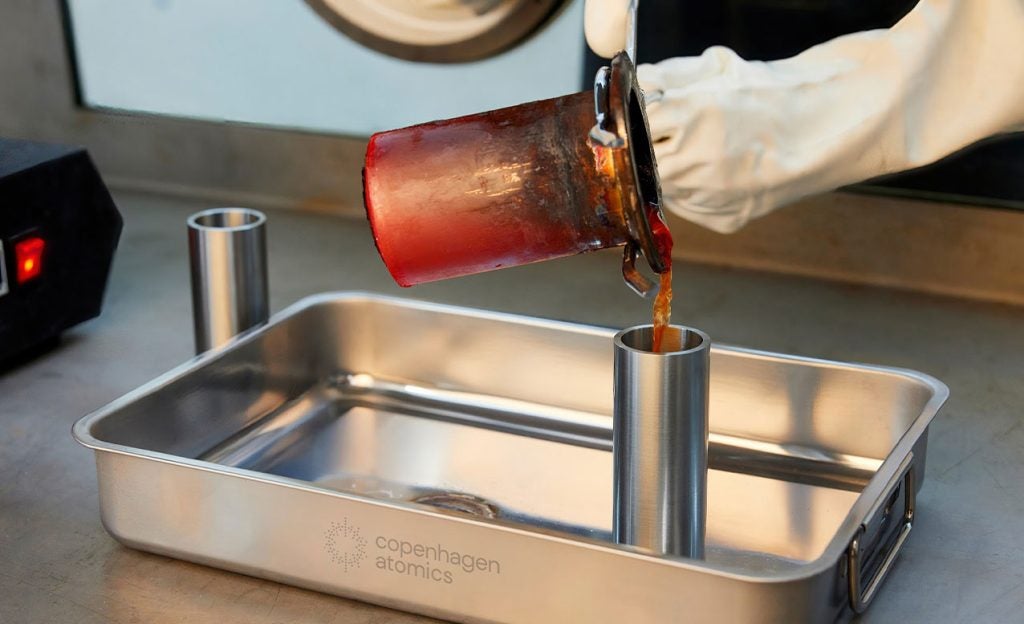
The salt purification process is a patented and commercially sensitive approach which has also been developed in-house by the Copenhagen Atomics team.
Crucially, in addressing the corrosion issue this process enables the use standard 316L stainless steel rather than exotic high-nickel alloys such as Inconel or Hastelloy. This has far-reaching implications for MSR economics as stainless steel is not only significantly cheaper, but also more widely available and easier to fabricate. “Stainless steel is roughly 10 times less expensive than some of the exotic materials,” Pedersen explains. “That directly reduces the cost of the reactor and ultimately the cost of energy.”
There are also downstream benefits in terms of lifecycle management as stainless steel is more straightforward to recycle. In the Copenhagen Atomics’ design, structural components such as pumps, heat exchangers and the reactor core are replaced approximately every five years due to neutron-induced material degradation. While these components become highly radioactive and cannot be refurbished, they can eventually be recycled after sufficient cooling. “The great thing about metals is that we’re very good at recycling them. After about 30 years, you can melt everything down, separate the radioactive slag, and reuse most of the steel,” says Pedersen. This approach reduces long-term waste volumes, with less than 10% of material ultimately requiring disposal as high-level waste.
A reactor based on reliability
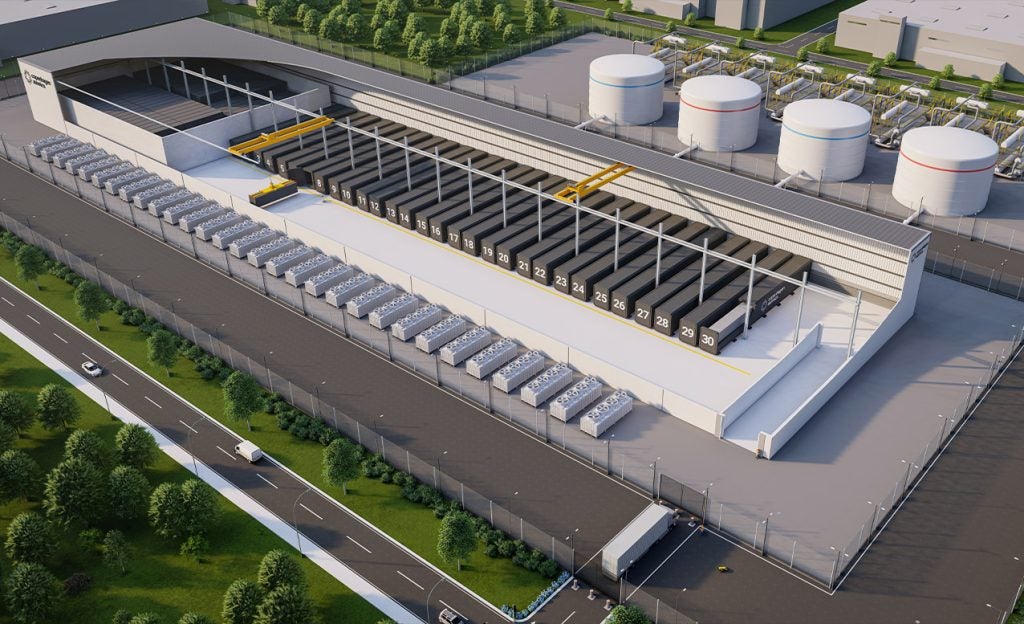
Underlying both the pump and corrosion developments is a consistent theme: reliability as the foundation of commercial viability. Pedersen points to historical experience with advanced reactor concepts such as sodium-cooled fast reactors and argues that technical feasibility alone is insufficient to achieve commercial success. He observes that many advanced reactor designs have failed to achieve widespread deployment due to operational complexity and reliability challenges. High capacity factors are essential not only for nuclear competitiveness, but for industrial applications requiring continuous, low-cost energy, Pedersen states, explaining: “If the very first commercial reactor only runs 20 or 30% of the time, it will be seen as a failure. We need to be successful from the beginning and the only way to do that is through extensive testing.”
Beyond the testing programme, Copenhagen Atomics ultimately aims to deliver energy at a cost significantly below that of conventional nuclear and even fossil-fuelled generation. Indeed, Pedersen suggests that their technology could achieve prices “roughly half” those of coal-fired power.
While such claims have yet to be validated, they do reflect the company’s strategic focus on core industrial energy markets such as steel, aluminium and ammonia where energy cost is a primary driver of competitiveness.
Pedersen believes that molten salt reactors, with their high operating temperatures and potential for high load factors, are both well suited to such applications and cost effective. Nonetheless, despite reaching important milestones in terms of technical progress, significant hurdles remain. Chief among these is regulatory approval, which Pedersen acknowledges will likely take longer than initially anticipated. Commercial deployment is now projected around 2030–2031, contingent on licensing timelines in multiple jurisdictions.
“We expect it will take a number of years before customers receive licenses and we can start building,” Pedersen says.
Even so, by systematically generating long-term data on component performance and materials behaviour, the company is building the evidence base required for regulatory approval and investor confidence. As Pedersen puts it: “What matters is whether the underlying components have been tested long enough to satisfy regulators and customers. This is how we turn molten salt reactors from a promising concept into an engineered, licensable technology.”
In a sector where ambition has often outpaced execution, that distinction may prove critical.


