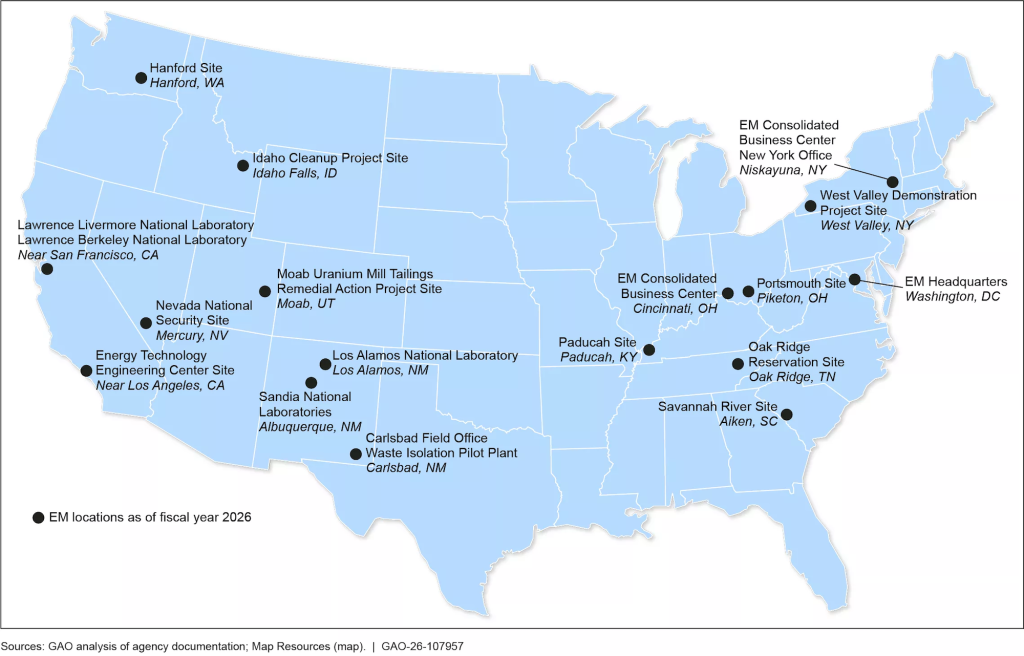
The US nuclear legacy is costing billions of dollars. Nuclear research and development at 15 sites across the US have taken decades to clean up and the work is still not done, according to the US. Government Accountability Office (GAO). Its new 59-page report, Nuclear Waste Cleanup: Better Data and Project Prioritization Vital to Managing Aging Infrastructure and Communicating Needs, says many facilities at nuclear cleanup sites have operated longer than they were designed for, which further increase costs and risks.
The Department of Energy (DOE) is responsible for cleaning up the hazardous and radioactive waste at sites contaminated by nuclear weapons production and nuclear energy research. Cleanup involves tearing down contaminated buildings, remediating contaminated soil and groundwater, and treating millions of gallons for radioactive liquid waste.
GAO noted that, if untreated, nuclear waste from radioactive decay could last thousands of years. Cleanup is critical to preventing long-term environmental contamination, damage to water supplies and cancer-causing exposure to humans and animals. “This is no small job. And DOE has had to contend with some major issues over the years with its efforts, including aging facilities and equipment, spiralling costs, and increasing maintenance and repairs.”
Many of the 6,000 facilities (and the equipment used within them) are 50-70 years old. They are being used well beyond their intended life. For example, at the Savannah River Site (SRS) in South Carolina, a mission-critical crane used to move radioactive parts through a facility was last replaced in the 1980s. Its replacement isn’t planned for another two years. At that same site, the roof of a shutdown facility is falling apart. Leaks in that roof could allow dangerous chemicals to seep into the ground in the short term and likely would increase demolition costs in the long term.
At Waste Isolation Pilot Plant (WIPP) in Carlsbad, New Mexico – the nation’s only US repository for disposing of certain nuclear waste from defence related activities – an elevator used to move contaminated waste is mission critical. “The machinery was built more than 100 years ago. And its motor is more than 40 years old, operating well beyond life expectancy. It has repeatedly required unplanned and expensive maintenance”.
DOE spends about $781m a year maintaining about 2,200 buildings; 2,500 other structures and facilities; 1,200 trailers; and support elements such as roads and utilities at these cleanup sites. “And those costs are spiralling. For example, as of June 2025, DOE reported over $1.5bn in repair needs across its efforts”. During the last five years, DOE’s budget for maintenance and repairs at cleanup sites has nearly doubled. “These costs are anticipated to further increase over time. In fact, the department’s budget request included over $950m in maintenance spending at cleanup sites for fiscal year 2026 alone.”
GAO noted that there is some good news. “DOE reports that the number of facilities at cleanup sites with deferred maintenance and repair needs has been declining since 2022. The department has made significant progress in reducing the number of facilities in poor or very poor condition. In fact, as of last June, DOE reported that 80% of all facilities were considered to be in ‘good’ or ‘very good’ condition.”
Nevertheless, maintenance backlogs remain. And funds are still needed to complete those repairs. These backlogs were concentrated at four sites: the Hanford site – $467m for 1,547 facilities; SRS- $278.1m for 1,842 facilities; the Oak Ridge site – $62.8m for 547 facilities; and the Idaho site – $48.1m for 409 facilities. For all the other sites the backlog was $97m for 1,548 facilities.
To help prioritise projects, DOE created its “master asset plan” in 2023 that looks at all sites’ conditions, maintenance needs, and work priorities. “But when we looked at it, we found it may not capture the reality of each site’s current needs. This may be, in part, because individual sites have more detailed data about their needs than is used in the plan. Specifically, eight of 13 sites reported that the plan doesn’t reflect their current maintenance needs.”
DOE has also identified projects that it says could save money long term. This includes 19 projects totalling $120m. “But the department hasn’t communicated these potential costs-saving projects to Congress, which needs this information to inform its budget decisions.”
DOE’s Office of Environmental Management (EM) reported over $1.5bn in repair needs across its about 4,300 operating facilities, as of June 2025. EM’s budget request included over $950m in maintenance spending in fiscal year 2026, an 80% increase since fiscal year 2020.
EM sites and headquarters use data from condition assessments of facilities to make maintenance decisions. EM validates these data for accuracy using scorecards. According to GAO’s analysis, some scorecards included inaccurate or unsupported data and did not have completed corrective action plans. Also, GAO’s review of site responses to a questionnaire found that some sites used different methods to generate data elements categorised as performance measures by a DOE order. “As EM uses these data to make decisions for funding repairs, accurate and comparable data would help EM to better plan, prioritize, and fund the continued reduction of its maintenance needs,” GAO noted.
GAO is making four recommendations to DOE.
- The Assistant Secretary for EM should ensure sites create and complete corrective action plans to correct data validation issues identified in the FIMS validation scorecard process. (Recommendation 1);
- The Assistant Secretary for EM should ensure EM sites have procedures to accurately and comparably capture deferred maintenance and annual actual maintenance data elements (Recommendation 2);
- The Assistant Secretary for EM should better incorporate more reliable information from EM sites in the Master Asset Plan, such as site project prioritisation decisions for infrastructure maintenance projects, to better reflect site maintenance needs. (Recommendation 3);
- The Assistant Secretary for EM should communicate to Congress the reductions in cost and risk to mission that can be achieved by specific projects identified by their prioritization model. (Recommendation 4).
GAO gave examples of three sites: the Oak Ridge Site in Tennessee; WIPP in New Mexico; and SRS.
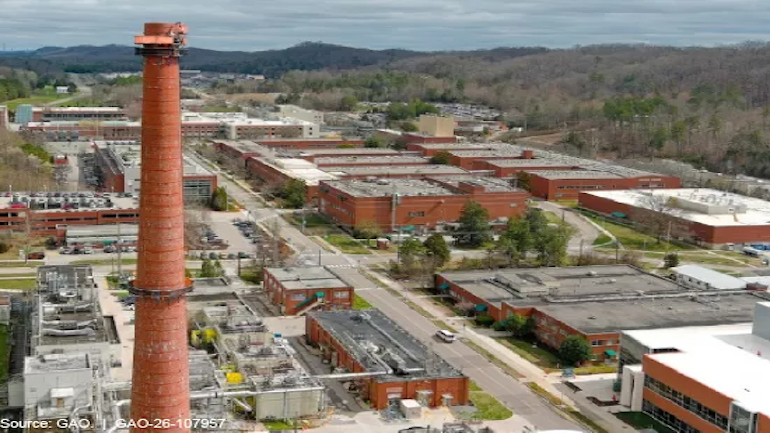
The Oak Ridge Site, one of the three original sites in the Manhattan Project, faces a variety of challenges related to cleanup of past nuclear missions and DOE’s other ongoing nuclear missions at the site. For example, according to officials from Oak Ridge:
- Maintenance operations at the site involve support infrastructure with ongoing missions of several other DOE units: National Nuclear Security Administration, Office of Nuclear Energy, Office of Science, and the Office of Legacy Management.
- Coordinating ongoing missions and cleanup operations can be difficult. For example, when a set of evaporators used for treating toxic waste became irradiated and costly to repair, the site had to install and operate new units before demolishing the old evaporators.
- Budget and mission needs can force the site to delay certain maintenance despite potential for increased long-term costs. For example, the scheduled demolition of an air release stack was delayed even though replacing it with modern air scrubbers would reduce maintenance costs.
At WIPP, current contractor representatives at the site stated that since the facility’s life has been extended, there is a need to upgrade the infrastructure for longer duration service. Site officials stated in questionnaire responses that they anticipate annual maintenance costs will increase over the next five years as the site seeks to replace buildings, utilities, and supporting infrastructure in use beyond their design lives.
“The representatives told us that the hoist, used to transport transuranic waste from the surface to the underground facility, is designated as a mission-critical asset. The hoist repeatedly required unplanned maintenance throughout 2024, according to officials from the Defense Nuclear Facilities Safety Board. In June 2024, the hoist stalled while transporting nuclear waste underground. The hoist was built in 1924 and installed at the Waste Isolation Pilot Plant in 1984, and, according to site officials, its motor is 40 years old and likely past its design life.”
The SRS National Laboratory faces a number of challenges. According to Laboratory staff, the key challenge they face is having sufficient space. The laboratory requires significant maintenance activities to clean out and update old, unusable space that is highly dangerous due to past radiation. By clearing out this space, they can then make the choice to assist in speeding the closure of other parts of the EM mission or adding new capabilities.
Other challenges include maintenance on the air filter system, effluent drains, and the cooling water system, according to site officials. The laboratory’s air filter systems contain older filters held in place by wood, which is a higher safety risk. The drains, which are used to safely move high radiation effluent, are rotting and leaking. The laboratory had to shut down many of the drains, which means that the high radiation effluent had to be moved manually around the facility. Finally, the cooling water system pipe support system has long-term water damage, increasing the risk of the system failing and flooding parts of the facility.
GAO concluded that EM should make better use of its Master Asset Plan and communicate potential cost savings and risk reductions to Congress. “A model that shows how to save millions of dollars while reducing risk is a powerful tool, but EM will not realise the goal of its model – to maximise the expected return from a limited budget – if it does not inform those who can help EM achieve its goal. Therefore, we continue to believe that EM should communicate to Congress the unfunded projects identified by the Master Asset Plan and the reductions in cost and risk to mission that can be achieved if they are prioritised.”