
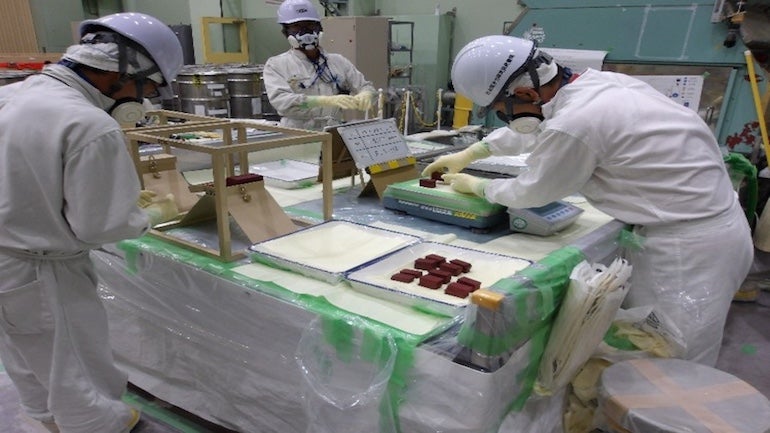
The US has received 1.7 tonnes of high-assay low-enriched uranium (HALEU) from Japan, marking the largest single international shipment of its kind in the history of the US Department of Energy’s (DOE’s) National Nuclear Security Administration (NNSA). The material came from Japan’s now-defunct Fast Critical Assembly programme. It is being transported to the Y-12 National Security Complex in Tennessee to be reconstituted for use by the US nuclear industry.
This transfer is a central component of President Trump’s strategy to achieve energy dominance by securing a domestic fuel supply for next-generation nuclear reactors including small modular reactors (SMRs). HALEU is critical for advanced reactors because its higher concentration of uranium-235 (between 5% and 20%) allows for smaller designs and longer operating cycles. By securing this supply from Japan, the US aims to reduce reliance on foreign fuel sources while accelerating the commercial deployment of advanced reactors to support growing energy demands, such as AI data centres.
The shipment aligns with President Trump’s May 2025 Executive Order (EO) 14299, Deploying Advanced Nuclear Reactor Technologies for National Security, which mandates the release of at least 20 tonnes of HALEU into a fuel bank to jumpstart the advanced nuclear industry.
NNSA’s Y-12 National Security Complex is managed and operated by Consolidated Nuclear Security, a joint venture led by Bechtel National alongside Leidos, Northrop Grumman (formerly Orbital ATK), and SOC LLC.
The complex includes the Uranium Processing Facility (UPF) – the site’s future Uranium Centre of Excellence, designed to consolidate uranium processing activities, including the reconstitution of feedstock into forms usable for the commercial nuclear industry. The Highly Enriched Uranium Materials Facility (HEUMF) at Y-12 is the designated arrival and long-term storage point for sensitive nuclear materials received from international partners.: Until the UPF is fully operational Building 9212, a legacy Manhattan Project-era facility, handles the chemical processing and purification required to downblend or reconstitute uranium material.
The UPF is in its final phase of construction but has faced significant cost increases and schedule delays. The project is currently transitioning from construction to the start-up and commissioning phase. Five of the seven major subprojects had been completed by late 2025, including the Mechanical/Electrical Building and the Process Support Facilities. The project recently achieved “energisation” of the final building, the Salvage and Accountability Building, marking its connection to the Y-12 power grid and the start of the final construction stage. Following a major “re-baselining” in late 2024, the UPF’s estimated cost has risen to $10.35bn (from the original $6.5bn cap). While NNSA previously aimed for 2025–2026 for operation, current projections indicate construction will finish by 2032, with full operations expected to begin in 2034.
Once processed at these facilities, the HALEU will be managed by the DOE Office of Nuclear Energy’s HALEU Availability Program to fuel next-generation advanced reactors. This fulfils the “fuel bank” requirements established by EO 14299.
The operation to deliver the HALEU to the US involved collaboration between Japan’s Ministry of Education, Culture, Sports, Science & Technology, the Japan Atomic Energy Agency, and the UK’s Nuclear Transport Solutions (NTS) and Civil Nuclear Constabulary, which assisted with logistics and security. NTS delivered the material using the specialist vessel Pacific Grebe, a purpose-built diesel-powered ship designed specifically for the safe carriage of nuclear materials and modified to handle new nuclear fuel transport packages.
“NNSA is breaking records with rapid approvals and decision making to support America’s nuclear industry,” said NNSA Administrator Brandon Williams. “Supplying advanced reactor designs with HALEU fuel is vital to making America energy dominant in pursuit of President Trump’s vision to strengthen our nuclear industrial base.”
Dr Matthew Napoli, NNSA’s Deputy Administrator for Defense Nuclear Non-proliferation, noted: “This milestone accelerates our progress towards a secure and independent energy future, while reaffirming our commitment to nuclear nonproliferation. Through this partnership with Japan, we are fuelling the next generation of nuclear power, and solidifying America’s energy dominance.”


