
The US Department of Energy’s DOE’s) Idaho Operations Office (DOE-ID) has approved the Documented Safety Analysis (DSA) for the Aalo Atomics Aalo-X Critical Test Reactor. This represents the “hardest regulatory gate” for the project and serves as the authoritative safety basis for the facility, similar to a Nuclear Regulatory Commission operating licence.
The DSA is the authoritative safety basis for a DOE nuclear facility. It demonstrates in detail that a facility can be operated safely across its full range of normal, off-normal, and accident conditions, advancing Aalo into its final pre-operations phase, the Operational Readiness Review (ORR).
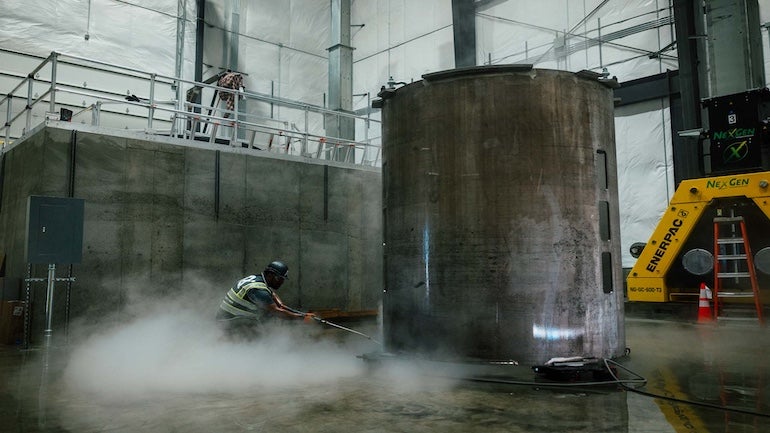
In March Aalo Atomics unveiled its completed Critical Test Reactor (CTR) at the Idaho National Laboratory (INL). The CTR facility, according to Aalo, serves as the “home” for the Aalo-X advanced reactor – a 10 MWe experimental sodium-cooled reactor unit. It is a “power-producing full-scale experimental nuclear power plant” designed to validate the technology for future commercial use.
Aalo was one of 11 advanced reactor projects selected by DOE in August for support through its Nuclear Reactor Pilot Program, which aims to see at least three of them achieve criticality by 4 July 2026. This was in line with President Trump’s May 2025 Executive Order (EO) 14301, Reforming Nuclear Reactor Testing at the Department of Energy.
Aalo Atomics officially broke ground on the Aalo-X Experimental Site in September 2025, specifically choosing a plot at the very edge of the INL boundary. They completed the building in just 36 days and the reactor assembly in 40 days. The Aalo-X Experimental Site serves as the physical proof-of-concept for Aalo’s “land-and-expand” strategy, where they aim to sit reactors directly next to high-demand customers such as AI data centres.
In the Aalo-X CTR, Aalo will test its full-scale nuclear core, with fuel equivalent to what is necessary for 10 MWe, before adding sodium coolant. The goal is to achieve criticality at low power and with reduced heat generation.
Aalo Co-founder and CTO Yasir Arafat said the CTR contains nuclear fuel, moderator, control rod drive mechanisms, shielding, and instrumentation systems that are direct analogues of what will operate in the 10 MWe Aalo-X power reactor being at an adjacent site.
“Operating the CTR will validate our neutronics and offer key test data that verifies our computational models,” he said. “To achieve this goal, we stood up an entirely new facility, exercised our supply chain, expanded internal manufacturing capabilities, and collaborated with the institutions needed to reach compliance with federal regulations. These accomplishments establish Aalo as a credible nuclear facility designer and operator.”
He added: AI data centres require power all over the country, and in general our customers’ sites will have no onsite DOE presence. So, to serve these customers, we must be able to do more than just license reactor technology, we also need to build and independently operate nuclear facilities. That is exactly what we are doing at the CTR.”
The Critical Test Reactor Building, formerly called the Critical Assembly Facility (CAF), is located at INL on land leased from DOE. Its construction, management, and operation will be performed almost exclusively by Aalo and its subcontractors.
“Our team’s experience with the Documented Safety Analysis brought to light many facets of compliance that we’ll carry forward to the commercial licensing process when building Aalo Pods for AI data centres,” said Arafat. “We radically improved our internal competencies on nuclear licensing, and as such we laid the foundation for regulatory success during commercial scaleup.


