
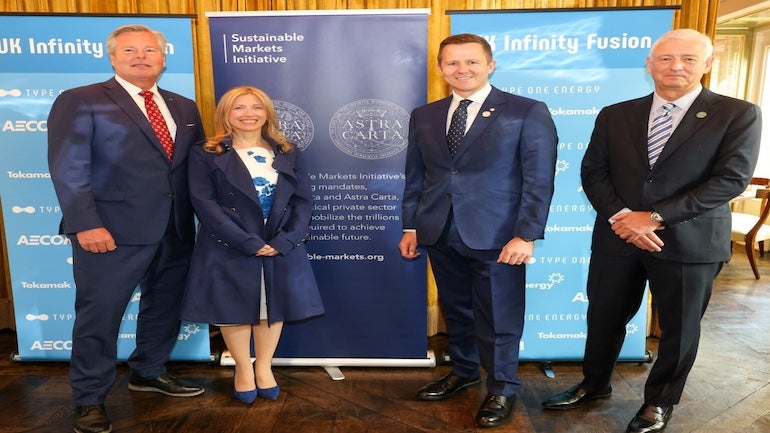
US fusion start-up Type One Energy, UK-based Tokamak Energy, and US construction engineering firm AECOM have launched the UK Infinity Fusion Consortium (UKIFC) to pursue development of the first private-sector-led fusion power plant project in the UK. The companies intend to develop a fusion project that is commercially credible, deployable using existing enabling technologies, and capable of attracting private capital in line with the long-term goals of the government’s recently announced UK Fusion Strategy.
At its core, UKIFC combines Type One Energy’s 400 MWe Infinity Two stellarator fusion power plant design, AECOM’s engineering capabilities, and Tokamak Energy’s HTS magnet technology and manufacturing expertise in the UK. The Consortium will use these capabilities to develop a UK Infinity Two fusion power plant project that will include participation by the broader UK fusion value chain spanning construction, finance, offtake and other supply chain partners.
The consortium was formed through the Sustainable Markets Initiative (SMI) founded by King Charles III and includes broader participation from UK supply chains in finance, construction, and manufacturing.
Using a “partner-intensive” model called FusionDirect, the group aims to shorten deployment timelines compared with traditional experimental programmes. The project is designed to complement the UK’s publicly funded STEP Fusion programme, which is building a prototype spherical tokamak plant at West Burton.
UKIFC plans to follow a timeline and siting strategy that leverages existing UK fusion infrastructure while benefiting from “first-of-a-kind” (FOAK) data from the US. The consortium’s strategy is designed to accelerate deployment by using technical validation from an earlier US project.
- 2025–2027 – technical and supply chain validation through the sister Infinity Two project at Tennessee Valley Authority’s (TVA’s) Bull Run site in the US. The TVA Infinity Two project is a first-generation 350 MWe baseload power plant based on Type One Energy’s stellarator fusion technology. It is being supported by the US government and provides a strong technical and programmatic foundation for the UK Infinity Two deployment project.
- By 2028 – target start for construction of the US Infinity Two plant.
- Early 2030s – the estimated timeframe for the UK Infinity Two plant to begin construction, following lessons learned from the American deployment.
- 2034 – targeted commercial operation for the US pilot plant, which will provide the operational data needed to finalise the UK project’s delivery.
While a specific site for the UKIFC plant has not yet been named, the consortium will build on the extensive power plant siting research already conducted for the government’s STEP programme. Key criteria include:
- preference for former industrial or power station sites (such as the West Burton coal-fired plant) that already have grid connections and cooling water access.
- proximity to regions already designated for fusion development under the UK’s new National Policy Statement for Fusion Energy, which streamlines planning for such facilities.
- sites located within “fusion clusters” (such as the Oxford-Cambridge corridor or the East Midlands) to ensure access to a specialised workforce and engineering partners such as AECOM.
- leveraging the community engagement frameworks established during the 2021–2022 STEP site competition, which shortlisted sites such as Ardeer, Moorside, and Severn Edge.
The Consortium will build on the UK’s significant investment in magnetic confinement fusion technology, supply chain capabilities, regulation, and power plant siting for the government’s STEP Fusion programme. The development of a UK Infinity Two fusion power plant project by the Consortium is aligned with the UK Government’s strategy to move from world-leading fusion science to commercial deployment – a strategy guiding the STEP Fusion programme. The Consortium will create a private-sector-led fusion commercialisation pathway complementing the STEP Fusion programme.
“Fusion needs to be delivered, not just developed,” saidType One CEO Chris Mowry. “This Consortium brings together the core industrial capabilities in the UK and US required to deploy real-world fusion power plant projects that are commercially viable. By aligning fusion technology, advanced manufacturing, and power plant engineering, we are closing the gap between today’s energy innovation and tomorrow’s energy infrastructure. Our initiative is fully aligned with UK and US ambitions to be leaders in commercial fusion deployment.”
Tokamak Energy CEO Warrick Matthews, Chief Executive Officer, , said: “This Consortium puts Tokamak Energy’s transformative magnet technology and manufacturing expertise in the centre of another world-class fusion programme. Together, we can accelerate towards commercialising a new form of limitless, clean energy and, in combination with our role as STEP magnet systems partner, strengthen the UK supply chain’s leadership in global fusion.”
AECOM Chairman and CEO Troy Rudd said:“Delivering on fusion’s potential requires disciplined engineering, well-established infrastructure delivery models and collaboration across the entire energy ecosystem. Through this Consortium, AECOM is bringing its global experience in complex energy infrastructure to help lay the groundwork for commercial fusion projects that can scale with confidence, supporting the UK’s energy system while strengthening its industrial and infrastructure base.”


