
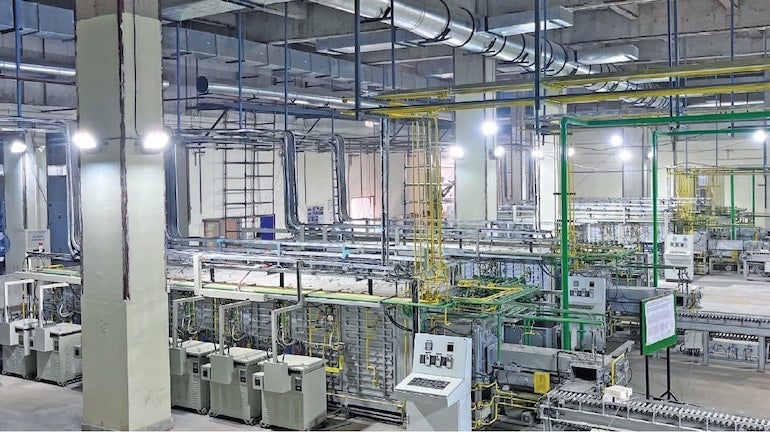
India’s Atomic Energy Regulatory Board (AERB) has granted an operating licence to the Nuclear Fuel Complex-Kota (NFC-Kota), which will provide fuel for 700 MWe pressurised heavy water reactors (PHWRs). The facility in Rajasthan’s Rawatbhata has a licensed annual capacity of 500 tonnes of natural uranium dioxide (UO2) fuel assemblies.
The licence was granted after AERB conducted a detailed safety assessment under its regulatory framework. “The activities at NFC-Kota are of low hazard category. The systems required for radioactive waste management and prevention of spread of contamination during operation are available,” AERB noted. “The application, the subsequent submissions and the review carried out have shown that the associated safety aspects have been adequately addressed.”
The licence is non-transferable and subject to modification, suspension, or revocation, as considered necessary by the AERB. It includes conditions such as adherence to reporting of safety-significant events and submission of periodic health physics reports.
The Nuclear Fuel Complex (NFC) headquarters in Hyderabad submitted its application for an operating licence for the Kota facility in March 2026. The authorisation also covers the safe handling, disposal, and transfer of radioactive waste, and is valid until 30 April 2031. The approval follows the Consent for Hot Commissioning issued in November 2025 after NFC-Kota’s satisfactory demonstration of fuel bundle assembly production in April 2023.
The Department of Atomic Energy (DAE) said operational clearance for NFC-Kota “marks a decisive step in strengthening the nation’s nuclear fuel cycle”, meaning NFC is now “fully geared” to supply nuclear fuel for Nuclear Power Corporation of India Ltd’s 700 MWe indigenous PHWRs.
India is constructing 10 indigenous 700 MWe PHWRs in “fleet mode” to boost nuclear capacity. These include: the Kaiga Atomic Power Project (KAPP-5&6) in Karnataka; Gorakhpur Haryana Anu Vidyut Pariyojana (GHAVP-3&4) in Haryana; Chutka Madhya Pradesh Atomic Power Project (CMPAPP-1&2) in Madhya Pradesh; and Mahi Banswara Rajasthan Atomic Power Project (MBRAPP-1-4) in Rajasthan. The 700 MWe PHWRs already in operation include units 3&4 at the Kakrapar Atomic Power Station (KAPS-3&4) and unit 7 at the Rajasthan Atomic Power Station (RAPS-7) where RAPs-8 is undergoing commissioning.
NFC was established in late 1960s as a pivotal industrial arm of the Department of Atomic Energy with the mandate to fuel India’s nuclear power programme. It is the only facility worldwide to have a comprehensive manufacturing cycle from ore to core, involving processing of both uranium and zirconium streams under the same roof. NFC manufactures assemblies for existing PHWRs (mostly 200 MWe), boiling water reactors (BWRs) and fast breeder reactors as well as many reactor core components, various tubes, and high purity special materials.
It has developed state-of-art facilities and process technologies with several innovations in the field of nuclear fuel production and fabrication. The complex also symbolises the strong emphasis on self-reliance in the Indian nuclear power programme.


