
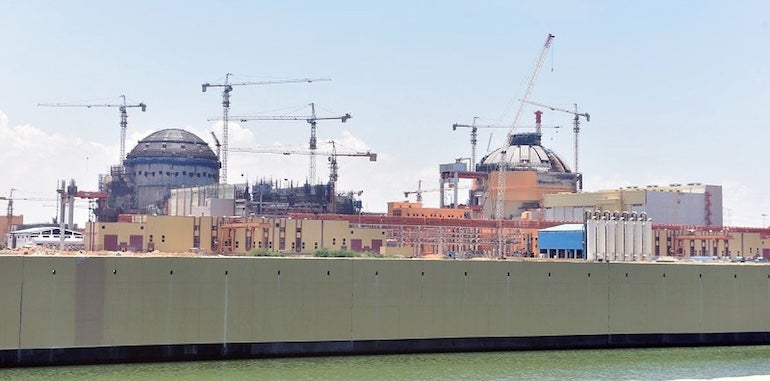
Nuclear Power Corporation of India (NPCIL) and Rosatom have begun flushing the safety systems at unit 3 of India’s Kudankulam NPP in the southern state of Tamil Nadu.
The flushing process, using demineralised water, is intended remove impurities from pipelines, check pump sets, process safety systems and normal operation systems and to check everything has been installed correctly. Samples of flush water are collected and sent to a chemical laboratory for analysis.
“During the second stage, the active part, the safety system pumps are filled with water from the used fuel pool and then activated, pumping water into the open reactor. During the flushing operations, foreign objects that could enter the reactor vessel and damage its internal components during startup are removed from the pipelines connected to the primary circuit,” Rosatom explained.
Andrey Petrov, President of JSC Atomstroyexport, said the safety system testing phase is the final stage before reactor assembly. “After this, testing of the primary circuit systems and equipment, as well as cold and hot testing, will begin. Our joint project with our Indian partners is proceeding according to plan and confirms the reliability and leadership of Russian nuclear technology. The commissioning of the second and third phases of the Kudankulam NPP will be a significant contribution to India’s energy supply and will further strengthen the long-standing ties between our countries.”
Bhuwan Chandra Pathak, Chairman and Managing Director, NPCIL, told The Federal: “The next step will be the hydrotest of the primary circuit, followed by a hot run. Activities are in full swing,” Following the cold an hot tests, nuclear fuel will be loaded.
Chairman and Managing Director of the Atomic Energy Corporation of India, Bhuvan Chandra Patak, who observed the start of the flushing operation, thanked the Russian side for their support and participation in the implementation of the project.
Kudankulam NPP will comprise six units with VVER-1000 reactors. Work began following an intergovernmental agreement between India and Russia signed in 1988. Units 1&2 (Phase I) are already in operation and work is underway to build units 3-6 (Phases II and III). The customer and operator of the station is NPCIL, the general contractor is JSC ASE (Rosatom’s Engineering Division), general designer Atomenergoproject and equipment designer OKB Gidropress.
Units 1&2 began operation in 2016. The general framework agreement with Rosatom on the construction units 3&4 was signed in 2014 and, in 2017, the engineering division of Rosatom and NPCIL signed an agreement on the construction units 5&6. Work on units 5&6 began in 2021. Fuel for unit 3 was delivered by Russia’s TVEL in December 2025.


