
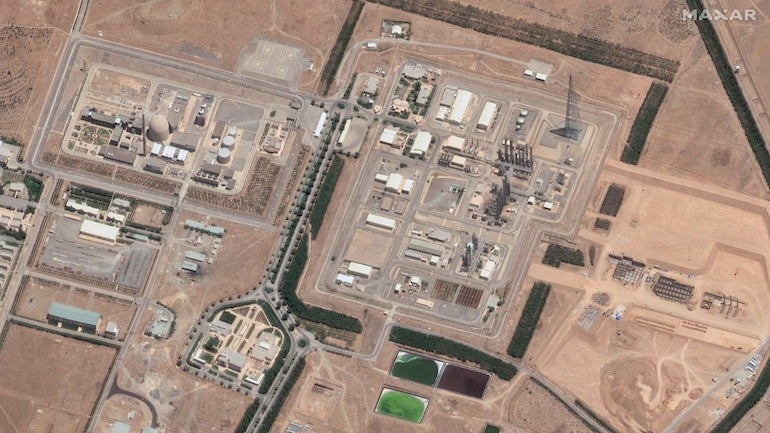
The International Atomic Energy Agency (IAEA) has confirmed that Iran’s Khondab Heavy Water Production Plant (HWPP) sustained severe damage and is no longer operational following Israeli strikes on the plant. “Based on independent analysis of satellite imagery and knowledge of the installation, the IAEA has confirmed the heavy water production plant at Khondab, which Iran reported had been attacked on 27 March, has sustained severe damaged and is no longer operational,” the Agency said on X.
The IAEA reported severe damage to key buildings, including the distillation unit, rendering it currently non-operational, adding: “The installation contains no declared nuclear material.” The Atomic Energy Organisation of Iran (AEOI) said on X that the Khondab plant was targeted in two stages. “Based on initial assessments and given the safety measures taken, there is no risk of contamination to the people of the region,” it said.
In a statement shared on Telegram, the Israel Defence Forces (IDF) said the Israeli Air Force targeted the site based on intelligence inputs. It was not clear whether the Khondab Heavy Water Reactor (formerly IR-40 reactor) on the same site had been hit. “The IDF will not allow the Iranian regime to continue advancing its nuclear weapons programme, which poses an existential threat,” the statement said, adding that the strike was part of operation Rising Lion.
The heavy water reactor had been targeted in the June 2025 strikes by the US and Israel against Iran’s nuclear facilities. At that time, the IAEA noted that the facility was not yet completed and that there were no nuclear materials present. According to Iranian authorities, no one was injured in the latest strike, and no leaks of radioactive materials were recorded.
Heavy water has a density approximately 10% higher than that of regular water. It can be used as a moderator in nuclear reactors.
Before the military strikes on 27 March 2026, the HWPP was a significant strategic and economic asset for Iran. The facility had an annual production capacity of approximately 16-20 tonnes of high-quality heavy water. As of late 2019, the IAEA reported that Iran had accumulated a total stockpile of 131.5 tonnes, exceeding the 130-tonne limit originally set by the now expired 2015 Joint Comprehensive Plan of Action (JCPOA). This agreement between Iran and the P5+1 (UN Security Council permanent members plus Germany) and the EU sought to limit Iran’s nuclear programme in exchange for sanctions relief. The deal was severely compromised after the US withdrew in 2018, leading Iran to again accelerate its nuclear programme.
Iran had established itself as a global supplier of nuclear-grade heavy water, exporting dozens of tonnes to various international markets. This included 32 tonnes exported to the US in 2016 for approximately $8.6m as part of the JCPOA. Approximately 38 tonnes were also sold to Russia. Iranian officials reported receiving purchase requests and interest from customers in Europe and Asia, citing the high purity of the product. Iran frequently used Oman as a transit and storage hub for its surplus heavy water while awaiting final buyers to comply with international stockpile limits.
The IR-40 reactor at Khondab is currently non-operational following severe damage from military strikes on 27 March 2026. The IAEA confirmed on 30 March that the facility is “no longer operational” after sustained damage to key buildings and infrastructure. The IAEA noted that the reactor was not yet fueled at the time of the March 2026 strike, meaning there was no declared nuclear material present and no reported risk of radiological contamination.
Construction of the IR-40 reactor in Arak officially began in October 2004, after Iran notified the IAEA of its plans to build a heavy water research reactor. The tank-type reactor uses heavy water as both a moderator and a coolant and was designed to use natural uranium dioxide (UO2) fuel for an output of 40 MWt.
The core featured an original calandria (vessel) intended to hold approximately 150 fuel assemblies. The fuel was based on a modified version of the Russian RBMK fuel rod bundle, consisting of 18 zirconium-clad fuel pins per assembly. There were concerns that the reactor could produce 8–12 kilograms of plutonium a year, sparking allegations that Iran intended it for weapons development.
Under the 2015 JCPOA, Iran in 2016 removed the reactor’s original core and rendered it inoperable by filling it with concrete. A working group led by China and the US was formed to assist in redesigning the reactor to use 3.67% enriched uranium fuel instead of natural uranium. In March 2021, Iran began cold testing the redesigned reactor’s systems (fluid and cooling circuits) as a prelude to full commissioning. By 2023, Iran had manufactured IR-20 dummy fuel assemblies based on the new design for testing purposes.
While the power remained at 40 MWt, the new design is more compact. This higher power density unit is optimised for producing medical radioisotopes and testing materials rather than plutonium. The redesigned core is estimated to produce less than 1 kilogram of plutonium annually. However, the reactor still uses heavy water as a moderator.
The reactor was initially expected to be operational by 2023–2024, but IAEA reports from 2025 indicated that commissioning had been pushed to late 2025, with full operation targeted for 2026. The unfinished reactor was struck by the Israeli military on 19 June 2025. The strike targeted the reactor’s roof and core seal to prevent its restoration.
According to AEOI, along with the latest attack on Khondab, the US and Israel also struck the yellow cake (uranium concentrate) production complex in Ardekan in Yazd. After checking the consequences of the Ardenek impact, experts did not detect any release of radioactive substances outside the facility, AEOI said on X. “The assault on these peaceful facilities is a blatant violation of international law and a serious threat against regional security. The inaction of international bodies, especially the IAEA, in the face of these barbaric actions, is astonishing,” AEOI said.
Separately, Iran reported that the Khuzestan Steel Production Factory, an industrial facility using sealed radioactive sources – Cobalt-60 (Co‑60) and Cesium-137 (Cs‑137) – for industrial gauging, was also targeted. Authorities said there was no off-site radiation release and the facility remains under normal operations.


