
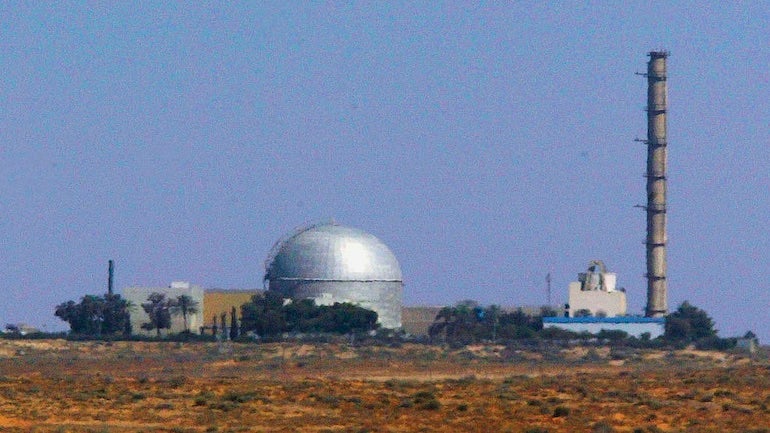
Iranian missiles have reportedly struck the Israel town of Dimona in the Negev Desert which hosts Israel’s nuclear research complex. According to the Times of Israel, the latest Iranian ballistic missile attack struck an open area in northern Israel in an attack appearing to target Israel’s largest power plant.
Missiles have also previously struck buildings some 17 kilometres from the Shimon Peres Negev Nuclear Research Centre, which is widely understood to be the site of nuclear weapons development and production for the Israeli military. However, Israel has neither confirmed nor denied that it possesses nuclear weapons and the facility is not subject to any international inspection by the International Atomic Energy Agency (IAEA) as Israel has not signed the Nuclear Non-Proliferation Treaty (NPT).
Regarding earlier strikes IAEA previously said on X that it was “aware of reports of an incident in the Israeli city of Dimona involving a missile strike, and has not received any information about damage to the Negev Nuclear Research Centre”. It added that information from regional States indicated that no abnormal radiation levels had been detected. IAEA Director General Rafael Gross said he was closely monitoring the situation and stressed that “maximum military restraint should be observed, in particular in the vicinity of nuclear facilities”.
A 2013 report from the International Panel on Fissile Materials (IPFM) noted that it was generally accepted that the Dimona facility produced plutonium for the alleged nuclear arsenal. A 2025 report from the Stockholm International Peace Research Institute, estimated that Israel has a stockpile of around 90 nuclear warheads.
The reactor at Dimona, designated as IRR-2 (Israel Research Reactor-2), was built in the late 1950s with significant assistance from France. Its design was heavily influenced by the French EL-3 research reactor. It is a heavy-water-moderated and heavy-water-cooled reactor that uses natural uranium as fuel.
While officially reported to have a capacity of 26 MWt, independent analysts and historical testimony former technician Mordechai Vanunu suggest it has been upgraded multiple times. Norway reportedly sold Israel 20 tonnes of heavy water in 1959. Estimates of its current capacity range from 70 MWt to 150 MWt. The reactor is believed to be the primary source of plutonium and tritium for Israel’s undeclared nuclear weapons arsenal.
In 1986, Vanunu leaked photos and technical details of the reactor to The Sunday Times, providing the first concrete proof of Israel’s nuclear arsenal. He was lured from London to Rome where he was drugged and kidnapped back to Israel where he served a full 18-year sentence (1986–2004), including 11 years in solitary confinement. Since 2004, he has been re-imprisoned several times for violating his release terms by speaking to foreign media or attempting to travel. He continues to live under severe legal restrictions.
The images given to the Sunday Times were examined by nuclear experts, who assessed that they proved Israel had possessed a nuclear weapons production facility for two decades and that the facility produced enough material for the construction of 10 bombs a year.
The reactor is now one of the oldest still operating. In late 2024 and throughout 2025, satellite imagery analysed by groups such as IPFM revealed a major expansion at the Dimona site. A massive dig –roughly the size of a football field and several stories deep – was identified just hundreds of metres from the ageing reactor dome. Analysts suggest this is for a new underground facility, likely intended to replace the original reactor’s functions as it nears 60 years of operation.
Because a nuclear core cannot be easily “swapped,” experts believe Israel is building a successor reactor or a processing plant to maintain its production capabilities. In 2016, a study by scientists at the Negev Nuclear Research Centre revealed 1537 defects in the Dimona reactor’s aluminium core. These findings were presented at a scientific forum in Tel Aviv and were the result of advanced ultrasound testing. This physical degradation is the primary driver behind the massive new construction seen today.
The defects are located in the reactor’s core, which is a concrete-coated aluminium vessel that houses the fuel rods. Because this component is the primary containment for nuclear fission, it cannot be replaced without decommissioning the entire facility.
Israeli officials, including the Israel Atomic Energy Commission, stated that the defects do not pose an immediate danger and that the facility continues to meet “strict maintenance procedures”. However, several experts, including Uzi Even, a scientist who helped establish the plant, have argued that the reactor should be closed because its original 40-year design life expired around 2003. To mitigate risks, the reactor is reportedly not operated as frequently as it once was, and it requires specialized permits for each use.
The defects present a unique problem for Israel’s policy of nuclear ambiguity. Because Israel is not part of the NPT, it cannot officially purchase a replacement reactor from a foreign supplier, forcing it to either maintain the current ageing facility or build its own successor domestically.


