
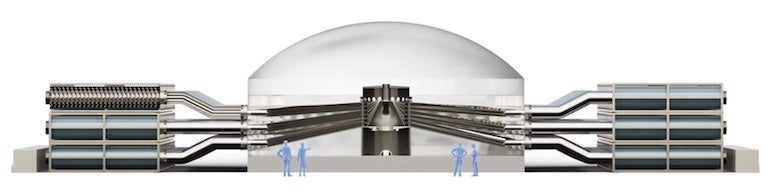
California-based startup Pacific Fusion has launched the Pacific Fusion Users Programme (PFUP) – a new initiative that will make its fusion system available for selective use by external users
By launching the Pacific Fusion Users Program (PFUP), the company is shifting from a closed R&D model to an open-innovation platform. This allows external partners such as academic researchers, national labs, and industrial energy experts to run experiments on their high-energy system.
Pacific Fusion uses a brick-based pulsed power architecture. Instead of one massive, expensive machine, they use many small, mass-producible modules (the bricks) to deliver the massive electrical currents needed to compress fusion fuel. According to Pacific Fusion, this Demonstration System (DS) is designed to achieve net facility gain, producing more fusion energy than the total energy stored in the system, by 2030.
“It will be the only pulsed-power inertial fusion facility of this scale in the world and, starting in 2028, the DS will be capable of creating some of the most intense bursts of energy produced on Earth,” the company noted. “This includes plasma conditions and high-neutron and photon flux that create unique opportunities for a range of fusion energy research, commercial applications, fundamental high-energy-density (HED) science, and national security.”
Opening the system to external users is a major move toward third-party verification of their fusion results. The company has been vocal about reaching magnetic confinement fusion conditions similar to those seen at the National Ignition Facility (NIF), but with a much more efficient and scalable electrical driver. This programme follows a $285m Series A funding round led by Hemant Taneja (General Catalyst) and Breakthrough Energy Ventures.
Pacific Fusion noted: “We are now making the DS available for external use, dedicating experimental time on its flexible architecture, which features 17 configurable target-area diagnostics for high-fidelity data capture and is purpose-built for high-yield experimentation. Our objective is to enable new kinds of partnerships that support a range of frontier research applications.”
In fusion energy science, the DS could support ignition-scale physics experiments, target validation, diagnostics development, and materials testing under extreme conditions.
In commercial applications, high-flux radiation environments can help test how components will hold up in outer space over time, radiation tolerance, and evaluation of materials exposed to high-energy debris and thermal loads, medical isotope production, and other applications of pulsed power technology.
In fundamental HED science, access to intense neutron and X-ray sources can reveal new behaviours, shorten qualification cycles, and open new engineering frontiers.
“We also expect collaboration with the US government on applications relevant to national security,” the company said. “The PFUP will begin by accepting Expressions of Interest from researchers in private industry, academia, and government – a process that will help us understand user needs, experimental concepts, and technical requirements.”
Over the coming months, Pacific Fusion will engage with prospective partners to refine ideas and assess feasibility. That engagement will ultimately inform a Call for Proposals aligned with the commissioning timeline of the DS.


