
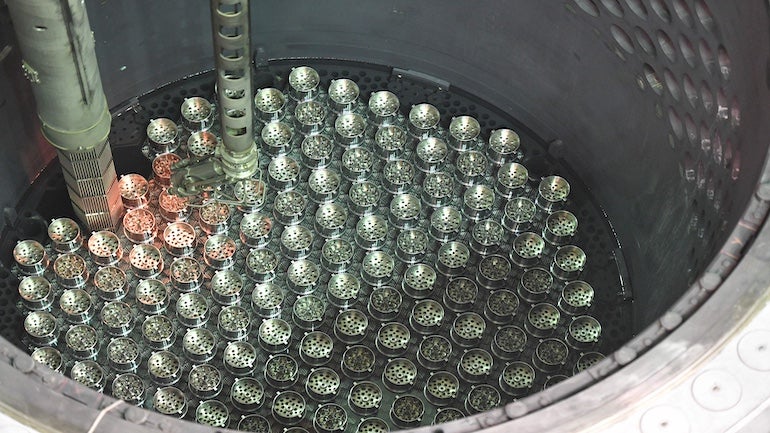
The final cycle of pilot operation of VVER accident tolerant fuel (ATF) has been completed at unit 2 of Russia’s Rostov NPP. Three innovative fuel cassettes with fuel elements (were loaded into the VVER-1000 reactor in 2021 and went through a full operating cycle – three fuel campaigns of 18 months each.
The pilot operation programme involved three TVS-2M combined assemblies, each containing 12 innovative fuel rods. Six were made using 42KhNM chromium-nickel alloy as a structural material and six had chromium-coated zirconium alloy shells. The use of new materials will make it possible, in the event of an emergency, to completely eliminate or significantly slow down the development of a zirconium vapour reaction in the reactor core.
The zirconium-water (vapour) reaction is a high-temperature chemical reaction that is the primary concern during a “loss-of-coolant” accident. Traditionally, zirconium alloy is used for fuel rod cladding because it does not absorb neutrons, allowing the reaction to stay efficient. However, if the cooling water is lost and the core temperature rises above 800°C to 1,000°C, the zirconium becomes chemically unstable, and the zirconium cladding begins to “steal” oxygen atoms directly from the surrounding steam.
This can lead to two dangerous developments. The metal cladding turns into a brittle ceramic (rusts), causing the fuel rods to crumble potentially leading to a core meltdown. The reaction also releases massive amounts of explosive hydrogen gas.
ATF fuel rods use either chromium-nickel alloy (42KhNM), which is much more “inert” and does not react with steam at high temperatures, or chromium-coated zirconium, in which a thin layer of chromium acts as a shield, preventing the steam from touching the zirconium underneath.
Initial inspections of the ATF rods removed from the Rostov reactor confirmed the fuel rods maintained their hermetic seal and structural stability. Their appearance was described as “practically indistinguishable from fresh fuel” after years in the core. The fuel is now being transferred to the Research Institute of Atomic Reactors (NIIAR) in Dimitrovgrad for destructive and non-destructive testing to verify internal material changes.
Based on the results, Rosatom has selected chromium-coated zirconium alloy as the primary choice for large-scale industrial implementation due to its superior economic and technological balance.
A key discover during the pilot programme was that the chromium-plated surface properties make it possible to eliminate several manual assembly steps. This is a critical prerequisite for the fully automated, unmanned production of next-generation fuel (TVS-5) and also for mixed uranium-plutonium fuel.
Following the success at Rostov, a dedicated production line has been established at the Chepetsky Mechanical Plant to apply these coatings at scale. The final qualification phase will involve loading full ATF fuel assemblies (containing all 312 rods rather than just 12) into a high-power commercial reactor for a final trial before widespread adoption across the VVER fleet.
The fuel assemblies ran three full fuel campaigns normally. Now we have to prepare a fairly large package of documents for Rostechnadzor, and then the fuel will be transferred for post-reactor research at NIIAR,” said Rostov NPP Director Andrey Salnikov.
Based on the totality of all factors – economics, technology, regulation, procedures – the best option for industrial implementation is a classic zirconium alloy with chromium coating, commented Alexander Ugryumov, Senior Vice President for Scientific & Technical Activities at Rosatom’s Fuel Division, TVEL. “This is a decision that all the world’s leading nuclear fuel producers have reached. But for Russia, where the strategy of closing the nuclear fuel cycle is being implemented, the ATF development programme has yielded another important result. The properties of the chrome surface make it possible to eliminate a number of operations during the fabrication of nuclear fuel for VVER reactors, where manual labour is still involved.


