
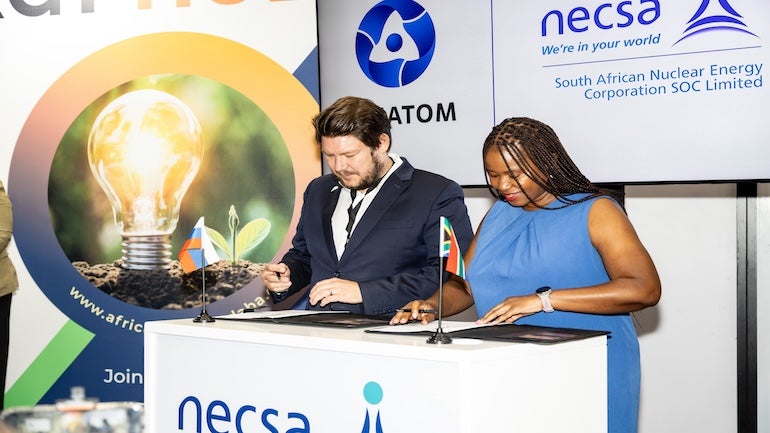
Rosatom and the South African Nuclear Energy Corporation (Necsa) have signed a memorandum of understanding (MOU) for co-operation on training and nuclear knowledge exchange. The MOU was signed on the sidelines of the Africa Energy Indaba 2026 conference in Cape Town.
“The document establishes a long-term framework for interaction in the field of skills development and knowledge exchange in nuclear and related technological areas,” Rosatom said in a statement. “The parties will focus primarily on training young specialists and strengthening local and regional technical capacity in Africa.”
The MOU outlined priority areas of work including joint educational and training programmes, initiatives to support women and young professionals, staff internships, the development of engineering skills and professional competitions, as well as joint research projects.
“Our strategic partnership with Necsa in the field of human capital development is based on shared values: a people-centred approach, a commitment to the highest safety standards, innovation and continuous professional growth,” said Rosatom Deputy Director General for Human Resources Tatiana Terentyeva.
“Through our joint training initiatives, we are fostering knowledge exchange that will enable Russian and South African professionals to work together to build a technological future that meets the challenges of the 21st century. This year, Rosatom will provide an additional 15 bursaries for students and young professionals from South Africa to study at Rosatom flagship universities which already host more than 2,400 international students from 65 countries,” she added.
“This partnership is focused on building sustainable human capital to support the growth of the nuclear and related technology sectors,” said Necsa Executive Director for Human Capital Sithembile Mbuyisa. “Developing skills, empowering young professionals, and expanding leadership capacity are central to the long-term success of the energy sector. Through collaboration on education, training and knowledge exchange, we aim to contribute to a globally competitive and future-ready nuclear workforce.”
As part of the Atomic Forum within Africa Energy Indaba, a meeting was held of the expert session of the BRICS Platform on Nuclear Energy. The event was moderated by the Chief Coordinator of BRICS Nuclear Energy Platform, Elsie Poulet. Participants included: Elizabeth Marabwa, Chief Director of the Programmes & Projects Management Office at the South African Department of Electricity & Energy; Shirley Mabika, Human Resources Operations Manager at South Africa’s Koeberg NPP; Rosatom’s Tatyana Terenteva; Necsa’s Sithembile Mbuyisa; and Dr Fidèle Ndahayo, CEO of the Rwanda Atomic Energy Board among others.
Discussions included the best practices for nuclear organisations in the BRICS countries and in African countries to develop human resources and to support the expansion nuclear industry on African continent. During the discussion, participants emphasised the need to accelerate localisation of technologies and specialist training.
BRICS Nuclear Energy Platform Chief Coordinator Elsie Pule announced the start of the Atoms Empowering Africa 2026 competition, a regional competition held by African countries to support education of nuclear specialties. The Platform will act as the main partner of the competition.
The BRICS Nuclear Energy Platform is a corporate-level alliance established in October 2024 to strengthen cooperation in the peaceful use of nuclear technology among BRICS+ nations. Unlike the intergovernmental BRICS bloc, the platform is composed of individual companies, research institutions, and government agencies rather than sovereign states. In late 2025, the platform approved its first strategic document, a concept paper that outlines core workstreams for 2026 and beyond. These included capacity building, project financing, technological coordination and supply chain sustainability.
BRICS+ nations currently account for nearly one-third of all operating NPPs worldwide and more than 70% of nuclear units currently under construction globally. By 2030, BRICS members are expected to account for at least two-thirds of the total global nuclear fleet. As of March 2026, BRICS+ comprises 11 full members as well as a secondary tier of 10 official partner countries. The five original founders are Brazil, Russia, India, China and South Africa. Countries that have joined since early 2024 include Egypt, Ethiopia, Iran, UAE, Indonesia and Saudi Arabia. More than 30 other countries have expressed interest or formally applied for membership.
BRICS Nuclear Energy Platform include Rosatom (Russia); China National Nuclear Corporation (CNNC); Necsa and State Power Company Eskom (South Africa); Brazilian Association for development of nuclear activities (ABDAN – Associação Brasileira para Desenvolvimento de Atividades Nucleares) and NBEPar – Núcleo Brasil Energia Participações Ltda (Brazil); Nuclear Power Production & Development Company (Iran); Nuclear Power Plants Authority (Egypt); Ministry of Innovation & Tehcnology (Ethiopia); and Bolivian Nuclear Agency (ABEN – Agencia Boliviana de Energía Nuclear).


