
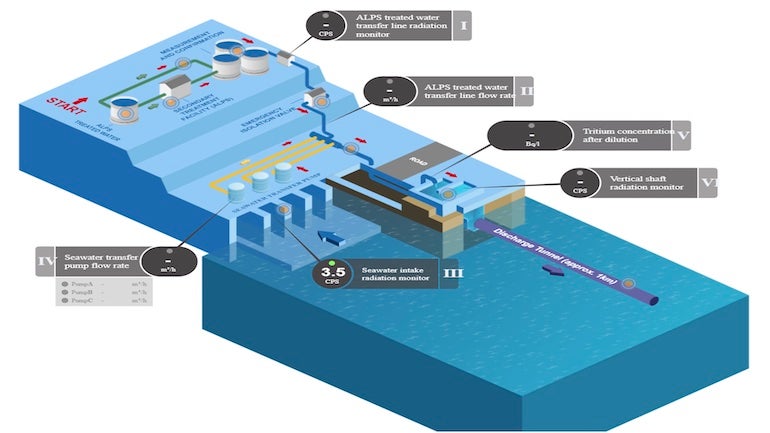
Tokyo Electric Power Company Holdings (Tepco) has begun the 18th discharge of Advanced Liquid Processing System (ALPS)-treated water from the Fukushima Daiichi NPP into the Pacific Ocean. The operation, scheduled to run until 24 March, will result in the release of about 7,800 tonnes of treated water containing tritium diluted with seawater and discharged through an undersea tunnel about 1 kilometre offshore.
In fiscal 2026, which begins on 1 April the plant is set to release about 62,400 tonnes of treated water in eight rounds of discharge, Tepco said. The combined amount of tritium is expected to be about 11 trillion becquerels Since Japan began releasing ALPS-treated water in batches in August 2023, roughly 133,000 cubic metres have been discharged. The International Atomic Energy Agency (IAEA) has confirmed that the tritium levels in all first 17 batches were far below the operational limits set by Japan.
The IAEA similarly confirmed that the tritium concentration the 18th batch of treated water is far below Japan’s operational limit of 1,500 becquerels per litre and consistent with the international safety standards. As part of its ongoing safety assessment, IAEA conducted independent sampling of the latest batch at the discharge vertical shaft and seawater pipe header, where ALPS-treated water is blended with seawater prior to release. On-site analysis confirmed that the tritium concentration is far below Japan’s operational limit and is in line with international safety standards.
In a comprehensive report issued on 4 July 2023 before the first discharge began, the IAEA’s safety review found that Japan’s plan for handling the treated water was consistent with international safety standards and that the release as planned would have a negligible radiological impact to people and the environment.
An IAEA Task Force has been set up to review the plans and actions related to ALPS-treated water discharge. It consists of staff members from across the departments and laboratories of the IAEA, and 11 internationally recognised experts with diverse backgrounds from Argentina, Australia, Canada, China, France, the Marshall Islands, the Republic of Korea, the Russian Federation, the UK, the US and Viet Nam. The Task Force members are not working in a national capacity but as part of an international team managed by the IAEA. The Task Force is referring to the IAEA Safety Standards and is conducting the reviews in an objective and science-based manner, which will help send a message of transparency and confidence to the international community.
The Agency initiated its support to Japan under this project in 2021 and will continue the project for many years, consistent with the IAEA Director General’s commitment to provide support before, during and after ALPS-treated water discharge. Most of the IAEA’s technical review was completed prior to the discharge of ALPS-treated water, which started in August 2023, subject to domestic regulatory approvals; however, ongoing monitoring and periodic review activities will continue in the years to come.


