
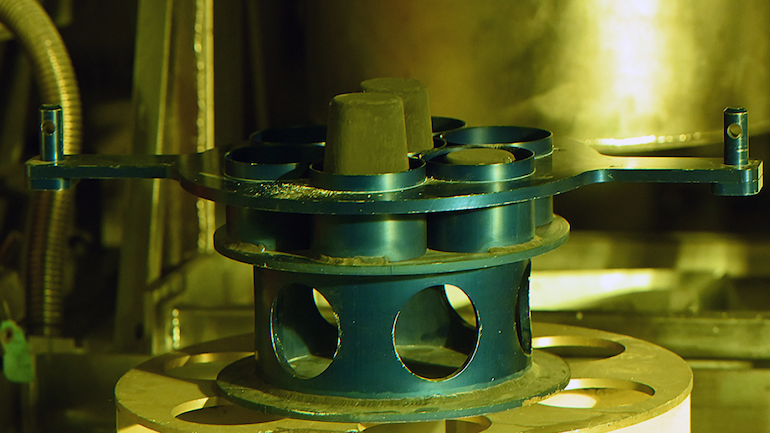
US-based start-up Standard Nuclear has received its first shipment of high-assay low-enriched uranium (HALEU) feedstock at its facility in Oak Ridge, Tennessee as part of a US Department of Energy (DOE) initiative to establish a domestic fuel supply chain for advanced reactors.
Standard Nuclear, a producer of tri-structural isotropic (TRISO) fuel, is the first company to receive both DOE authorisation and a physical shipment of HALEU for fuel production. In December, Standard Nuclear announced that it would operate under DOE oversight rather than the Nuclear Regulatory Commission (NRC), with the aim of significantly expanding TRISO fuel manufacturing capacity. The Other Transaction Agreement (OTA) with DOE is part of the effort to bring privately funded advanced nuclear-fuel production infrastructure online in support of TRISO-fuelled reactor demonstrations in 2026. Several companies are seeking to demonstrate a low-power test reactor before 4 July 2026, in line with President Trump’s May Executive Order 14301, Reforming Nuclear Reactor Testing at the Department of Energy.
Standard said DOE oversight enables a substantial increase in the company’s TRISO fuel manufacturing throughput within its existing facilities. The company is drawing on expertise across the DOE complex. Idaho National Laboratory (INL) is providing technical assistance through a Strategic Partnership Project (SPP) agreement executed earlier this year. The company is also receiving technical support and specialised training from Oak Ridge National Laboratory (ORNL) and the Y-12 National Security Complex.
“We are proud to be the first company authorised by the DOE to take this step toward full-scale TRISO fuel production, which is essential for bringing US-made, reliable, and advanced nuclear power to the nation,” said Kurt Terrani, CEO of Standard Nuclear. He added that receiving the HALEU shipment allows the company to move toward full-scale TRISO fuel production.
The HALEU material was safely and securely transported from Lynchburg, Virginia, following close coordination and expert management provided by the National Nuclear Security Administration (NNSA) and its prime contractor, Consolidated Nuclear Services (CNS), which operates the Y-12 National Security Complex.
Standard Nuclear was the first company accepted under DOE’s Fuel Line Pilot Program launched in July. The initiative, issued in accordance with President Trump’s Executive Order Deploying Advanced Nuclear Reactors for National Security seeks to eliminate US reliance on foreign sources of enriched uranium and critical materials while opening the door for private sector investment. DOE issued a Request for Application from qualified US companies to build and operate nuclear fuel production lines using the DOE authorisation process.
Under the Fuel Line Pilot Program Standard Nuclear aims to leverage the DOE authorisation process to ensure a robust supply of nuclear fuel for its facilities in Tennessee and Idaho. Standard Nuclear will be responsible for all costs associated with the construction operation, and decommissioning of the facility. Reactor project developers will manage the sourcing of nuclear material feedstock for fuel fabrication, which could be acquired through DOE’s HALEU allocation programme.
This first feedstock delivery has been allotted by DOE to Radiant, a California-based start-up developing nuclear microreactors. Standard Nuclear will process the material into TRISO fuel for Radiant’s advanced reactor demonstration scheduled for 2026. The material received is sufficient to produce a full core load for Radiant’s first reactor startup.
This shipment is part of a broader federal effort to develop a domestic supply of uranium enriched between 5% and 20%. The US government recently allocated $2.7bn in funding to strengthen the supply chain for low-enriched uranium and HALEU to reduce reliance on foreign sources.
Radiant plans to test its 1 MWe Kaleidos microreactor in 2026, with initial customer deployments scheduled for 2028. The company recently raised more than $300m in funding and intends to begin construction on a factory in Oak Ridge to manufacture transportable nuclear generators. DOE selected Radiant for the Reactor Pilot Program in August 2025.


