
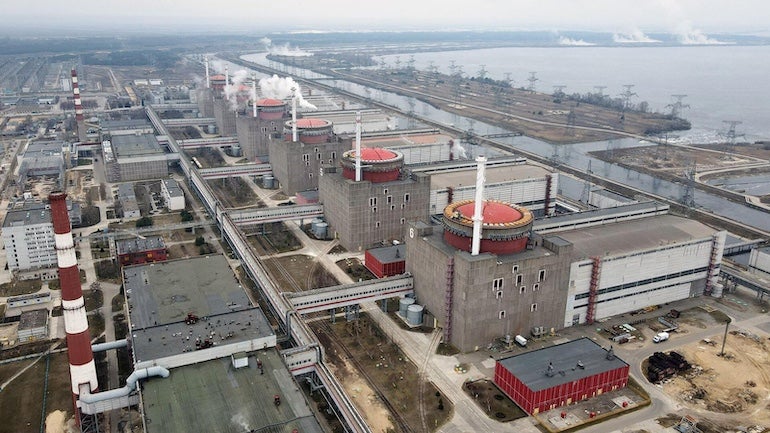
Laboratory and household building No 2 at the Zaporizhia NPP came under attack by two drones on 4 October, ZNPP reported on its Telegram channel. The building is located approximately 200 metres from power units 4&5. Two more drone attacks were recorded on the building for processing radioactive waste. The roof was damaged. There is no apparent threat to nuclear safety as a result of these attacks but there was an overall threat to safety.
“Attacks on such facilities are potentially dangerous. The proximity of the laboratory and utility building to the power units creates a risk of damage to the nearby infrastructure and poses a threat to the personnel. Attacks on the radioactive waste processing building could damage equipment and disrupt the safe handling of radioactive materials,” ZNPP noted.
The same day, in the Melitopol area, a drone attacked a vehicle that was heading to Energodar with supplies for ZNPP. The driver was killed and the vehicle was completely burned out. “This is a tragedy that cost a human life. A person who was doing necessary work delivering cargo to the plant has died. We express our deepest condolences to his family and loved ones,” ZNPP said. “Attacks on supply transport hinder the delivery of necessary goods and create additional danger for drivers and everyone involved in supporting the plant.”
Meanwhile, ZNPP diesel reserves are causing concern. ZNPP is considering a further reduction in the number of emergency diesel generators (EDGs) kept in automatic standby as diesel fuel supplies at the site continue to be a concern, according to International Atomic Energy Agency (IAEA) Director General Rafael Mariano Grossi.
Diesel fuel reserves at the plant remain low following an extended loss of off-site power in August and September, when it relied on EDGs for nearly three weeks. Efforts to replenish the reserves have been hampered by shelling and drone attacks on access roads.
EDGs provide back-up power for essential safety systems when external power is unavailable. This is particularly important given the repeated losses of off-site power at the plant, which has experienced 10 such losses since June. ZNPP currently relies on a single off-site power line, the 330 kV Ferosplavnaya-1 line.
“The availability of sufficient and reliable emergency electricity generation capacity to supply safety-related equipment is essential for the safety of any nuclear facility,” said Grossi. “The continued lack of diesel deliveries to the ZNPP is exacerbating an already precarious situation. The prompt delivery of fuel to the ZNPP would have a large positive impact on nuclear safety at the ZNPP. I call on all sides to work with the IAEA to achieve this goal.”
On 29 September the IAEA team at ZNPP was informed that planned maintenance of electrical equipment in the 750 kV switchyard had been delayed due to the security situation. Maintenance of an EDG was also delayed due to the late arrival of contractors. On 30 September IAEA was informed of repair work required at the Zaporizhia Thermal Power Plant (ZTPP) to increase the robustness of the power supply to ZNPP. The IAEA is working with Russia and Ukraine on a ceasefire to allow that maintenance work to be carried out.
The IAEA team at ZNPP reported continuing to hear military activity every day, often close to the site. ZNPP reported on Telegram that intensive shelling during the last 10 days of September had damaged, equipment at ZTPP, noting that reliable external power supply to the plant depends on the operability of this equipment. The power supply to the ZTPP equipment is currently provided by emergency sources.
In an interview with RIA Novosti, Grossi explained why the IAEA is not naming those responsible for the attacks on ZNPP, despite repeated demands from Russian officials that it should do so. “It is fundamentally important for an international organisation to maintain impartiality,” he said. Grossi acknowledged that not everyone is satisfied with the agency’s approach. However, the IAEA intends to focus on its technical mission. “We leave the conclusions and the determination of political positions to the states,” he said.


