
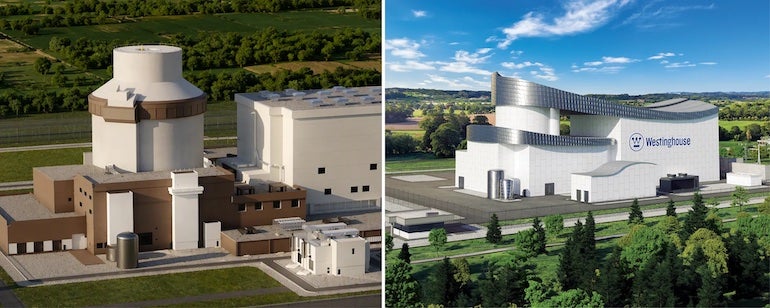
Westinghouse Electric Company and global engineering company Amentum have entered into a series of agreements supporting the Westinghouse APX technology platform. This partnership establishes a unified industrial foundation to scale global nuclear energy deployment using Westinghouse’s single APX technology platform.
The collaboration aims to fast-track licensing for the AP300 small modular reactor (SMR) with the US Nuclear Regulatory Commission (NRC). Both companies will optimise engineering and execution to build AP1000 reactors at scale. Amentum will leverage its extensive nuclear lifecycle expertise to secure a repeatable, robust deployment model.
The APX platform acts as a unified technical baseline. The smaller AP300 SMR is designed directly from the innovations of the full-scale AP1000 plant. This allows the SMR to use pre-existing, validated engineering, components, fuel designs, and structural frameworks. By doing so, utilities can deploy smaller-capacity reactors without having to navigate an entirely new reactor architecture.
“Westinghouse is pursuing a disciplined APX technology strategy built on the proven AP1000 reactor and extended through the AP300 SMR,” said Westinghouse President & CEO Dan Sumner. “We continue to make investments to strengthen our proven APX platform, and our ongoing collaboration with Amentum is expected to accelerate the licensing of the AP300 SMR with the NRC. Separately, our two companies will work together to enhance our engineering and execution capabilities for delivering 1 GW reactors at scale.”
Amentum CEO John Heller noted: “Amentum’s expertise spans the full spectrum of the nuclear project lifecycle, accelerating the development and deployment of advanced nuclear solutions, strengthening energy security and powering the growth of AI and other energy critical industries. There is an expanding global market for firm baseload power, and our collaboration with Westinghouse will enable us to help meet that demand.”
Westinghouse and Amentum have an established history of partnership on nuclear projects worldwide, including nuclear power and decommissioning projects in the US, UK, Poland, Slovakia, Lithuania and South Africa.
The historical partnership between Westinghouse and Amentum is rooted in a highly specialised, multi-decade collaboration that spans the entire lifecycle of a nuclear power plant from early construction to the hazardous dismantling of high-consequence legacy infrastructure.
Rather than a newly formed alliance, their joint operations have historically integrated Westinghouse’s proprietary reactor engineering with Amentum’s field execution and environmental remediation capabilities. The most prominent active example of their historical joint execution is The Decommissioning Alliance (TDA). This long-standing commercial consortium unites Amentum, Westinghouse, and AtkinsRéalis to manage some of the world’s most complex nuclear clean-up projects.
Working directly alongside Sellafield Ltd, TDA handles the retrieval, segmentation, and cleanup of highly radioactive material from the legacy ponds facilities. Amentum brings over 50 years of experience to this site, while Westinghouse provides remote-controlled handling and radiological shielding design.
In Slovakia, the companies collaborated on a European decommissioning project at the Bohunice V1 Plant. When state company JAVYS tasked a Westinghouse-led consortium with the first-ever dismantling of a VVER-440 Soviet-designed reactor, Amentum served as the critical subcontractor, designing and manufacturing the remotely operated waste management equipment used to segment the highly radioactive reactor internals.
In the US, both companies serve as primary contractors for the Department of Energy (DOE) across its defence nuclear and legacy waste complex. At the Savannah River Site & Waste Isolation Pilot Plant (WIPP), while often operating via distinct project management offices, Amentum and Westinghouse have frequently collaborated to operate and safeguard military transuranic waste facilities and environmental clean-ups. This established the standardised radiological safety cultures and data-sharing protocols that both companies now leverage to speed up their commercial reactor deployments.
Beyond localised cleanup, their operations in Central and Eastern Europe historically focused on shifting former Soviet-bloc countries toward Western technology standards. Both entities provided technical support following the post-accession shutdown of Lithuania’s RBMK reactors at Ignalina NPP, handling early-stage graphite core storage and waste characterisation studies.
In South Africa and Poland, their historical presence involves multi-decade consulting frameworks. In South Africa, activities centred on the Koeberg NPP where their combined efforts have focused on maintaining, fuelling, and extending the operating lifespan of the plant. In Poland, their long institutional history laid the foundation for the national atomic energy agency to accept Amentum as a tier-1 partner to build out the nation’s planned three-unit AP1000 fleet.


