

A delegation from Uzbekistan’s Agency for the Development of Nuclear Energy, Uzatom, has visited the Belarusian NPP. Plant officials provided a detailed overview of the entire Belarus NPP project cycle: from technology selection and the establishment of regulatory and institutional frameworks to the stages of construction, commissioning, and daily management. Special attention was given to project management, interaction with regulatory bodies, nuclear and radiation safety, as well as the development of human resources for the sector.
The Uzbek delegation also toured the Belarusian NPP Training Centre, where full-scale simulators identical to the plant’s control panels are used to model various emergency scenarios. This allows for effective staff training, regular retraining, and skill enhancement. An important topic of discussion was public engagement—from conducting public hearings to raising awareness and promoting societal acceptance of nuclear energy.
Special emphasis was placed on workforce development. Uzbekistan expressed interest in fostering partnerships between specialised educational institutions of both countries to exchange expertise and jointly train specialists for the nuclear industry.
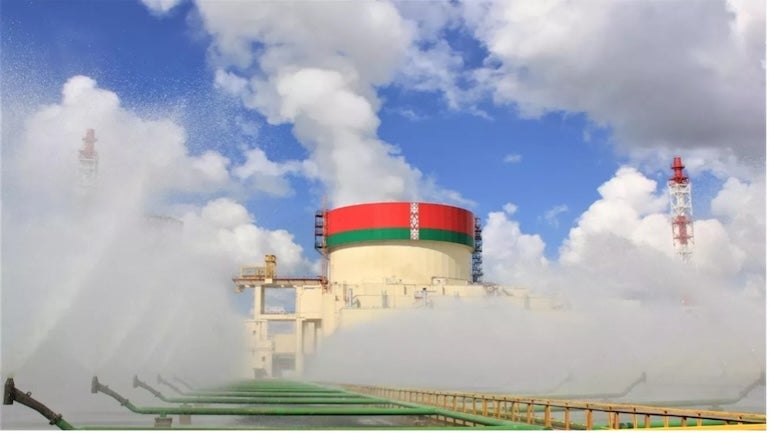
The Belarus NPP, comprising two VVER-1200 reactors was built by Rosatom and was fully commissioned in 2023. A critical safety feature of the plant is the integration of active and passive protection systems, ensuring resilience to various external and internal impacts. Each unit is equipped with a core melt localisation device (melt trap) and other systems that operate autonomously even in the event of a complete power outage.
The visit followed a high-level meeting in Minsk hosted by Belarusian Energy Minister Denis Moroz and attended by a the Uzatom delegation led by Director Azim Akhmedkhadjaev. Discussions covered a broad range of potential collaboration areas, including nuclear infrastructure development, specialist training, radioactive waste and spent fuel management, and integration of nuclear power into national energy systems.
“We welcome Uzbekistan’s decision to join the club of states using atomic energy for peaceful purposes and implementing a national nuclear program,” Moroz said, expressing Belarus’s readiness to share its experience. “The nuclear power plant has become a springboard for Belarus to reach a new technological level,” he said. Uzatom Director Akhmedkhadjaev expressed interest in involving Belarusian experts in Uzbekistan’s nuclear development efforts. The Uzbek delegation also visited the dispatch control centre of Belenergo, Belarus’s national energy company, to observe nuclear grid integration in practice.
Uzbekistan signed a contract with Russia’s Atomstroyexport, a subsidiary of Rosatom, in May 2024 to build a small modular nuclear power plant in the Jizzakh Region. The design includes six 55 MWe RITM reactors with a combined capacity of 330 MWe. In February, Uzatom also formed an international consortium to expand its nuclear capacity, incorporating technologies from Russia, China, Europe, and the US.
Read also: Belarus analyses options for second NPP


