
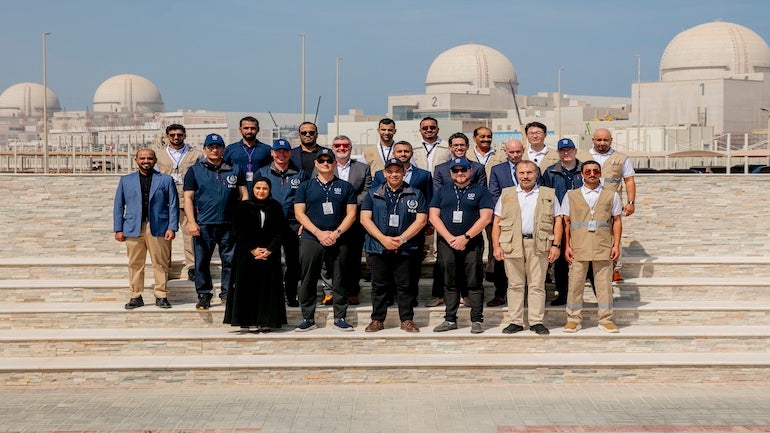
An International Atomic Energy Agency (IAEA) mission to the United Arab Emirates (UAE) found that the national authorities and Barakah Nuclear Power Plant (BNPP) had responded appropriately to the loss of off-site power event at unit 3 due to a drone strike on 17 May 2026. The team said effective action was taken to maintain safety during the event including prompt national and international notification, implementation of the established emergency response procedures, and public communication.
BNPP is operated by ENEC Operations, a joint venture subsidiary of the Emirates Nuclear Energy Company (ENEC) and Korea Electric Power Corporation (KEPCO). The plant is located in the Al Dhafra region of the Emirate of Abu Dhabi on the Arabian Gulf, approximately 53 km west-southwest of Al Dhannah City, UAE. The plant’s four APR1400 reactors produce 40 TWh a year, equivalent to around 25% of the UAE’s electricity needs.
The mission was conducted at the request of the UAE Government, following an agreement between IAEA Director General Rafael Mariano Grossi and the Emirati Government during his visit to BNPP in June 2026. The six-member team visited the affected areas of the plant and key emergency response facilities, reviewed operating and emergency procedures, and met the senior management and technical staff of BNPP and nuclear regulator, the Federal Authority for Nuclear Regulation (FANR). The mission focused on plant response actions, national arrangements for emergency preparedness and response (EPR), lessons learned from the event, and the reactor operator’s arrangements to ensure safety.
“By requesting this mission, FANR and BNPP have demonstrated their strong commitment to safety and continuous improvement,” said Amgad Shokr, Director of the IAEA Incident and Emergency Centre and mission leader. “FANR and ENEC are encouraged to continue implementing the organizational and technical measures identified through the assessment of lessons learned from the event, with the aim of further enhancing safety and strengthening emergency preparedness and response arrangements in line with IAEA Safety Standards.”
The mission team identified several good practices and performances, including the adoption by the UAE authorities of the IAEA’s Seven Indispensable Pillars for Nuclear Safety & Security. The team also acknowledged the successful restoration of off-site power within a short period following the event, effective regulatory oversight over the event, strengthening of safety procedures, training of operating staff, and resilience of critical infrastructure based on lessons learned from the event.
The team made recommendations for further improvement, including strengthening emergency preparedness and response arrangements, strengthening the reliability and resilience of critical infrastructure, and reinforcing coordination among relevant stakeholders to ensure the effective integration of nuclear safety and security measures.
IAEA Deputy Director General and Head of the Department of Nuclear Safety & Security Karine Herviou said the mission recognised the UAE’s strong record of engagement with the IAEA, adding: “The real value of an international mission lies not only in confirming what worked, but also in identifying lessons and opportunities for continuous improvements. In this regard, the team recognized the technical knowledge and competence of FANR, the Barakah management and operating personnel, and the national electrical grid field operators.”
FANR Director General Hamad Al Kaabi noted: “The UAE shares the position of the international community and the IAEA on the importance of protecting nuclear facilities at all times. The UAE responded swiftly and effectively to the incident, applying the IAEA’s Seven Indispensable Pillars for Nuclear Safety & Security. This mission reflects our continued commitment to implementing the highest standards of nuclear safety, security and emergency preparedness, drawing lessons from experience and further strengthening our national capabilities. We will continue working closely with the IAEA and our national partners to enhance the safety and security of nuclear facilities and ensure the protection of the community and the environment.”


