
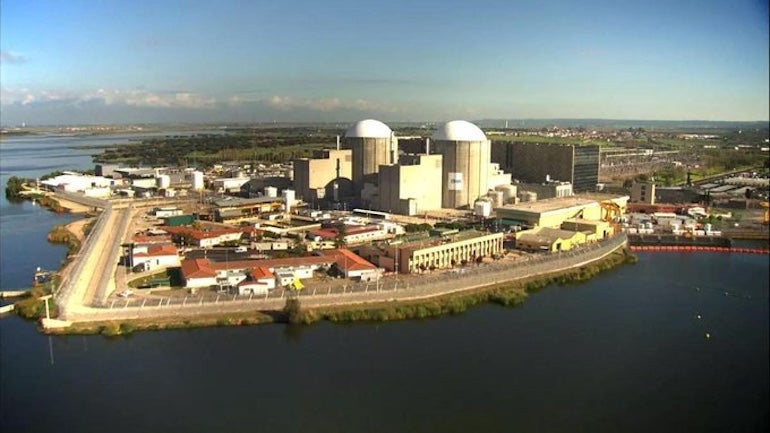
Spain’s Ministry for Ecological Transition and the Demographic Challenge (Miteco – Ministerio para la Transición Ecológica y el Reto Demográfico) has authorised a three-year operational extension for the Almaraz NPP in Extremadura until 8 June 2030, through a ministerial order published in the Official State Gazette (BOE – Boletín Oficial del Estado). This policy shift postpones the original decommissioning dates for the plant’s two reactors, which were previously slated to shut down in November 2027 and October 2028.
The Almaraz plant supplies more than 7% of Spain’s electricity and employs about 4,000 people. Almaraz units I and II are pressurised water reactors (PWRs) Unit I (1,011 MWe) entered commercial operation in 1983 and unit II (1,006 MWe) in 1984. The plant is owned by Iberdrola (53%), Endesa (36%), and Naturgy (11%). The three companies requested the extension in October 2025.
Miteco stated that the extension mitigates consumer exposure to natural gas price fluctuations and fuel supply risks linked to the ongoing war in Ukraine and the armed conflict in the Middle East. Public concern escalated following a major nationwide blackout across the Iberian Peninsula in April 2025, reviving intense debates over baseload energy security.
Under the country’s nuclear phase-out plans, agreed in 2019, four reactors are scheduled to close by the end of 2030, including the two at Almaraz, and other three reactors by 2035. Spain’s seven operating reactors – Almaraz I and II, Ascó I and II, Cofrentes, Trillo and Vandellós II – currently generate about 20% of its electricity. According to Miteco’s order, the operating extension will be subject to strict compliance with the safety conditions and instructions dictated by the Nuclear Safety Council (CSN -Consejo de Seguridad Nuclear).
CSN in July had issued a positive report regarding the requested renewal, conditioned on compliance with the limits and requirements for nuclear safety and radiological protection now included in the order. The file was sent to the government, opening a period for the executive to make a definitive decision on its continuity and the government confirmed the extension would incur no additional costs for taxpayers.
Sumar, the far-left junior partner in Prime Minister Pedro Sánchez’s coalition government, strongly condemned the move. They characterised the extension as a capitulation to “corporate pressure” that stalls decarbonisation efforts. However, in Extremadura, local leadership warmly welcomed the announcement which temporarily secured 4,000 jobs.
Maria Guardiola, President of the Junta de Extremadura welcomed the extension in a post on X. “Almaraz will remain open until 2030. And with it, an essential part of our land will continue to beat,” she said. “A decision that brings certainty to a region, that protects thousands of jobs, and that keeps in Extremadura an activity that for decades has been fundamental to the life of so many towns and families who depend on it. Today, justice is done for a plant that is an inseparable part of the history and development of Extremadura. I want to thank all of Extremadura’s society, which has fought united and has raised its voice with dignity to make it possible for Almaraz not to close.” The Junta de Extremadura is the collegiate body that holds the executive and administrative functions of the Autonomous Community of Extremadura.
There is speculation that extending the operation of the two Almaraz reactors until 2030 will force the rest of the nuclear park’s schedule to be reviewed, in particular the closures of Ascó I (Tarragona) and Cofrentes (Valencia), currently also planned for 2030.
Recently, Catalan business leaders called for the shutdown timetable for the Ascó and Vandellós plants to be reconsidered, as industrial engineers and various energy analysts warned of the risks to national electricity supply if the planned pace of the phase-out is maintained.
However, the order expressly mentions that the extension requested for Almaraz, “is limited to around 31 and 19 months respectively, which represents a reduced proportion of the expected half-life of the Spanish nuclear park, without altering the rest of the calendar or the date of definitive cessation of the entire nuclear park to 2035.”
Nevertheless, pressure is building for a change of policy. In February, a delegation of ten MEPs led by the chair of the European Parliament’s Petitions Committee, Bogdan Rzońca, visited the Almaraz site in response to a citizens’ petition against its closure, signed by workers, local governments, residents, farmers and associations from across the area.
As a result of that visit, the Petitions Committee in May approved a report explicitly urging the Spanish Government to reconsider the shutdown timetable, concluding that the decision was based on “purely political and ideological reasons, without sufficient technical basis”, and warning of the serious economic, social and energy consequences it would have for the region and for Spain’s electricity system as a whole. The report also stated that decisions on strategic energy infrastructure must be taken on the basis of rigorous, transparent and technically justified assessments, taking into account energy security, socio-economic impact and decarbonisation objectives.
The extension was welcomed by the citizens’ platform Yes to Almaraz, Yes to the Future, set up in January 2025, which brought together more than a hundred municipalities, business organisations, chambers of commerce, workers, ancillary companies and associations from across the Cáceres area to support keeping the plant open.
The platform, which defines itself as a civic, plural and cross-cutting movement with representatives of different political persuasions, has also enjoyed the backing of international organisations such as Mothers for Nuclear – which has campaigned for the continued operation of the US nuclear plant Diablo Canyon – and WePlanet, a leading pro-nuclear environmental group in Europe.
In addition, Women for Almaraz, an association made up of more than a thousand women from Campo Arañuelo, defended the plant as a guarantee of jobs, economic development and decarbonisation. Opponents of the phase out point out that Almaraz has a ‘twin’ in the US North Anna plant, which has already been authorised to operate for up to 80 years.
Despite the government’s official timeline, there is growing pressure from the energy industry to reconsider these final dates. Organisations such as the Spanish Nuclear Industry Forum, Foro Nuclear, continue advocating for long-term operations to prevent localized supply shortages.
Foro Nuclear President Marta Ugalde welcomed the Almaraz extension. “The continued operation of Almaraz provides certainty for the region and highlights the value of safe, emission-free, competitive nuclear energy that complements renewable energies,” she noted.
Foro Nuclear said it is necessary to use this new perspective to address, calmly and rigorously, the role that nuclear energy should play in Spain’s future energy model. “Likewise, it is essential to review the regulatory, economic, and tax conditions that will allow it to maintain its contribution, in line with European priorities of strategic autonomy, industrial competitiveness, and decarbonisation.”
While the official hard deadline of 2035 for a fully nuclear-free Spain remains on paper, the 2025 blackout, which eased the path to the Almaraz extension, has proved that the phase-out timeline can be bent when grid stability is compromised.


