
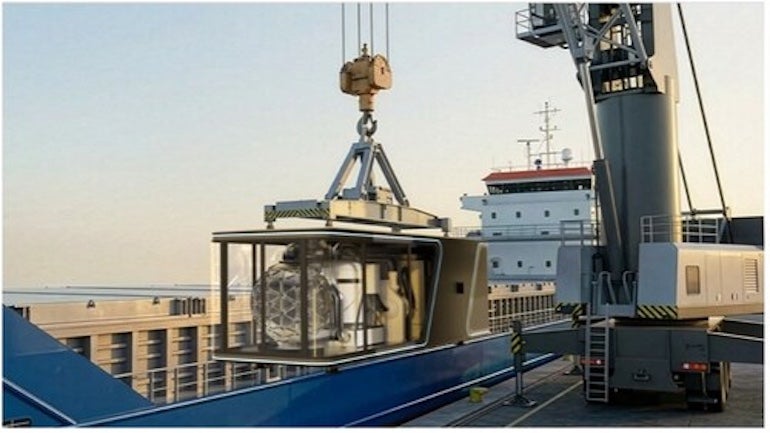
Monaco-based Scorpio Tankers has signed a strategic collaboration agreement with US-based nuclear start-up Ampera, which emerged from stealth in 2025. They plan to jointly develop and commercialise advanced micronuclear power solutions for marine, shipping and related maritime applications, including floating nuclear power barges in the near term and nuclear-powered vessels over the longer term.
Through the collaboration, Scorpio Tankers will serve as the strategic market lead and domain expert for marine and maritime applications. It will contribute marine engineering, technical design, regulatory expertise and global commercial relationships across shipping and maritime infrastructure markets. Ampera will provide access to its micro-nuclear reactor technology and work jointly with Scorpio Tankers to develop commercial models and technical configurations tailored for maritime deployment, including power-as-a-service, leasing and long-term service agreements.
The collaboration will focus on floating nuclear power barges, nuclear-powered commercial vessels, offshore and remote maritime energy supply, and port and coastal power infrastructure.
“This collaboration represents an important step toward the future of clean maritime energy, and our $10m investment in Ampera reflects both our conviction in nuclear and our confidence in the team,” said Emanuele Lauro, Chairman CEO of Scorpio Tankers. “Nuclear microreactors have the potential to fundamentally change how ships and offshore infrastructure are powered, and we believe this collaboration positions us at the forefront of that transition.”
Ampera CEO and Founder Brian Matthews noted: “Ampera’s ultra-safe reactors are well aligned with the maritime sector as they could cut fuel costs, reduce weight, improve efficiency, increase capacity and eliminate carbon emissions for shipping companies. We are pleased to team with Scorpio Tankers, which brings deep marine engineering expertise, global commercial reach and maritime regulatory experience.”
Scorpio Tankers, which currently owns 89 product tankers, claims to be the global leader in modern, eco-friendly vessels. #According to its website: “Our fleet of wholly owned, finance-leased, or bareboat-chartered vessels are outfitted for higher environmental performance and are capable of operating in the most challenging conditions for on-time delivery of refined petroleum products.”
Ampera claimed in November 2025 to be “backed by a Fortune 500 global technology leader in AI, cloud, and data-centre infrastructure with operations spanning more than 100 countries”. Ampera says it is developing “subcritical hybrid fusion–fission microreactors that produce no long-lived waste and require no refueling”. Each fully containerised system is designed to be available in 15 MWe defence and 30 MWe commercial configurations.
The company operates out of two buildings in Palm Beach Gardens, Florida, and is currently using these sites to develop and build its active reactor prototype designs. Prior to establishing this headquarters, Ampera operated out of the offices of sister company, Additec, an industrial 3D-printing firm based in Palm City, Florida.
Ampera’s reactor design, specifically its Genesis (15 MWe) and Nexus (30 MWe) models combines subcritical operation with advanced materials and manufacturing. The reactor requires an external “driver” to maintain the fission process. If this driver is turned off or loses power, the nuclear reaction stops instantly and naturally, providing an inherent “off switch”.
The reactor uses thorium-232, which it “breeds” into fissile fuel during operation. The sealed, solid-state core is engineered to operate for decades without needing to be opened or refuelled. It uses subcritical CO2 as the working fluid to drive its turbines. This allows the system to be much more compact and efficient than steam-based plants.
The reactor’s internal structures and fuel matrices are additively manufactured (3D printed) using high-performance materials such as silicon carbide to ensure extreme durability. Each unit is designed to be fully containerised and factory-built, meaning it can be shipped via truck, rail, or sea and “plugged in” upon arrival. The systems integrate AI-driven control frameworks that monitor and adjust performance automatically, allowing for autonomous operation with minimal on-site staffing.
Ampera has also developed a proprietary TRISO (Tristructural-Isotropic) fuel design that is protected by 66 global patents. Unlike traditional TRISO fuel, Ampera’s platform is specifically designed to utilise thorium. By integrating 3D printing directly into its platform, Ampera can produce these complex fuel forms and reactor components with high precision and at a lower cost than traditional methods.
Ampera is currently in the pre-application and prototype stage, with a target to have reactors at customer locations by 2030. In February it submitted a formal letter to the US Nuclear Regulatory Commission (NRC) to begin the pre-application process. I recently announced its intent to use NRC’s new regulatory framework, which is designed to expedite the licensing of advanced microreactors.
In 2027. Ampera is targeting development of active reactor prototypes at their Florida HQ with plans to hire 2,500 people over five years. After delivery of first mobile micronuclear reactors to customer sites (data centres or defence in 2030, Ampera plans high-volume production in Florida and expansion into the UK/European markets.
Ampera’s investment plan is a multi-billion-dollar commitment over the next five years to establish Palm Beach County as a global hub for advanced nuclear technology – both for reactors and fuel. The company projects this will scale its operations from research to full-scale commercial deployment. According to PitchBook, the company has raised approximately $20m in total funding as of early 2026.
The investment includes developing a second, larger location in Palm Beach County within the next five years dedicated to full-scale production. The facility is designed to manufacture 100–150 units a year once operational. The investment is supported by the Business Development Board of Palm Beach County, which assisted with permitting to accelerate the company’s “factory-built” mission.
In January, Ampera added the maritime sector as a primary segment in its growth portfolio, joining data centres and defence applications. “Our game-changing technology strongly aligns with the business demands for commercial shipping and defence vessels,” CEO Brian Matthews said at the time. “Having a power generation unit onboard that can provide consistent, clean and safe energy, while drastically shrinking the engine room footprint and significantly reducing vessel weight is a strong value proposition.”
Matthews earned his MSc in Physics and Technology of Nuclear Reactors from the University of Birmingham in the UK. Before launching Ampera in 2025, Matthews founded the Nuclear Safety & Technology Services (NSTS) consultancy in 2012. NSTS specialises in nuclear engineering and national security, specifically supporting sensitive nuclear facilities and complex government programmes. The firm’s expertise covers reactor core design, criticality safety, and systems architecture.
Before and during his time at NSTS, Matthews held roles as a Reactor Physicist and Nuclear Criticality Safety Specialist at major industry players including Atkins Nuclear Solutions US, BNFL (British Nuclear Fuels Ltd), and AMEC. He has been a legally authorised Nuclear Emergency Controller for EDF Energy, meaning he was qualified to lead a nuclear station (specifically Hartlepool) during emergency situations.


