
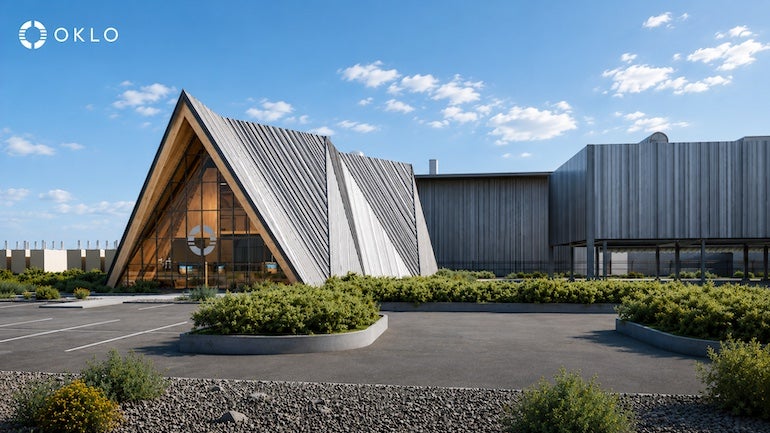
The US Department of Energy’s (DOE’s) approval of Oklo’s Preliminary Documented Safety Analysis (PDSA) represents the third of four major steps required to secure full federal authorisation to construct and operate the Aurora Powerhouse fast neutron reactor at Idaho National Laboratory (INL).
The approval validates the comprehensive evaluation of the Aurora-INL plant’s technical safety foundation under the DOE’s Reactor Pilot Program (RPP). The approved safety analysis specifically establishes formal commitments for:
- Identification and systematic evaluation of potential operational risks;
- Modelling of potential system failures and corresponding mitigation strategies;
- Verification of structural safety control systems and engineering safeguards;
- Hard criteria outlining how the physical plant design meets stringent federal safety parameters.
The Aurora-INL reactor, designed as a liquid metal-cooled, metal-fuelled fast reactor, builds directly upon the operational legacy of the Experimental Breeder Reactor II (EBR-II), which ran at INL from 1964 to 1994. It will use high-assay low-enriched uranium (HALEU) or recycled nuclear material. It will source its initial fuel assemblies from the nearby Aurora Fuel Fabrication Facility (A3F), which received its own separate PDSA approval in December 2025 becoming the first project authorised under the DOE’s Fuel Line Pilot Program.
While the RPP provides an accelerated mechanism for early deployment, testing, and operational experience under federal DOE oversight, Oklo is simultaneously continuing its licensing engagement with the independent the Nuclear Regulatory Commission (NRC) to clear the way for future commercial power plants across the country.
“This approval represents an important milestone for Aurora-INL and helps establish a foundation for future Aurora deployments,” said Jacob DeWitte, Oklo’s co-founder and CEO. He added that the Idaho project is demonstrating how advanced reactors can progress through real-world safety reviews, construction activities, and eventually commercial licensing.
The Aurora-INL project has steadily advanced since 2019, when the company received a site-use permit at INL and later secured access to recovered fuel from the EBR-II through a competitive DOE process. Oklo also received approval to begin site characterisation work at the Idaho site in November 2024.
Oklo also entered advanced negotiations last month under DOE’s Surplus Plutonium Utilization Program. The initiative aims to make designated surplus plutonium available for conversion into reactor fuel under strict security and safeguards requirements.
In May, Oklo announced a Strategic Partnership Project (SPP) with Battelle Energy Alliance (BEA), the managing contractor for INL, to integrate advanced artificial intelligence (AI) technologies into the design and engineering workflows of next-generation nuclear infrastructure including advanced reactor and fuel-system design work. Oklo and INL will integrate the Prometheus AI platform with Oklo’s Multiphysics design and analysis infrastructure to streamline engineering workflows and support development of Pluto.
Oklo is already conducting plutonium fast reactor critical tests with Los Alamos National Laboratory (LANL) at DOE’s National Criticality Experiments Research Center (NCERC) under another SPP. NCERC is located at the LANL-operated Nevada National Security Site (NNSS), under the oversight of DOE and the National Nuclear Security Administration (NNSA).
In April, Oklo announced a strategic collaboration with NVIDIA, and LANL to advance nuclear fuel validation and support the development of nuclear-powered AI factories. The partnership integrates Oklo’s sodium-cooled fast reactor technology, NVIDIA’s advanced AI and high-performance computing (HPC) infrastructure, and LANL’s expertise in materials science and nuclear fuels. LANL hosts the collaborative R&D efforts at its facility in New Mexico.


