
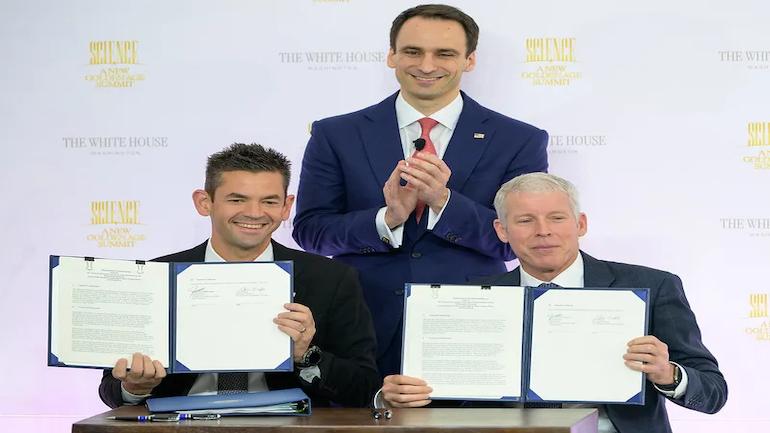
NASA Administrator Jared Isaacman and US Secretary of Energy Chris Wright have signed a memorandum of understanding (MOU) titled Accelerating American Leadership in Space Nuclear Power and Propulsion. The agreement, which takes effect on 1 November, marks the beginning of what Isaacman calls the “Nuclear NASA era”, establishing an end-to-end framework for developing next-generation nuclear technology for civil space missions. The joint initiative aims to transition space nuclear capabilities from theoretical laboratory research into operational, deep-space deployment.
Space Reactor-1 Freedom, scheduled to launch in late 2028, is intended to be the first ever nuclear-powered interplanetary spacecraft. It will use a 20 kWe nuclear electric propulsion (NEP) system to travel toward Mars, carrying the SkyFall capsule and three advanced Martian helicopters.
Lunar Reactor-1 (2030), in line with December 2025 Executive Order 14369, titled Ensuring American Space Superiority, is a fission surface power system will be deployed to the Moon. It is designed to provide continuous, baseline power to sustain a permanent Moon base.
The agreement also expands collaboration on radioisotope batteries, which will power NASA’s upcoming Dragonfly drone mission to Saturn’s moon Titan (launching in 2028) and support the European Space Agency’s Rosalind Franklin Mars rover.
Development of the lunar surface nuclear reactor relies on public-private partnerships under NASA’s Fission Surface Power (FSP) project, managed by the Department of Energy’s (DOE’s) Idaho National Laboratory.
NASA initially awarded $5m contracts to three major commercial consortiums to produce competing design concepts for a 40 kW fission system.
- The IX Joint Venture was formed specifically for space nuclear markets by Intuitive Machines and X-energy backed by Boeing and Maxar Space Systems.
- Lockheed Martin led a team focused on scalable modular grid technologies and high-temperature Brayton engines partnering with BWX Technologies (BWXT) for nuclear fuel components and Creare.
- Westinghouse Electric Company is designing a compact space-optimised reactor in partnership with Aerojet Rocketdyne.
Auxiliary technology contracts for the reactor’s specialised dynamic power conversion solutions were awarded Rolls-Royce, Brayton Energy, and General Electric.
NASA’s Moon Base “Ignition” architecture separates deployment into three phases: Phase 1 – Validation (to 2029); Phase 2 (2029-32) – Infrastructure; and Phase 3 (2032 onwards) – Extended Ops.
Building a Moon base requires an uninterrupted power source. Lunar Reactor-1 (LR-1) is scheduled to launch by 2030 to provide the baseline power grid needed to support multi-week operations. The physical deployment of the fission systems (which must weigh less than 6 tonnes) relies on commercial heavy-cargo variants of the Human Landing Systems (HLS). NASA has contracted SpaceX and Blue Origin to fly this infrastructure to the lunar surface during the 2029–2031 window.
The long-term Artemis goal includes mining lunar ice for life support and propellant, which will require scalable electricity (estimated at 25-50 kW). The modular architecture of the FSP systems allows multiple reactors to link together. Beyond this, the operational data gathered on the Moon will validate the radiation shielding, autonomous control systems, and low-enriched uranium fuels required to eventually send humans to Mars.
In March, Isaacman announced that the previous Lunar Gateway orbital space station had been “paused” with its assets shifted to the surface-first lunar strategy to counter international competition and accelerate deployment of the Moon Base.
The cornerstone of this resource shift involves the Power and Propulsion Element (PPE) module built by Maxar Space Systems as a high-power solar-electric propulsion (SEP) module to manoeuvre the Gateway station in lunar orbit. While the Gateway’s habitable modules (like HALO) suffered from severe design setbacks, the PPE module was in good condition and was repurposed to serve as the main propulsion for SR-1 Freedom.
The financial relief of halting the orbital construction project allowed NASA to pivot its budget and freed up funding within the Artemis budget. NASA redirected this into a $20bn lunar surface infrastructure programme and the flight of SR-1 Freedom.
NASA had originally booked a heavily customised SpaceX Falcon Heavy launch vehicle to lift the combined PPE and HALO modules into lunar orbit. This launch architecture has now been re-allocated to place the 12,000 kg SR-1 Freedom spacecraft directly onto an Earth-escape trajectory in late December 2028.
However, NASA’s policy shift shocked its primary international partners, the European Space Agency (ESA) and the Japan Aerospace Exploration Agency (JAXA), which had committed several billion dollars to the project. ESA was heavily invested in Gateway, manufacturing the core habitation and refuelling modules.
Isaacman attributed part of the sudden pivot to a safety crisis involving “severe metallurgical corrosion” on the primary structures of the Gateway modules. ESA rejected this allegation. While confirming minor, manageable material irregularities on the HALO and I-HAB structures, ESA blamed schedule delays on US supply chain bottlenecks involving life support systems and thermal control pumps.
Frustrated by being forced to adapt to Washington’s pivoting political priorities, ESA policymakers decided to establish a collectively governed “middle power lunar consortium” with JAXA and the Canadian Space Agency (CSA) to design future infrastructure that no single external space power can unilaterally cancel or redirect.
ESA, nevertheless, moved to adapt its technology to NASA’s new surface focus and is pushing its Lunar I-Hab module through critical design review before making a formal pivot. Its communication architecture is being re-evaluated for deployment as a dedicated, standalone lunar communications satellite constellation to support surface operations, while development on the deep-space refuelling module will focus on future non-NASA exploration pipelines.
Rather than confronting NASA, JAXA responded by strengthening its bilateral ties with Europe to mitigate exposure to shifting American space policies. JAXA had originally committed to providing the critical Environmental Control and Life Support System (ECLSS) and batteries for ESA’s I-HAB module. Following the programmatic shift, JAXA engineers began collaborating with industrial partners to transition these technologies away from an orbital module configuration adapting them for pressurised surface rovers and fixed habitat structures for the South Pole Moon Base.
The July, the US Government Accountability Office (GAO) annual assessment of NASA’s major projects portfolio detailed the technical, structural, and procurement bottlenecks that had forced the early-2026 restructuring of the Artemis programme. Artemis III dropped its mid-2027 lunar landing plans in favour of launching a crew into a low Earth orbit. The timeline for a lunar landing was also postponed and shifted to Artemis IV, targeted for early 2028.
The audit highlights that while most of NASA’s non-Artemis projects remained within basic cost boundaries, the systems designed to support the lunar programme faced severe engineering limits, supply chain strain, and human resource shortages. The most severe near-term bottleneck centred on launchpad infrastructure.
The Mobile Launcher 2 (ML-2) project suffered from extensive cost overruns and design delays under its contractor, Bechtel with the schedule slippage threatening to stall the entire long-term manifest. In early 2026, NASA had moved away from the SLS Block 1B rocket for future missions and closed out the ML-2 project. The unfinished hardware is now being processed for long-term storage.
GAO noted that, by combining modules and altering Gateway’s original layout, the PPE needs a far more advanced, high-power SEP system to generate the thrust needed for transport. However, this system is still in development. If the advanced SEP system encounters developmental delays, the entire timeline for the repurposed hardware, including its integration into the Space Reactor-1 Freedom bus, will stall.
The audit revealed that severe human resource deficits have degraded NASA’s ability to troubleshoot complex aerospace engineering challenges. Responding to federal directives to shrink bureaucracy, NASA slashed its civil servant workforce by 4,000 – a 22% reduction. GAO said 25 of 36 major NASA projects had reported direct, negative impacts from these staff reductions.
While NASA announced plans to resume hiring to fill these “skill gaps” in early 2026, the FY 2027 budget request proposes a funding cut of more than 20%. This creates uncertainty about whether NASA can recruit the advanced aerospace and nuclear engineers required to handle the rigorous development cycles of space reactors and surface landers.
The audit builds on Joint Confidence Level (JCL) data from previous reviews regarding development of commercial lunar landers. GAO notes that the technical timeline for the Human Landing System (SpaceX and Blue Origin) remains constrained by the unproven physics of large-scale orbital cryogenic propellant transfer (storing and transferring liquid methane and liquid oxygen in zero gravity).
The technical uncertainty of executing over a dozen sequential tanker flights to fill a single lunar lander is what originally caused the JCL to show a year-and-a-half delay for a crewed landing, forcing NASA to convert the mid-2027 Artemis III mission into a low-Earth orbit.
GAO reported that NASA carries 46 open recommendations and had failed to implement any of its designated “priority recommendations” since August 2025. The GAO highlighted four open priority unfulfilled recommendations that undermine the financial transparency and security of the Artemis campaign and admonished NASA for persistent failure to provide transparent fiscal oversight for its deep-space missions.
In December 2019, GAO mandated that NASA establish a comprehensive lifecycle cost estimate for specific Artemis missions. NASA has continually resisted this directive. Isaacman asserted that a flight-by-flight benchmark misrepresents how the agency structures its long-term milestones. GAO said this leaves Congress and the public blind to the total cost of landing humans on the Moon.
GAO also had instructed NASA to prepare an enterprise-wide cybersecurity risk assessment. However, NASA continues to manage its cybersecurity in localised silos rather than evaluating its vulnerabilities as a singular entity. GAO therefore lacks verification that NASA can detect suspicious activity or defend its lunar communications networks from sophisticated network intrusion.
In July 2021, GAO recommended that NASA adopt a balanced set of performance metrics to manage its procurement portfolio. Despite holding billions of dollars in commercial space contracts, NASA has not implemented these federal procurement metrics. GAO said this would give better visibility into vendor performance and potentially save taxpayers millions of dollars in wasteful commercial cost-overruns.
In response, to GAO’s criticism, NASA stated that the agency is prioritising “simplifying policies so teams can focus on delivering missions, not navigating paperwork”.


