
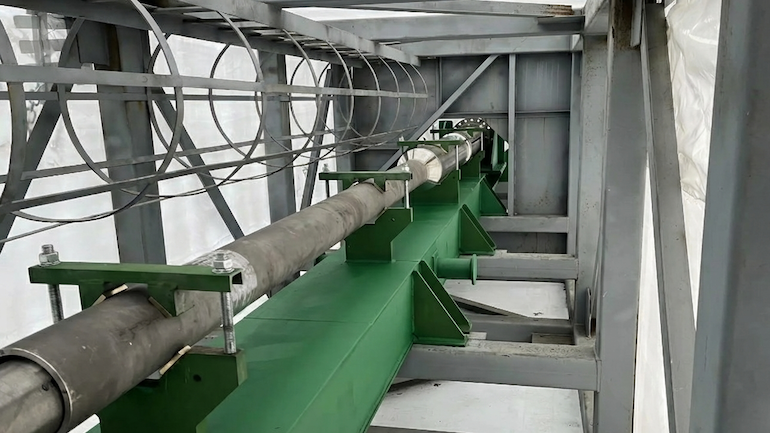
The reloading mechanism and steam-water washing receptacles for used fuel assemblies for Russia’s multi-purpose fast neutron research reactor (MBIR – Mnogotselevoi Bistrii Issledovatelskii Reaktor) have been delivered to the construction site at the Scientific Research Institute of Atomic Reactors (NIIAR – Nauchno Issledovatelskii Institut Atomnikh Reaktorov) in Dimitrovgrad.
The equipment is intended for the effective functioning of the transport and technological part of the installation. It is a key part of the control assembly of the reactor.
The refuelling mechanism is a complex electromechanical unit more than 10 metres long and weighing 3.3 tonnes. It has the capacity to take gas samples to determine the tightness of fuel rod shells and can rotate to the required angle to control the extraction of fuel elements.
“Before being sent to the institute’s site, the equipment was tested on a factory stand in order to confirm it complied with the functional and strength characteristics laid down by the designer,” said Valery Gorelov, head of the project management department at NIIAR.
The steam-water washing receptacle is a pipe of variable cross-section with shut-off valves, thermal insulation and a bellows compensator. It is intended for placing and washing used fuel assemblies and other removable core elements of the reactor to remove coolant residues, as well to monitor their tightness. Final assembly is carried out directly on site. When assembled each receptacle is 5.5 metres long and weighs 2.2 tonnes.
The 150 MWt multi-purpose sodium-cooled fast neutron MBIR reactor will be the world’s largest facility of its kind. It is expected to provide the nuclear industry with a modern and technologically advanced research infrastructure for the coming 50 years. Its unique technical characteristics will make it possible to solve a wide range of research problems to support the development new competitive and safe NPPs, including fast reactors based on closing the nuclear fuel cycle. Research time needed at the new reactor will be several times less in comparison with the currently operating installations. MBIR will be the basis of an international research centre and will replace the BOR-60 experimental fast reactor that has been in operation at NIIAR since 1969.


