
Iran is working on a proposal for an agreement that would ensure the peaceful use of nuclear energy, although it does not fully trust the US, said Iran’s Foreign Minister Abbas Araghchi in an interview with the RT television. Araghchi said that the plan would guarantee that Iran does not possess nuclear weapons, while at the same time ensuring the country’s right to use nuclear technology for peaceful purposes. He emphasised that after the strikes on its nuclear facilities carried out by the Israel and the US in June 2025 while negotiations were underway, Iran still does not fully trust Washington.
After months of no contact, discussions with the US have resumed amid heightened threats of a potential conflict, following Washington’s increasing military buildup in regional waters near Iran that began in January. Iran responded to the threats by warning that even a single shot fired at the country would receive a massive response. The two sides subsequently de-escalated by announcing plans to resume the nuclear talks, which had collapsed in June.
Iran’s nuclear programme is no longer subject to international inspections, following the June 2025 attacks and the expiry in October 2025 of the Joint Comprehensive Plan of Action (JCPOA). Iran’s Foreign Ministry in October issued a statement underlining that Iran’s nuclear programme must now be treated like that of any other non-nuclear-weapon state under the Nuclear Non-Proliferation Treaty (NPT) with no additional limitations either imposed or recognised.
Iran’s nuclear programme had been under massive sanctions since 1979 imposed by the US and Europe and later also by the UN because of allegations that it was developing a nuclear weapons programme. Sanctions had been lifted in 2015 when Iran signed the JCPOA with the P5+1 group of countries (the USA, UK, France, Russia, and China plus Germany) under which Iran had agreed to limit its nuclear development programme and allow International Atomic Energy Agency (IAEA) inspections of its nuclear facilities.
However, the US withdrew from the JCPOA in 2018, reimposing its unilateral sanctions, which the European states tacitly supported. After a year of fruitless negotiations, Iran, in turn, began to ramp up its nuclear programme again. After more years of unsuccessful negotiations, Israel and the US launched their military strikes on Iran’s nuclear facilities as a result of which Iran cut its ties with the IAEA, ending all inspections, which had been ongoing.
Iran is now again engaging in talks on its nuclear programme with the US mediated by Oman and Qatar. Iran’s security chief Ali Larijani met with Qatari Emir Sheikh Tamim bin Hamad Al Thani in Doha. According to IRNA, they “exchanged views on the latest developments in nuclear talks and the issue of sanctions relief,” which Iran seeks as part of any potential deal with the US.
The Qatari Emir’s office said in a statement that Sheikh Tamim had held a phone conversation with US President Donald Trump earlier in the day. The statement added that the call focused on “international efforts aimed at de-escalation and strengthening regional security and peace.” Larijani’s visit to Qatar came a day after he held extensive talks with top government officials in Oman, which had hosted the renewed Iran-US talks.
Foreign Ministry spokesperson Esmaeil Baghaei has said Iran is ready to discuss the level of uranium enrichment and the size of its stockpile, provided that the rights of the Iranian nation are respected. In an interview with America’s PBS News he addressed a number of issues, including the diplomatic path with the US following the resumption of the nuclear and sanctions-removal talks in Oman. He emphasised that the negotiations would focus on the nuclear issue, stressing that “what we want is based on an established rule of international law” noting that Iran, a member of the NPT, develops nuclear energy for peaceful purposes.
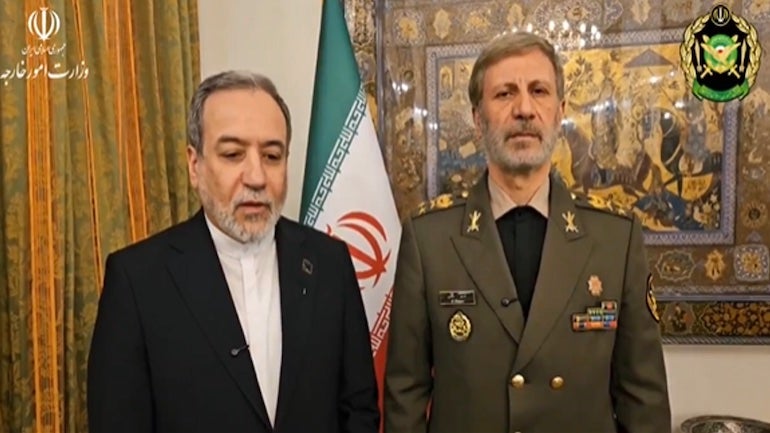
Following a meeting with senior military commanders Foreign Minister Araghchi noted: “Today, we enter the diplomatic arena backed by the strength of our armed forces…. We have now entered a new phase of negotiations. This process is the result of one year of resistance by the Iranian people and the Iranian armed forces in the face of all pressures, threats, and the war that took place…. God willing, we will continue this negotiating path from a position of equality, based on mutual respect and mutual interests. If we see seriousness from the other side, the Islamic Republic of Iran is also fully serious and will move this process forward. However, we will pursue this path with open eyes, taking into account all past experiences, without trusting the other side, and with confidence in our armed forces.”


