
Indonesia’s Nuclear Polytechnic the National Research & Innovation Agency (BRIN – Badan Riset dan Inovasi Nasional) is preparing vocational graduates in six new specialisations to support operation of Indonesia’s first commercial NPP planned for 2032.
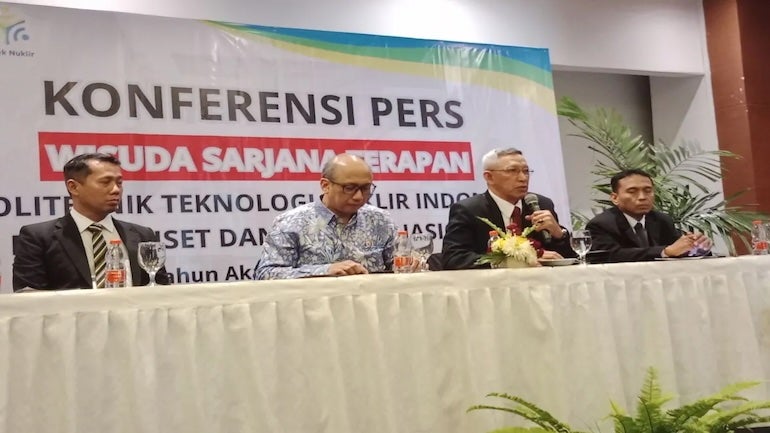
Polytechnic Director Zainal Arief told a press conference that curriculum adjustments have been made since 2024 to align with government policies and regulations. “The curriculum must be specific and aligned with BRIN’s vision. We are focusing three study programmes into six specialisations relevant to the human resource needs of the power plant,” Arief said.
The six specialisations are nuclear energy generation and nuclear analysis (electromechanics), nuclear medical instrumentation, accelerator technology (instrumentation electronics), nuclear fuel, radioisotope production technology, and radiopharmaceuticals. Arief noted that the programmes support government initiatives on nuclear energy use for industry, agriculture, and medicine. “Hopefully, with the new curriculum, by 2028, there will be graduates competent in the six specialisations,” he said.
Edy Giri Rachman Putra, BRIN’s Deputy for Human Resources and Science and Technology, stressed that Indonesia has long prepared nuclear talent and is ready for the 2032 target. He pointed to existing programmes: nuclear engineering at Gadjah Mada University (UGM), nuclear physics at Bandung Institute of Technology (ITB), and 40 years of training at Nuclear Polytechnic since its establishment in 1985.
While UGM and ITB produce nuclear scientists and engineers, Nuclear Polytechnic produces technologists competent in operating and maintaining facilities.
Indonesia’s experience managing three research reactors in Bandung, Serpong, and Yogyakarta serves as a foundation, Putra noted, adding that commercial plant operations also require expertise in mechanical and electrical engineering, physics, and socio-economic fields for stakeholder engagement.
Each year, Indonesia produces at least 300 nuclear engineering graduates from UGM, ITB, and the Nuclear Polytechnic enough to meet the workforce needs of future NPPs, Putra said.
Meanwhile, the Indonesian government has advanced its target for building a 250 MWe on-grid nuclear power plant from 2032 to 2029, according to Yuliot Tanjung, deputy minister at the Ministry of Energy & Mineral Resources. He said regulations for establishing the Nuclear Energy Programme Implementation Organisation are entering the harmonisation stage. He said that accelerating nuclear power development is part of Indonesia’s energy transition strategy.
In 2024, Dr Topan Setiadipura, the head of BRIN’s Nuclear Technology Research Centre said that BRIN targets approval from the Nuclear Energy Regulatory Agency (Bapeten – Badan Pengawas Tenaga Nuklir) of the reactor design by 2025, alongside site selection, before proceeding to construction approval. “We hope that in 2027 we can start construction, maybe let’s say it will take three years because the reactor is small. But that will also depend on our partners,” he noted.
Recently, the Energy & Mineral Resources Ministry confirmed that it had received official proposals from five countries, including Canada and Russia, to build NPPs in Indonesia. “We are still reviewing the proposals. We have already met with Canada and Russia,” Energy & Mineral Resources Minister Bahlil Lahadalia said. He emphasised that the government has not yet chosen a specific nuclear technology, and all proposals are still under evaluation.
Earlier, Lahadalia confirmed that a roadmap for nuclear development has been drafted, targeting a total capacity of 500 MWe by 2034, with 250 MWe to be built in Sumatra and the remainder in Kalimantan.


