
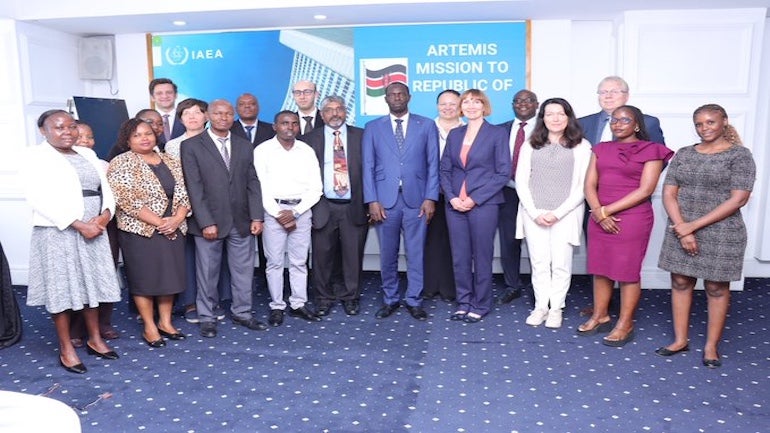
An International Atomic Energy Agency (IAEA) Integrated Review Service for Radioactive Waste and Spent Fuel Management, Decommissioning and Remediation (Artemis) team of experts found that Kenya is committed to continuous improvement of the safe management of radioactive waste as it prepares to introduce nuclear power to its energy mix.
The mission reviewed Kenya’s national programme for radioactive waste management based upon the IAEA Safety Standards and technical guidance as well as international good practices observed in IAEA member countries. The nine-day mission, the first of its kind to be conducted in Africa, was held at the request of the Government of Kenya and was hosted by the Kenya Nuclear Regulatory Authority (KNRA).
The team comprised four external experts in the safe management of radioactive waste and spent nuclear fuel from Lithuania, Morocco, Slovakia and South Africa as well as four IAEA staff members.
Kenya uses radioactive sources across medical, research and industrial sectors and manages its waste programme at the Central Radioactive Waste Processing Facility, in Oloolua, Kajiado County.
Preparations are also underway to establish Kenya’s first nuclear research reactor, which will serve as a key facility for education, training and research, and to develop a nuclear power programme to support growing energy demand. Both initiatives will require planning for the safe management of radioactive waste, including high-level waste in the form of used nuclear fuel.
The team held discussions and interviews with national counterparts on the policy and framework for the safe management of disused sealed radioactive sources and the envisaged radioactive waste and used fuel from the proposed nuclear power programme. They also took into account the findings from an IAEA regulatory review in October last year, which included observations of regulatory inspections at Oloolua’s waste processing facility.
The reviewers noted Kenya’s commitment to the sustainable safe management of radioactive waste and used fuel. They also made several recommendations and suggestions to KNRA and the Kenyan Government for further improvement of their efforts, including to ensure the independence of its regulatory activities; to finalise the national policies for nuclear energy, fuel cycle and radioactive waste management; and to focus on capacity building efforts that could enable it to further deliver on its mandates.
The team also encouraged Kenya to define a consolidated action plan to implement the findings from both the Artemis review and the 2025 regulatory review mission, which would help position the country to meet high standards of safety in radioactive waste management as it advances its nuclear power programme.
Artemis team leader Thiagan Pather, Designate Executive of Nuclear Technology and Naturally Occurring Radioactive Material at the National Nuclear Regulator of South Africa said: “The counterparts engaged in an open and constructive manner throughout the mission, enabling productive technical discussions. Addressing the findings from this Artemis mission, in an integrated manner with those from the 2025 mission, will assist Kenya in further enhancing the safe and effective management of its existing radioactive waste as well as the envisaged future radioactive waste and spent fuel.”
James Keter Chumba, Director General of KNRA, said: “The findings, the lessons learned and the experience of participating in an international peer review will help us strengthen our regulatory infrastructure and capabilities, as well as the radioactive waste management programme.”


