
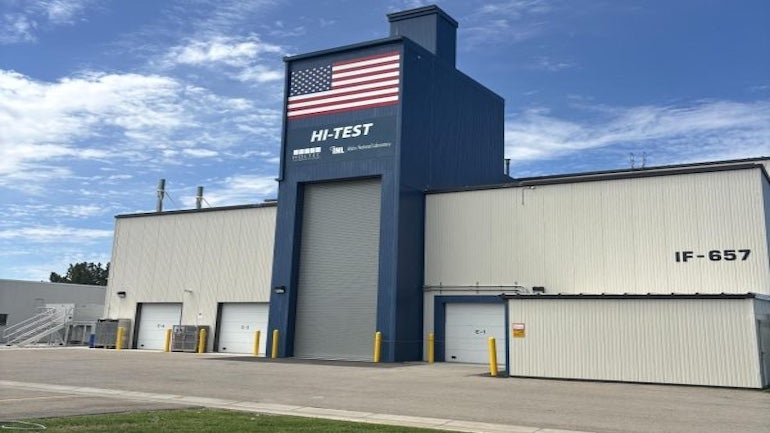
Holtec International’s HI-TEST facility at the Department of Energy’s (DOE’s) Idaho National Laboratory (INL) is currently undergoing fabrication of key components and installation preparations supported by DOE’s Advanced Reactor Demonstration Program. The 65-foot-tall, nominally 1/3rd scale test facility, is designed as a physical representation of Holtec’s SMR-300 small modular reactor plant.
The facility will test the SMR-300 under both steady-state and transient conditions. It will provide physical data validating the plant’s generation capacity, resilience, and operability. The huge facility is a heavy consumer of electricity. It requires more power than the INL’s installed capacity, making it necessary to draw additional power from across a nearby highway.
High-fidelity thermal-hydraulic data from these tests will create the regulatory foundation for future licensing and commercial SMR deployment. The project is using an “at-risk” procurement strategy that runs construction and engineering concurrently to accelerate the development timeline.
The Holtec SMR-300 is an evolutionary, pressurised water reactor (PWR) designed for grid electricity and industrial process applications. It integrates proven commercial light-water reactor technologies with advanced, completely passive safety mechanisms. The 300-320 MWe/1,050 MWt uses standard, commercially available low-enriched uranium (LEU) fuel with an operational lifespan of 60-80 years. It can be configured with air-cooled condensers to operate efficiently in water-scarce environments.”
Its passive safety features include eight engineered safety feature (ESF) systems based on gravity, pressure, and temperature differences to automatically shut down and cool the core. The reactor core is situated deep underground within a fortified steel-and-concrete containment enclosure to shield it from natural disasters and man-made threats. It features a used fuel pool located directly inside the containment area, using Holtec’s HI-STORM UMAX underground dry storage system.
The SMR-300 critical components and their integrated performance have already been qualified by Holtec’s extensive repertoire of state-of-the-art computational tools. As an example of the extensive computer simulation work performed for the SMR-300 design, Holtec’s analysis team performed a full 3D simulation of the steam generator to model performance under a range of operating conditions, including start-up, normal operation, and shut-down scenarios. These modern simulation tools detail all major subcomponents of the equipment with approximately 80m data points. This data set allows all aspects of the design to be validated and optimized for performance and manufacturability before building a single component.
HI-TEST will provide additional performance data for defence-in-depth design validation. A conservative design approach is being adopted for the initial licensing at Holtec’s Pioneer 1&2 project to be deployed adjacent to the existing Palisades Nuclear Generating Station in Covert Township, Michigan.
The twin-unit SMR facility will provide an additional 680 MWe of clean electrical output to the grid and will operate alongside the main Palisades reactor (which produces 805 MWe), where fuel loading is now underway. In December 2025, DOE selected the Pioneer project for a $400m matching grant under the Generation III+ SMR Pathway to Deployment Program.
Holtec is engineering and building the Pioneer site in collaboration with global industry partners Hyundai Engineering & Construction and Mitsubishi Electric. The Nuclear Regulatory Commission (NRC) accepted the first part of Holtec’s Construction Permit Application for review in February and NRC launched its environmental review for Pioneer 1&2 in June. A draft Environmental Impact Statement (EIS) is expected in autumn. Early site preparation and civil construction planning are already underway in accordance with approved local permits.


