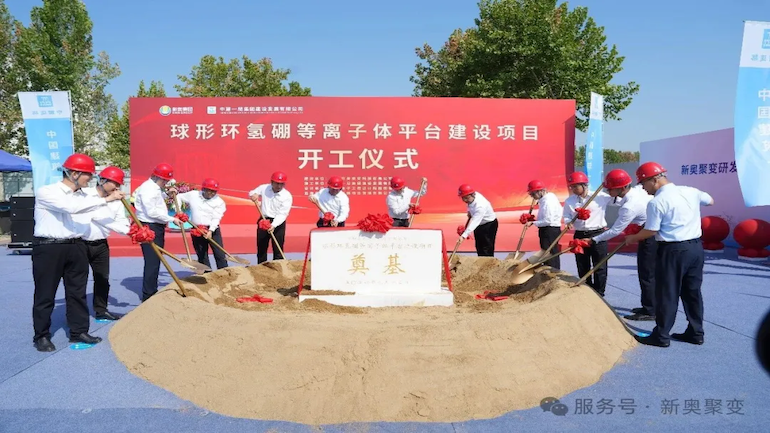
ENN Fusion (also known as Xin’ao Fusion) has broken ground for the construction of its Spherical Torus Hydrogen-Boron Plasma Platform (the Helong-2 device). The groundbreaking ceremony took place at the ENN Fusion R&D Centre in China’s Langfang Economic & Technological Development Zone. The project covers an area of about eight hectares and focuses on the construction of more than 10 core systems to create a world-leading experimental platform for hydrogen-boron fusion.
Helong-2 is being built by China Construction First Group Construction and Development Company. The site is expected to be ready for equipment installation by the end of June 2027, with device construction and commissioning to be completed and the experimental phase to begin by the end of 2027. The goal is to achieve the first ignition of hydrogen-boron fusion by 2030.
The heads of relevant departments of Hebei Province and Langfang City, as well as heads of engineering construction units, design units, construction units, and supervision units attended the groundbreaking ceremony and jointly laid the foundation stone and the soil for the project.
Yu Jianchao, Chairman of the Xin’ao Group, said: “Helong-2, as the third-generation fusion device built by Xin’ao, is a key engineering platform for moving towards a fusion intelligent power plant. It carries the important mission of breaking through key hydrogen-boron fusion technologies and exploring new paths for future energy. It is an important milestone in the commercialisation of hydrogen-boron fusion in Xin’ao and an important step on the road to commercialization of fusion energy in China.”
In 2017, ENN Group (Xin’ao) officially expanded its scientific R&D scope from low-carbon technologies to zero-carbon energy. They became the first private enterprise in China to build a dedicated, heavily funded programme targeting commercial spherical torus hydrogen-boron fusion. This 2017 pivot laid the groundwork for their consecutive milestones – developing their phase-by-phase commercial roadmap in 2018 and designing and constructing the Xuanlong-50 (EXL-50) and upgraded EXL-50U devices in 2019–2022.
After five years of research and exploration, Xin’ao has established a commercial route for spherical ring hydrogen-boron fusion. This technology route is highly suitable for future commercialisation needs due to its abundant and readily available fuel, low cost, safe and environmentally friendly reaction, and higher energy conversion efficiency. Xin’ao also participates extensively in international cooperation, becoming the first private enterprise in China to join the International Tokamak Physics and Engineering Activities (ITPEA).
Hydrogen-boron fusion is a promising nuclear fusion reaction in which a hydrogen proton combines with a boron-11 nucleus to form harmless helium nuclei (alpha particles) and release energy without emitting high-energy neutrons. A number of private thermonuclear companies, including the American TAE Technologies and the German Marvel Fusion, are also developing hydrogen-boron fusion technology, also known as proton-boron fusion.
The construction of ENN Fusion’s Helong-2 represents a major shift in China’s broader nuclear fusion landscape. It introduces private-sector agility and alternative physics to a national strategy that has traditionally been state-driven, massive, and uniform.
China’s baseline fusion strategy is anchored by massive, state-owned national laboratories under central planning. Helong-2 acts as a commercial, privately funded “fast-follower” trying to beat the state’s timelines to the grid. The state-funded path relies on massive, traditional tokamaks, its flagship projects being the Experimental Advanced Superconducting Tokamak (EAST), the near-complete Burning Plasma Experimental Superconducting Tokamak (BEST slated for 2027), and the ultimate China Fusion Engineering Test Reactor (CFETR) targeting commercial power by 2040–2050.
The ENN Path (Helong-2), funded heavily by the private energy giant ENN Group, is aiming to bypass the heavy state infrastructure. ENN’s roadmap targets a commercial demonstration reactor by 2030–2035, around a decade ahead of the state’s schedule. Helong-2 departs completely from the mainstream fuel mixture used by almost all Chinese national projects. Projects such as EAST and CFETR focus on deuterium-tritium (D-T) fusion. D-T fusion is easier to ignite but releases high-energy neutrons that degrade reactor walls and create radioactive waste.
Helong-2 is designed specifically for Proton-Boron fusion. This reaction is aneutronic, meaning it produces no harmful neutrons and yields clean helium nuclei. While it eliminates the need for heavy radiation shielding, it requires ignition temperatures upwards of 300m-1bn °C, several times hotter than D-T reactors.
In addition, reactor shapes define how plasma is trapped, and Helong-2 represents China’s frontier in alternative engineering. The state’s leading reactors use conventional, large donut-shaped magnetic fields to hold plasma. Helong-2 uses a spherical torus (ST) geometry, which shapes the plasma more like a cored apple. This layout is more compact and achieves much higher magnetic efficiency, making it the ideal host for the ultra-hot plasma required by hydrogen-boron reactions.
Ultimately, Helong-2 serves as China’s premier high-stakes hedge. While the Chinese government pours billions into massive, traditional D-T tokamaks to guarantee eventual success, ENN’s Helong-2 acts as a high-reward vanguard exploring the ultimate goal of direct, neutron-free commercial power.


