
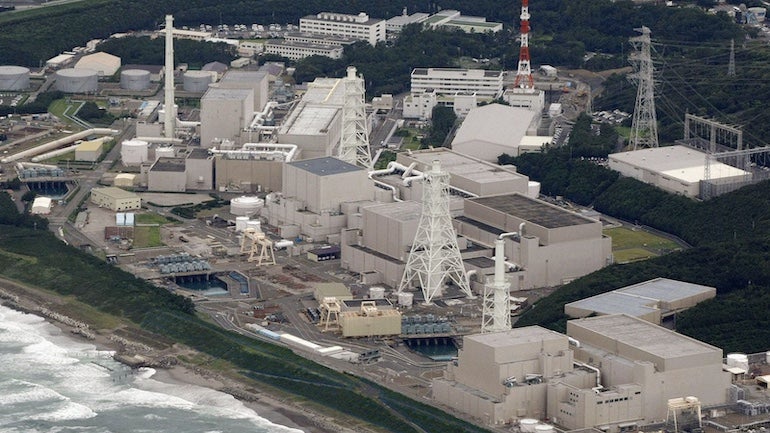
Japan’s Chubu Electric Power Company, which was found to be falsifying data on the seismic resistance of the Hamaoka NPP, has decided to withdraw its application to restart the plant. Initially, it was assumed that the third and fourth power units at the Hamaoka NPP would be restarted.
The investigation into the violations began in May 2025, but data was distorted even after that. In January 2026, Chubu admitted that it used one method to assess seismic resistance, while reporting another method in the documentation submitted to the regulator. The Japanese government has already signalled that it will take serious measures against the energy company.
The Chubu management resigned in face of the growing scandal. Chubu President Shingo Hayashi and Board Chairman Satoru Katsuno are leaving their posts. From 1 October, Minoru Yasui will take over as president.
In a scathing editorial, The Mainichi said the resignations “are only natural” after an investigative report had “laid bare the self-righteousness of Chubu Electric’s nuclear power division”. If shaking from an earthquake is underestimated and safety measures are neglected, the result could be a catastrophic accident. “The Fukushima disaster should have taught us that making light of risk invites grave consequences,” the paper said.
“A tendency to look down on regulators had become entrenched in the company’s highly specialised nuclear power division. Personnel transfers were few and the organisation had a closed culture. The report points out that the division becoming a “black box” created a breeding ground for misconduct.”
What made the wrongdoing even more malicious was pressure from management. “Katsuno and Hayashi repeatedly called for an early restart and demanded that the nuclear power division hurry to finalise the standard seismic motion calculations. When Katsuno was president, without fully grasping why the review was delayed, he scolded employees with remarks such as, ‘This is completely different from what you have explained so far’ and ‘our company has not made enough effort’.”
The emphasis on speed may have prompted the employees in charge to commit the misdeeds, Mainichi noted. “In the past, Toshiba Corp and Nidec Corp also saw management impose unrealistically high targets on workplaces, leading to accounting scandals. One can only be stunned that scandals are being repeated without lessons being learned.”
Nor is this scandal the only one. “In November last year, it came to light that in placing orders for safety work aimed at restarting the nuclear plant, the company had failed to carry out formal contract-change procedures and had not paid business partners the necessary costs. Last month, falsification of reports was revealed in decommissioning work for Hamaoka reactors 1 and 2. Outside the nuclear power business as well, the company knew it had overcharged for electricity but left the problem unaddressed for two years and five months.”
The paper concluded: “It must be said that Chubu Electric’s corporate governance has collapsed. The company’s very nature will not be reformed merely because its top executives resign and it withdraws its nuclear plant restart application.” Incoming president Minoru Yasui “faces a difficult start”.
Moreover, “it is clear that Chubu Electric lacks the capability and qualifications required of a nuclear power operator. The NRA [Nuclear Regulation Authority] should determine the actual state of the company’s safety culture and quality assurance system and consider severe sanctions.”


