
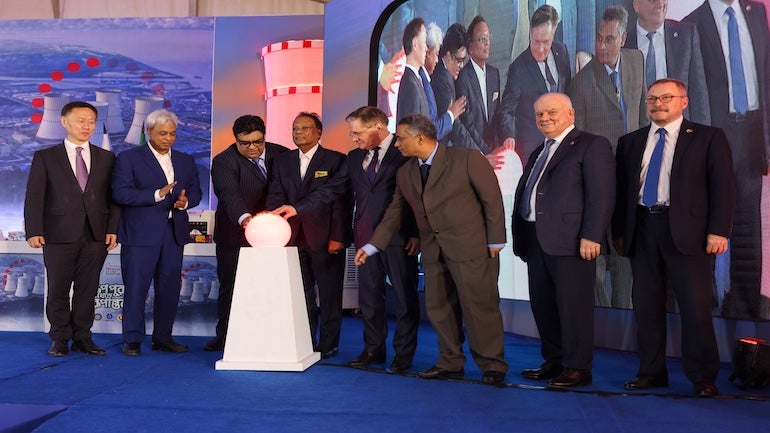
Fuel loading has begun at unit 1 of the Rooppur NPP under construction in Bangladesh. The event was attended by Rosatom Director General Alexey Likhachev and the Bangladesh Minister of Science & Technology, Fakir Mahbub Anam. After 163 fuel assemblies are loaded into the reactor core, the unit will be brought to a minimum controlled level followed by a gradual increase in power. The next stage will be an energy start-up and grid connection. Fuel loading I being undertaken by trained Bangladeshi operators with the direct assistance from Rosatom experts. The International Atomic Energy Agency (IAEA) is monitoring each fuel rod through real-time software.
In accordance with the government plan, the intention is to progressively enhance production each month, aiming to achieve full capacity of 1,200 MW within a timeframe of 8 to 10 months. The initial power connection to the national grid is anticipated by July-August, with the objective of reaching full power production by December, contingent upon the successful completion of all technical and safety assessments. Concurrently, the second unit is also approaching its final phase, with plans to initiate fuel loading later in 2026. Once fully operational, the plant is expected to provide around 10% of total electricity demand, significantly contributing to energy security.
The Rooppur plant is being built by Rosatom on the eastern bank of the Ganges River in the Pabna district of Bangladesh, about 160 km northwest of Dhaka. It will comprise two VVER-1200 reactors. In November 2011, Russia and Bangladesh signed an inter-governmental agreement on cooperation in the construction of the NPP, and in mid-December 2015 a general contract worth $12.65bn was signed. Construction of unit 1 began in November 2017 and unit 2 in July 2018. The plant’s design life is 60 years, with the possibility of extending its operating life for another 20 years. Fresh fuel for the units was delivered to the site in the latter part of 2023. An operating licence was issued by the Bangladesh Nuclear Regulatory Authority earlier in April.
“The peaceful use of nuclear energy will play a key role in ensuring national energy security, accelerating industrialisation and promoting the development of technology-based economies,” said Anam. “The project serves as a symbol of Bangladesh’s scientific progress and demonstrates the country’s willingness and ability to master advanced technologies responsibly and effectively.”
Likhachev said the Rooppur NPP will become the most important element in Bangladesh’s energy system. “For Rosatom, this project is another important step in the development of global nuclear energy, in strengthening friendly relations with our foreign partners. We are glad that, together with our Bengali friends, we are participating in the creation of a modern and reliable NPP and see further prospects for our cooperation.”
Likhachev subsequently had a meeting with Prime Minister Tariq Rahman during which the progress of the project was discussed including the physical start-up of unit. By the end of 2026, the unit should begin supplying electricity to consumers. Rahman and Likhachev emphasised the strategic importance of the project for the energy system of Bangladesh and confirmed their interest in its successful and timely implementation.
“Cooperation between Russia and Bangladesh in the nuclear field is a prime example of a strategic partnership based on trust, mutual respect and the desire for technological development. We highly appreciate the level of interaction that has developed during the implementation of this large-scale project for the construction of the Rooppur NPP,” said Likhachev. “I am confident that the successful completion of the project will become a solid basis for further expansion of cooperation between the two countries and will open up new opportunities for joint high-tech projects both in the energy sector and in related industries, science and education.”
Bangladesh University of Engineering and Technology (BUET) Professor Dr Iqbal Mahmud told Views Bangladesh, “The Rooppur project will enhance the country’s technological capabilities and create opportunities for a new generation of scientists and engineers.” He said that the biggest challenge now is to build nuclear safety and skilled human resources.
Professor Dr AKM Fazlul Bari, Director of the National Institute of Nuclear Medicine & Allied Sciences (NINMAS), told Views Bangladesh, “This project will also strengthen Bangladesh’s diplomatic position. Through cooperation with Russia, the country has forged a new strategic partnership, which will pave the way for more technological cooperation in the future.”


