
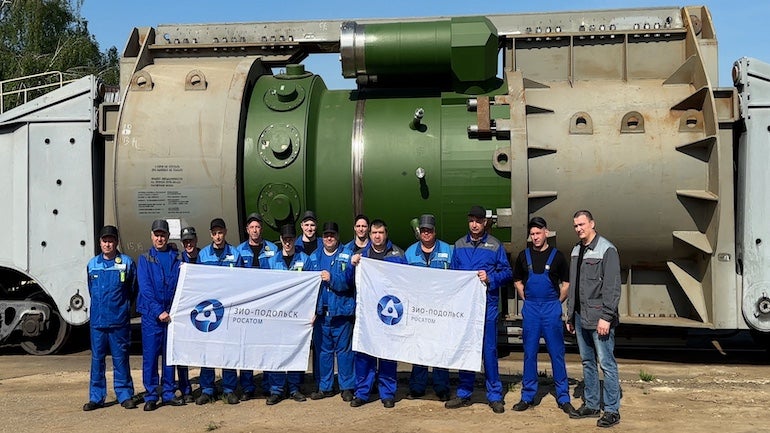
Russia’s ZiO-Podolsk plant (part of Rosatom’s Mechanical Engineering Division) has completed manufacture of the first RITM-200S reactor unit for the lead floating nuclear power unit (PEB-106) for the Baim project in the Arctic.
The PEB-106 was previously called MPEB (Modernizirovannii Plavuchii Energoblok – modernised floating power unit). A series of four such power units (Project 20871) is being built to supply energy to the Baimskaya ore zone in Chukotka. The developer of Project 20871 is the Iceberg Central Design Bureau. The developer of the reactor plant is OKBM Afrikantov. The first of the four units is scheduled for commissioning in 2028.
The Baim ore zone in the Bilibinsky district of the Chukotka Autonomous Okrug will see the largest project for the construction of a mining and processing plant based on the Peschanka copper-porphyry field. Investment in the project was initially estimated at RUB900bn ($10bn) but has been revised upwards with some RUB170bn already invested.
The annual ore processing capacity is expected to be 70m tonnes. The resources of the Peschanka field in the Baim region, are estimated by the JORC (Joint Ore Reserves Committee) at 9.9m tonnes of copper and 16.6m ounces of gold. PEB-106 project, designed specifically for the Far North and Far East uses RITM-200S reactors, which will supply 106 MWe to consumers. Their service life is 40 years and the interval between refuelling is five years.
The units will be held in place by rigid mooring devices, which make it possible to compensate for the movement of the power units from the ebb and flow. The power generated by the power unit is transmitted to the shore using 50 high-voltage cables. Three main floating power units and one reserve unit will be installed, which will be used during the repair of the main units.
Rosatom continues to expand the line of floating power units, and the completion of the manufacture of the first reactor for the lead PEB-106 is an important milestone on this path, noted Rosatom Director General Alexey Likhachev. “Today, only Russia has an operating floating nuclear power plant, and we intend to maintain our leadership in the development of low-power technologies, offering partners in our country and abroad innovative and low-carbon energy solutions.”
Each PEB-106 includes two RITM-200S reactor units with an electrical capacity of 58 MW each. This is a modification of the RITM-200, which is already operating in the latest generation of nuclear icebreakers (project 22220) – Arktika, Siber, Ural and Yakutia.
“Our machine builders have enormous experience in the manufacture of the latest generation of ship reactor plants,” said Igor Kotov, ~Director of Rosatom’s Mechanical Engineering Division. “We already have 13 RITMs of varying power behind us for the country’s nuclear icebreaker fleet.” Currently, the division’s enterprises are at various stages of production with 14 more RITM-200 reactor units for nuclear icebreakers and floating power units.
Since 2020, the world’s first floating power unit Akademik Lomonosov has been operating at Pevek in Chukotka, during which time it has generated more than 1.2 TWh of electricity and avoided 400,000 tonnes of greenhouse gases emissions.


