

The European Commission (EC) has presented a strategy to accelerate the development and deployment of small modular reactors (SMRs) and advanced modular reactors (AMRs) in Europe. SMRs and AMRs are innovative nuclear technologies that could support the European Union’s (EU’s) path towards climate neutrality, energy security and industrial competitiveness, the EC said. “With good coordination, SMRs could mobilise entire value chains across several EU countries and different sectors, and become one of Europe’s next major industrial development projects.”
By complementing renewable energy sources, they can support the decarbonisation of the power sector while delivering a wide range of low-carbon solutions – from district heating and industrial heat to chemical industries and hydrogen production – and provide stable power supply for emerging high-demand users such as data centres. Total SMR capacity in the EU could reach between 17 GWe and 53 GWe by 2050 for electricity generation and other purposes (heat, hydrogen, synthetic fuel), according to projections in the Commission’s Nuclear Illustrative Programme (PINC – Programme Illustratif Nucléaire).
To unlock and exploit this potential, the Strategy sets out nine actions to deploy the first European SMR projects by the early 2030s, emphasising a unified approach among EU countries, industry, regulators, and investors to avoid fragmentation, leverage synergies, and fast-track commercialisation. Alongside the interested EU countries, the European Industrial Alliance on SMRs will play a key role in driving implementation.
“Today, we are setting a clear pathway for Europe to move from research to concrete projects as soon as possible,” said Dan Jørgensen, Commissioner for Energy & Housing. “Europe must remain at the forefront of next-generation nuclear technologies, including advanced modular reactors, because there’s no competitiveness without industrial leadership.”
Key measures in the Strategy include fleet-based industrial deployment of SMRs/AMRs, closer industrial cooperation and a competitive European supply chain, including fuel cycle services. The industry is encouraged to develop and implement industrial standards that support a fleet approach to SMR deployment and modular manufacturing. Strengthening local supply chains and ensuring a high level of local content and European added value are essential in the implementation of all SMR projects.
To support the timely roll-out of SMRs, while upholding the highest nuclear safety standards, the Strategy promotes close regulatory cooperation, including joint early reviews and regulatory ‘sandboxes’ under the Net-Zero Industry Act, as well as the establishment of ‘SMR Valleys’ to further promote business collaboration and manufacturing. It also proposes a ‘SMR coalition’ for interested EU countries to advance policy, regulatory and economic coordination for selected SMR designs. The Strategy also encourages simpler administrative procedures for export controls between EU countries for SMR projects, as well as the protection of European intellectual property developed in the context of SMRs.
The EC also published the final PINC on nuclear investment needs, incorporating the Opinion of the European Economic & Social Committee of December 2025. The PINC estimates that around €241bn ($278bn) of investments will be needed by 2050 to deliver EU nuclear ambitions. This will cover both the lifetime extension of existing reactors and the construction of new large-scale facilities. PINC highlights the need for additional investment to realise the potential of SMRs, AMRs and fusion technologies, in support of a sustainable and secure long-term energy future.
The EC provides a “useful classification” of SMRs including:
- light water SMRs, which have typically been developed from existing water-cooled nuclear reactors;
- advanced modular reactors (AMRs), which use innovative concepts and next-generation (Generation IV) designs with different coolants (liquid metal, molten salt, or high-temperature gas) or novel nuclear fuel types; and
- Microreactors, which typically produce less than 10 MWe, have long refuelling cycles and can be transported.
Combining SMRs with renewable and large-scale nuclear energy sources could provide a flexible, sustainable energy mix, while making it easier to maintain grid stability. SMRs can effectively support grid load balancing. “While the first SMR projects worldwide focus on electricity production, SMR technologies are likely to maximise their potential when targeting hybrid or off-grid applications and heat production for hard-to-abate industrial and residential purposes rather than competing only in the established EU electricity market.” In addition, microreactors could be used in the future at various industrial sites, ports, airports and mining sites and to power defence or disaster relief operations.
According to the Strategy, SMR developers, utility companies, potential end-users, and companies along the supply chain, including small and medium-sized enterprises, need to work closely together to stimulate robust market demand, to develop the necessary supply chain capabilities and to establish compelling business cases for SMRs.
SMR start-ups and scale-ups across the EU working on the same or very similar reactor designs or technologies should explore opportunities to join forces and collaborate on bringing them to the prototype stage, even if they are likely to be competitors in end markets. These companies could pool access to testing facilities and build demonstration facilities jointly. The development of fuel cycle capacities, including new fuel production and, in some cases, additional reprocessing capacity, needs to proceed in parallel with reactor design activities. It is not economically viable to develop, produce, and implement a large array of different fuels and waste management strategies.
In some cases, start-ups could develop solutions by working together, and in other cases they could pool resources to co-invest in facilities with other economic operators, for example in the fuel supply chain. The barriers to overcome are significant and require vast resources – financial and human – and will thus be more effectively addressed through collective effort. Even projects working on different reactor designs should explore collaboration in the modular manufacturing of certain components and structures.
The nine actions listed in the Strategy are:
- Action 1: Focus on EU industry initiatives by identifying a limited number of projects to receive support from suppliers and other partners across EU countries;
- Action 2: Develop a competitive European supply chain in alignment with local content requirements;
- Action 3: Develop and implement industrial standards supporting a fleet approach to SMR deployment;
- Action 4: Develop de-risking schemes for the scaling up of innovative nuclear technologies;
- Action 5: Design an Important Project of Common European Interest (IPCEI) for innovative nuclear technologies, including SMRs, with a focus on creating the conditions for securing European global leadership and enhanced competitiveness. [An IPCEI is a strategic EU funding framework that allows member states to provide State aid for large-scale, cross-border projects that involve significant financial or technological risks.]
- Action 6: Support the development of SMRs within Net-Zero Acceleration Valleys. [A Net-Zero Acceleration Valley is a geographically defined area designated to accelerate the manufacturing of net-zero technologies and foster industrial clusters.]
- Action 7: Remove barriers to intra-EU flows and protect European intellectual property developed in the context of SMRs, mainly through foreign direct investment screening and merger control mechanisms.
- Action 8: Establish an “SMR coalition” on policy, regulatory, licensing and economic aspects of selected SMR designs to facilitate SMR deployment by early 2030s;
- Action 9: Work with international like-minded partners for mutual benefit.
The Strategy concludes: “Deployment of the first SMRs in Europe is realistically targeted for the early 2030s. However, the success of this endeavour hinges on access to capital, the pooling of knowledge, infrastructure and resources by various actors, an alignment of regulatory frameworks across member states, a shortening of licensing timelines, standardisation of designs, the adoption of a fleet approach, and the development of strong supply chains. This strategy calls for collective commitment and coordinated action from EU institutions, Member States, industry, and research organisations. Together, these efforts will realise the potential of SMRs to contribute to a sustainable, competitive, and resilient future European energy system.”
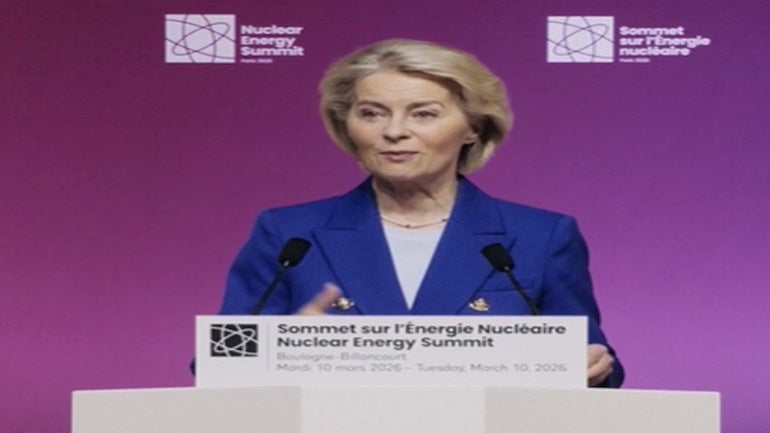
Read more: von der Leyen attacks EU nuclear rollback


