
Drones mounted with cameras and sensors are being used at the UK Atomic Energy Authority’s (UKAEA’s) Culham Campus for inspections of the JET (Joint European Torus) fusion research facility. JET is now in the early stages of being decommissioned and repurposed by the UKAEA, under the JET Decommissioning and Repurposing (JDR) programme.
Initially JET’s complexity precluded the use of drones but in October 2025 the first inspection drone flights took place. These began as a derisking exercise in the JET in-vessel training facility, then in the JET assembly hall, and finally around the exterior of the JET torus itself, in late November.
The flights were jointly conducted to gather data for the Robotics and Artificial Intelligence Collaboration (RAICo) UKAEA’s Remote Applications in Challenging Environments (RACE) and Italy-based Eni and EniProgetti, supported by RINA (formerly Registro Italiano Navale).
RAICo led a project to conduct inspection flights, to gather safety inspection data and establish the processes to support future inspections for decommissioning activities. The separate collaboration between RACE, Eni and EniProgetti, explored how they could use drones, alongside other inspection systems, to enable rapid checks of fusion devices and to help verify system readiness.
This aims to significantly shorten the time required for these assessments, a critical step for meeting the stringent reliability standards demanded by commercial fusion power plants. They were also keen to better understand the use of aerial drones for rapid inspection of fusion facilities, to complement ground-based inspection techniques.
The teams came together to conduct joint flights to meet their respective goals. To ensure safety, they conducted a detailed risk assessment, secured access permissions, completed local inductions and implemented safety measures, including post-flight contamination swabbing.
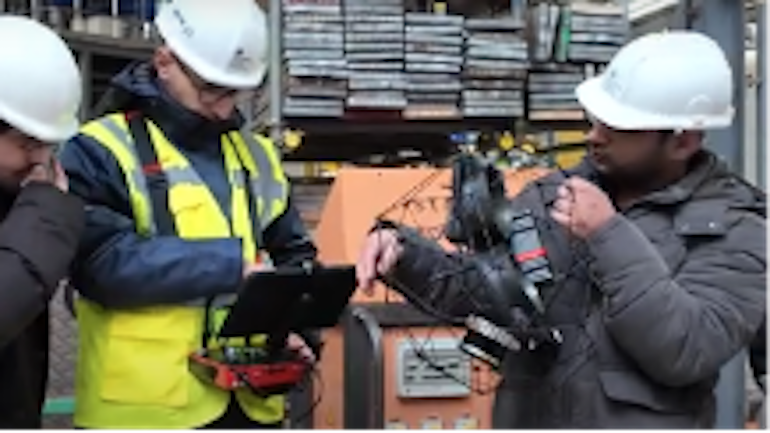
The flights used a Flyability Elios 3 drone which undertook more than 30 6-7-minute flights (the limit of a single battery) in the torus hall. The drone is equipped with built-in camera and LiDAR. Radiation sensors, added as a payload, enabled it to gather detailed data and high-resolution imagery. The drone was surrounded by a lightweight soft cage, allowing it to operate near sensitive structures without risk to itself or its surroundings.
The flights demonstrated that drones could operate for meaningful durations, manoeuvre safely in cluttered areas, and gather high-quality visual, spatial, and radiation data for inspection and planning.
The test also addressed key safety concerns. For example, drone propellers create downdrafts that disturb dust, which can lead to contamination risks. To address this, additional safety processes were implemented to mitigate potential health hazards. These measures built confidence among JDR stakeholders that the drones could be operated safely.
The RAICo team also used the opportunity to carry out a real inspection of high-up junction boxes, which highlighted minor maintenance issues.
These flights and the lessons learned pave the way for aerial drone use at JET, and in fusion engineering and decommissioning more widely. This aims to lead to enhanced situational awareness, reduced inspection time and downtime, and better data quality that can be easily integrated into a digital environment and artificial intelligence models. Their use also minimises the need for people to enter harmful environments.
According to UKAEA: “If adopted, drones could save time and money. For example, they would avoid the need to carefully erect scaffolding to inspect equipment at height, which is time-consuming in a controlled area. The initial inspection data captured from the flight, which has already improved one aspect of maintenance, hints at the wider potential.”
JET was a European project built and used collaboratively by European researchers. It is now owned, and in its last years operated by, the UKAEA, and used by scientists from 28 European countries to conduct research into the potential for carbon-free fusion energy in the future through work coordinated by the EUROfusion consortium. JET’s first deuterium-tritium experiments took place in 1997 and the final experiments using deuterium and tritium fuel were conducted in 2023, ahead of its retirement JET’s repurposing and decommissioning is expected to last until about 2040.


