The US Department of Energy’s (DOE’s) Office of Nuclear Energy (NE) has announced $50m in competitive funding over three years to revolutionise reactor cladding material. The opportunity focuses on accelerating the research, development, and fabrication to replace traditional metal tubes.
The aim is to support projects that can successfully fabricate 12-foot silicon carbide cladding fuel rods. These will undergo irradiation testing in research reactors to gather the data required for Nuclear Regulatory Commission (NRC) licensing and commercial deployment. Interested parties must submit their applications by 7 December.
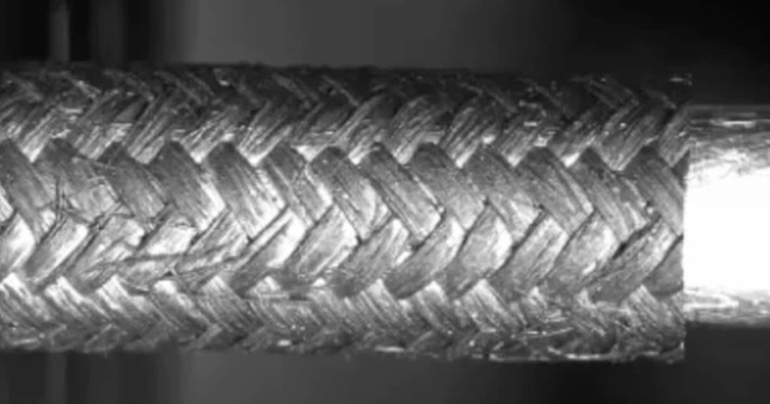
Traditional nuclear fuel rods rely on zirconium alloy or metal cladding to protect nuclear fuel pellets from reactor coolant. According to the NE, woven or braided strands of silicon carbide composite can withstand temperatures up to 3,800 degrees F – some 500 degrees F hotter than traditional metal cladding, dramatically improving a reactor’s safety margins, operational flexibility, and accident tolerance.
“The United States is home to the largest light-water reactor fleet in the world,” said Deputy Assistant Secretary of Nuclear Fuel Cycle Josh Jarrell. “Through this new funding opportunity, we’re excited to continue to work with industry on projects that can improve reactor performance and further enhance the safety of our country’s nuclear power plants, as well as inform the development of fuels to improve operational flexibility and reduce costs for future reactors.”
The US nuclear fleet is currently fuelled by uranium processed into small ceramic pellets and stacked into metal tubes (cladding), which are sealed at both ends to form fuel rods. Fuel cladding is a barrier between the reactor coolant and nuclear fuel pellets and is essential to protecting the fuel while also ensuring the safety of a nuclear power plant.
Accident Tolerant Fuel (ATF) technology represents a generational upgrade over traditional nuclear fuel systems, fundamentally altering how light-water reactors respond to severe conditions. The US approach divides into near-term (evolutionary) solutions, such as chromium-coated zirconium and chromia-doped UO2, currently undergoing commercial reactor testing, and longer-term (revolutionary) concepts undergoing deep R&D.
Silicon carbide is a “revolutionary” long-term ATF technology, along with advanced high-density fuels such as uranium nitride (UN). The US is currently leading the push toward commercialising SiC cladding, primarily driven DOE’s ATF Program and partnerships with national laboratories, while UN fuel is already under development in Russia for its fast reactor fleet.
In the US, General Atomics Electromagnetic Systems (GA-EMS) is the premier SiC developer with its patented SiGA engineered multilayer SiC composite cladding. The company has manufactured full-length 12-foot SiGA tubes and cleared major testing milestones
GA-EMS completed a 120-day loop of unfuelled SiGA rodlets under severe neutron flux in the Advanced Test Reactor at Idaho National Laboratory (INL). The rods showed zero structural degradation or mass loss. The company’s proprietary SiC joining method (for end-caps) was stress-tested for 180 days in a corrosive pressurised water reactor environment at Oak Ridge National Laboratory (ORNL) and remained completely gas-tight. Backed by a collaborative agreement with fuel vendor Framatome, GA-EMS is targeting full commercial reactor testing by 2028.
Ceramic Tubular Products (CTP), based in Lynchburg, Virginia, is developing high-purity SiC composite tubes for nuclear reactors, collaborating with national labs to scale up from 3-foot experimental samples to 12-foot commercial lengths.
Major fuel vendors such as Westinghouse and Framatome, maintain internal SiC R&D programmes, designing hybrid concepts and fuel assembly architectures designed to support ceramic rods once they are licensed by NRC.
Outside the US, the EU funded the SCORPION project specifically to address the manufacturing flaws of silicon carbide composite cladding. European research centres are focusing on solving early-stage material swelling under heavy radiation and improving the material’s compatibility with harsh coolant chemistry.
In Japan, Toshiba Energy Systems & Solutions is fabricating nuclear-grade SiC fuel rods. Concurrently, the Ministry of Economy, Trade and Industry (METI) sponsored rigorous loss-of-coolant simulations through Mitsubishi Nuclear Fuel. Tests proved that SiC components survived 1,200°C steam environments completely undamaged, while traditional Zircaloy rods ballooned and burst.


