
The US Department of Energy (DOE) has spent nearly $12m contesting worker compensation claims at the Hanford nuclear weapons site in Washington state, according reports by the International Business Times, ProPublica and Cascade PBS. Despite the state approving these claims, 152 cases remain trapped in lengthy federal appeals, leaving sick employees and their families without benefits.
Roughly half of the workers tied to the contested claims have already died while waiting for a final decision. State officials formally accepted the claims, but the federal government continues to use taxpayer funds to challenge them. The battle highlights a major breakdown between legal protections meant to help workers prove exposure and the federal agency’s resistance to paying out benefits.
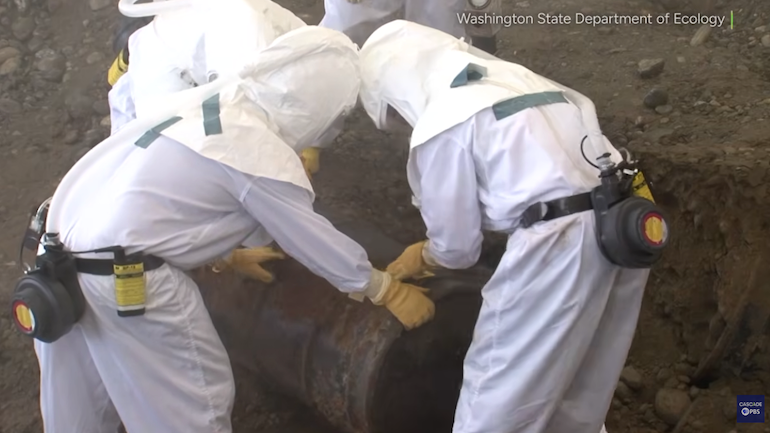
The Hanford site is the US’s largest and most complex environmental cleanup effort. For decades, workers handled plutonium and managed massive underground tanks containing radioactive sludge.
Between 1944 and 1989, Hanford’s nine nuclear reactors synthesised 74 tonnes of plutonium, roughly two-thirds of the total US stockpile. Five large onsite processing facilities (canyons) dissolved used uranium fuel to extract plutonium. This chemical extraction process left behind 56m gallons of highly toxic, chemically complex, radioactive liquid byproducts.
The waste, distributed across 177 underground storage tanks, is currently being moved from leaking single shell tanks to safter double-shell tanks to await final stabilisation via glass vitrification. To mitigate the risk of further leaks, crews use specialised robotic arms and high-pressure liquid sluicing to scrape, scour, and pump out the remaining solids from the ageing single-shell structures.
The primary health hazards and illnesses reported by workers include:
- Toxic vapor exposures – between 2014 and 2015, more than 50 separate chemical vapour releases or “burps” from the underground storage tanks directly exposed cleanup workers to highly toxic chemical mixtures.
- Neurological and brain damage – multiple workers, including former plutonium and tank monitor Lonnie Rouse, have been diagnosed with severe brain damage and central nervous system disorders tied directly to toxic chemical exposures.
- Respiratory illnesses and cancers – workers have developed severe lung diseases (such as chronic beryllium disease and silicosis) and various forms of radiation-induced cancer from exposure to airborne particles and radioactive materials.
In 2018, Washington lawmakers passed a unique “presumption law” specifically designed to aid sick Hanford workers. Historically, sick workers faced insurmountable hurdles trying to prove exactly which chemical or radiation spike caused their specific illness. The 2018 law amended this. If a worker develops certain cancers, lung diseases, or neurological illnesses after working in a high-risk area at Hanford, the state automatically presumes the work was responsible.
DOE resisted this law. The federal government sued, arguing the law was unconstitutionally discriminatory because it targeted a federal facility specifically. While the US Supreme Court ultimately struck down the original targeted bill in 2022, Washington state quickly countered by passing an expanded version that covers all radiological hazardous waste facilities across the state.
DOE nevertheless continues a strategy of blanket resistance. Investigations by ProPublica and Cascade PBS revealed that out of 102 new worker claims filed since 2023, DOE recommended zero for approval. When the state approved them anyway, DOE appealed all but seven of those decisions, lodging more than 500 total appeals since 2018.
The DOE spent nearly $10m on the outside law firm Wallace, Mann, Capener, Bishop & Debney between 2018 and 2025. Three physicians and an industrial hygienist collectively received more than $1.7m for testimony against Hanford workers since the law was introduced. One doctor received more than $200, from the department in 2025.
The spending covers legal representation and expert testimony used in disputes over workers’ claims. The figures do not, by themselves, establish that the department acted unlawfully, but they show the scale of the resources deployed to challenge compensation decisions.
DOE has declined direct interviews regarding the $12m spent on outside legal counsel and expert witnesses. However, their formal legal filings and public statements highlight their strategy. In official appeal documents, DOE has consistently argued that the workers’ severe illnesses are rooted in personal lifestyle factors rather than workplace toxins. They heavily attribute the medical conditions to smoking, alcohol use, obesity, and family conflicts.
A DOE spokesperson stated that the department strictly adheres to all relevant laws and maintains a core commitment to worker safety and protection, viewing the aggressive legal challenges as a necessary step to protect federal funds from “unduly high costs” imposed by state-level mandates.
The federal government’s legal pushback has sparked intense criticism from state officials and national whistleblower groups. Former Washington Governor Jay Inslee and State Attorney General Nick Brown have expressed profound frustration with the federal government’s “tremendous pushback”. State officials intended for the law to force the federal government to take accountability, rather than watch sick workers go bankrupt or die while waiting out decades of appeals.
Reports from advocacy organisations such as the Government Accountability Project highlight systemic interference within the Hanford claims programme. Their data shows that chemical exposure claims at Hanford are denied at triple the average rate of other self-insured employers, often using biased, independent medical exams that violate Washington state standards to force denials.
Dr Tim Takaro began treating Hanford workers in the early 1990s, a few years after the site’s mission shifted from making plutonium to cleaning up the waste. “The hazards at Hanford include some of the most toxic substances on the planet… back in the 50s and 60s, there was a lot of corners cut because the emphasis was on plutonium production and not so much on worker health and safety,” he said. “There is no treatment – you try to manage the symptoms.”
Lonnie Rouse spent nearly 20 years packaging plutonium and monitoring radioactive waste at Hanford. His claim was denied in 2009, but Washington approved it after the 2018 law took effect. DOE continued to appeal, contesting his entitlement despite a separate federal programme having approved benefits in 2010.
Rouse’s lawyers said he received most of his back pay in 2024. He has kept the money untouched while the dispute continues, and he requires round-the-clock care. Medical experts linked his neurological disease to chemical exposure at work. From 1998 to 2008, it was Rouse’s job to monitor the toxic waste held in the tank farms. The containers together hold more than 50m gallons of liquid waste. Rouse says he lost count of how many times tanks released toxic vapor that took his breath away, sometimes knocking him to the ground and making him vomit and bleed from his nose. According to a 2014 report funded by the federal government, tank farm workers exposed to chemical vapours commonly reported nausea, headaches and nosebleeds.
Isidoro Mata Jr, who spent nearly 30 years demolishing buildings at Hanford, was diagnosed with thyroid cancer in 2015. The state approved his claim in 2019, but DOE challenged the decision. It dropped its appeal in December 2020; Mata died less than three months later. The cases underline the difference between obtaining state approval and reaching a final outcome.
Hanford produced about two-thirds of the plutonium used in the US nuclear arsenal, including material for the bomb dropped on Nagasaki in 1945. Cleanup began after the site’s last reactor shut down in the late 1980s and is expected to continue until at least 2086. The ongoing appeals leave a central question for regulators: whether a compensation system intended to protect workers can deliver meaningful relief when approved claims remain contested for years.


