
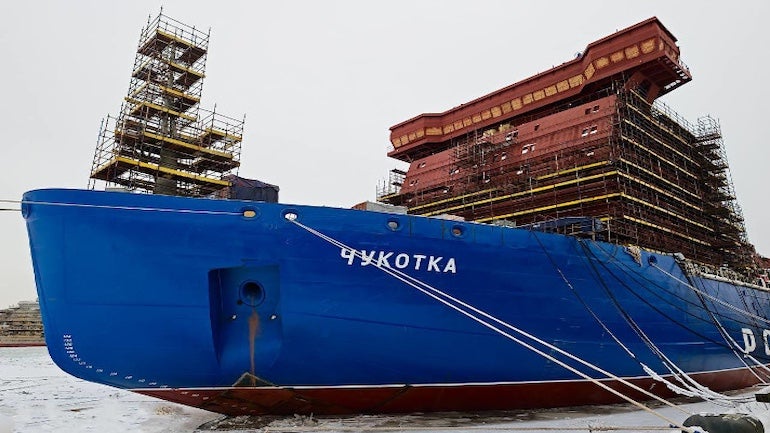
Shipbuilders at the USC Baltic Shipyard in Saint Petersburg successfully launched and tested two emergency diesel generators (ADGs) on Russia’s nuclear-powered icebreaker Chukotka. This is a critical phase of the vessel’s mooring trials, which began in late 2025.
Chukotka will have three 250 kWe generators that are designed to activate automatically if the emergency protection system of the RITM-200 powering the vessel is triggered. They provide immediate power for: emergency lighting and communication systems; critical pumping groups required for reactor safety; and the starting mechanisms for the larger back-up diesel generators that can take over full vessel power.
Each unit weighs 980 kg and is part of a multi-level autonomous power supply scheme designed to ensure crew and equipment safety during abnormal operating modes. Following the completion of mooring trials and instrument adjustments, the vessel will proceed to factory sea trials. The icebreaker is currently on track for delivery to RosAtomflot by December 2026.
Chukotka is the fifth vessel of Project 22220 (the Arktika-class), which includes the most powerful icebreakers in the world. The contract for the construction of Chukotka was concluded between FSUE Atomflot (part of Rosatom) and the USC Baltic Plant in August 2019 based on the results of an open competition. The laying of the icebreaker took place in December 2020 and it was launched in November 2024.
Meanwhile, specialists from the Nuclear Vessels Branch of the Russian Maritime Register of Shipping (RS) have completed an inspection of the Okean-22220 automatic control system, which is part of the electric propulsion system of Project 22220 universal nuclear icebreakers.
The system, developed at the branch of the Krylov State Scientific Centre – Central Research Institute of Marine Electrical Engineering (TsNII SET), was recognised as fully complying with the requirements of the RS rules and technical documentation. RS experts confirmed that the system ensures the required operating mode of propulsion electric motors without creating peak loads on the reactor and steam turbine units of the icebreaker. The ability to control one propulsion electric motor in emergency mode when operating from backup diesel generators was also tested.
A series of Project 22220 universal nuclear icebreakers is being built at the USC Baltic Shipyard. Arktika, Sibir, Ural and Yakutia have already been delivered to the customer. Chukotka, Leningrad and Stalingrad are at different stages of construction. The developer of Project 22220 is the Iceberg Central Design Bureau (part of the shipbuilding cluster of the Rosneft oil company). TsNII SET supplies the electric propulsion system.


