
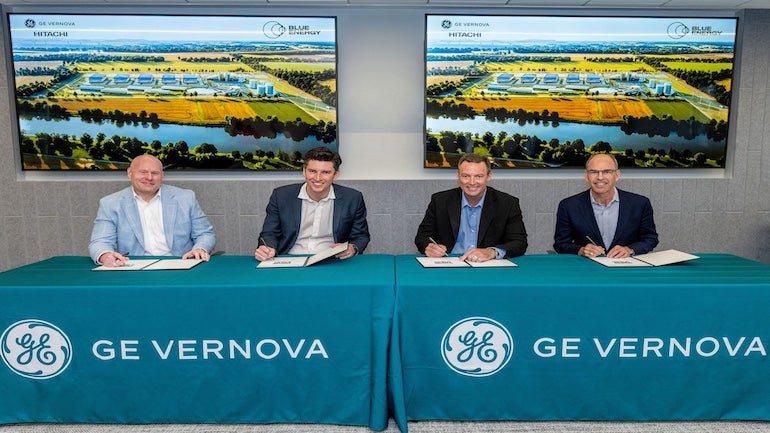
Texas-based start-up Blue Energy and GE Vernova Hitachi Nuclear Energy (GVH) have signed an agreement launching the next phase of their collaboration to deploy a 2.5 GWe gas-plus-nuclear power plant in Texas.
In November 2025, Blue Energy announced an agreement with AI infrastructure firm Crusoe through which it secured a site for an up to 1.5 GWe nuclear plant in the Port of Victoria, Texas, to power Crusoe AI factories on a nearby site. Blue Energy says its gas-to-nuclear conversion will see it power the proposed 1,600-acre Crusoe AI factory campus from 2028, with a transition to nuclear generation by 2031.
This agreement advances engineering design, licensing, and safety analysis of the Victoria, Texas, project that will deploy both GE Vernova 7HA.02 gas turbines and GVH BWRX-300 small modular reactors (SMRs), subject to a final investment decision in 2027.
This collaboration marks a pioneering shift toward hybrid digital infrastructure, aiming to resolve the historical bottleneck of multi-decade nuclear deployment timelines. The 2.5 GW Victoria, Texas facility is based on a staggered deployment strategy designed to generate near-term cash flow while navigating the rigorous nuclear regulatory framework.
In Phase 1 (2030), two GE Vernova 7HA.02 gas turbines will come online first. They will supply 1 GW of rapid baseload power directly to the nearby data centre campus. In Phase 2 (2032), the site will integrate up to five GE Vernova Hitachi BWRX-300 SMRs. This adds 1.5 GWe of carbon-free capacity to the facility.
Blue Energy, spun out from MIT’s Nuclear Science & Engineering Department in 2023, focuses on light-water SMRs. By integrating with established reactor vendors, Blue Energy can leverage existing regulatory progress to bring their plants to market faster. The company targets “next generation” reactors from established firms to ensure the technology is already familiar to the Nuclear Regulatory Commission (NRC). Their architecture is built specifically for the dimensions and passive safety requirements of modern SMRs.
Blue Energy’s integrated approach to prefabrication, transportation, and assembly – the Blue Way – builds on the standardised, modular design of the BWRX-300 to support execution certainty by enhancing schedule, costs and project delivery predictability through innovative logistics, off-site fabrication and super modules assembly. The first BWRX-300 is currently under construction at Ontario Power Generation’s Darlington site in Canada, with completion expected by the end of the decade.
“This agreement with GE Vernova Hitachi keeps Blue Energy confidently moving forward to build our nuclear energy production line that will unlock the promise of abundant nuclear energy,” said Jake Jurewicz, Blue Energy CEO and co-founder. “We are shifting from the old way of building large reactor nuclear power to instead do it the ‘Blue Way’ that slashes costs and time to power and finally makes nuclear a financeable, repeatable product.”
Blue Energy’s super-module concept envisages large modules of 1,000-tonnes or more being delivered with mechanical, electrical, and plumbing systems pre-installed. “It’s more than just bringing a bigger Lego piece to the site,” Jurewicz noted. “It’s about being able to wrap the risk and the guarantees and the warranties, and it drastically shortens the build time. It drastically shortens the risk.”
Eric Gray, CEO, GE Vernova’s Power segment, noted: “Meeting the surging demand for electricity requires proven, scalable technologies and the ability to bring them together as integrated solutions. Our work with Blue Energy combines GE Vernova’s flagship HA gas turbine technology with GE Vernova Hitachi’s advanced nuclear SMR technology, while supporting Blue Energy’s innovative project model. Together, we are establishing a blueprint for deploying reliable baseload power and at speed customers need.”


