
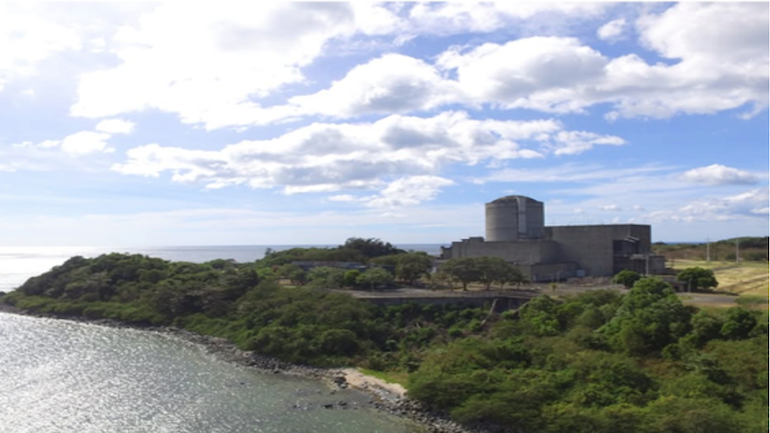
The proposed revival of the Bataan NPP (BNPP) in the Philippines is facing opposition after the Morong town council declared the area a nuclear-free zone. The municipal council approved a “Non-Nuclear Zone” ordinance on its third and final reading, according to the Nuclear-Free Bataan Movement (NFBM).
According to the Nuclear-Free Bataan Movement (NFBM), the local legislation effectively bans the construction, operation, and storage of nuclear facilities and radioactive waste within the municipality. The ordinance prioritised public health and environmental protection. It is in direct conflict with national government revival plans and marked a significant milestone for anti-nuclear groups.
The BNPP has remained inactive since its completion in the 1980s due to decades of deep-rooted community opposition over corruption, steep maintenance costs, and active geological safety hazards. While the national government has recently pushed to recommission the facility to address energy shortages, this municipal ordinance strengthens local legal power to reject nuclear energy in favour of safer, community-led alternatives. “This victory does not mark the end of the struggle but it is an important step forward in advancing a nuclear-free future,” NFBM said.
The history of the BNPP is a saga of geopolitical ambition, national debt, corruption allegations, and bad luck. Conceived as Southeast Asia’s first commercial nuclear facility, the $2.3bn facility was completed in 1984 but was never operated and has been mothballed for more than 40 years. It remains one of the most controversial infrastructure projects in Philippine history
The Philippines first began exploring nuclear capabilities in 1958 when the US supplied a small 1 MW open-pool general-purpose reactor under the Atoms for Peace programme. The Philippine Research Reactor-1 (PRR-1), commissioned in 1963, was designed entirely for scientific experiments, medical radioisotope production, and academic training.
The facility, operated by the Philippines Atomic Energy Commission, is located at the Philippine Nuclear Research Institute (PNRI) compound inside the University of the Philippines Diliman campus in Quezon City. In 1984, the government contracted US General Atomics to convert and upgrade it into a 3 MW TRIGA Mark III reactor, using a unique uranium-zirconium hydride (U-ZrH) alloy fuel.
Plans for a full-scale commercial NPP emerged during the 1973 global oil crisis. President Ferdinand Marcos Sr. used his Martial Law powers to decree the immediate construction of NPP at Napot Point in Morong, Bataan. Marcos overruled his own advisory panel, which favoured a detailed $700m bid from General Electric, to award the contract to Westinghouse Electric for a less detailed $500m proposal. It was later revealed that Westinghouse paid millions of dollars in “commissions” to Herminio Disini, a relative of the Marcos family, to broker the deal.
Due to severe inflation, systemic corruption, and delays, the cost of the 621 MWe reactor rocketed from $500m to $2.3bn accounting for a significant portion of the entire foreign debt at the time. Construction was severely disrupted by external events and rising local opposition. Following the partial nuclear meltdown at the Three Mile Island facility in the US, Marcos was forced to order an independent safety audit and freeze construction.
The audit uncovered more than 4,000 structural safety defects. Investigators found chaotic, uninsulated internal wiring, unstable high-pressure pipe brackets, and faulty valves. Critics accused Westinghouse of changing design paperwork rather than physically fixing the hardware. Protests intensified after volcanologists and geologists pointed out that the plant was built directly on the seismically active slopes of Mount Natib and near Mount Pinatubo, which erupted catastrophically in 1991 after being dormant for 500 years.
By 1985, the plant was physically complete, but escalating public protests and political instability prevented Marcos from loading the nuclear fuel. In February 1986, the People Power Revolution overthrew the Marcos regime and President Corazon Aquino, inherited the controversial facility. Two months later, the Chernobyl disaster occurred in Ukraine, cementing public fear of nuclear energy.
Citing unresolvable safety hazards and the rampant corruption tied to its origin, the Aquino administration mothballed the plant indefinitely. Despite never generating power, the Philippine government was legally bound to honour the international loans allocating taxpayer money to clear the debt until it was paid off in 2007. Since then, the National Power Corporation has spent an estimated $40-50m a year just on keeping the machinery preserved and air-conditioned.
The historical timeline of the BNPP has come full circle under President Ferdinand Marcos Jr, who is seeking to revive his father’s unfinished project to solve the country’s modern power grid crisis. The proposed revival faces two major hurdles: a complex legal tug-of-war between local and national laws, and severe, unresolvable structural and geological safety issues.
The national government can legally override the municipal ordinance, but it faces immense political friction and regulatory hurdles. In the Philippines, the Supreme Court has consistently ruled that local government unit ordinances cannot contradict national statutes or national policies. However, under the 1991 Local Government Code, municipalities have the power to protect public safety and the environment. Morong may argue that the national government cannot force an environmental hazard onto its populace without local consent.
Meanwhile, the Marcos government is pushing ahead with preparations for nuclear development. The Philippine National Nuclear Energy Safety Act was signed into law as Republic Act (RA) No 12305 (the PhilATOM law) in September 2025. This legislation marked the culmination of a nearly 20-year legislative effort to establish a formal framework for a domestic nuclear industry.
RA No 12305 introduces stringent safety policies aligned with International Atomic Energy Agency (IAEA) guidelines. PhilATOM has sole authority to approve or deny the siting, construction, operation, and decommissioning of all nuclear reactors. It mandates the creation of a national registry to account for, control, and document all radioactive waste and used fuel disposal sites. It introduces criminal liabilities for operating a reactor without a licence or mishandling nuclear material. It tasks the regulator with safeguarding nuclear facilities and sensitive digital materials against cyber-attacks and sabotage.
In early 2026, a joint order by the Food and Drug Administration (FDA) and PNRI launched the PhilATOM Transition Committee to transfer regulatory functions from PNRI to the new independent agency (PhilATOM) created by the new law. Historically, PNRI was seen as compromised because it had to both promote and regulate nuclear technology. PhilATOM will act as a strictly independent safety regulator.
However, the framework still lacks finalised Implementing Rules and Regulations (IRR). This has led to minor bureaucratic confusion between the Department of Energy (DOE) and PhilATOM regarding who legally controls initial tasks such as site selection.
Although Morong’s local ordinance can be overridden by the new it nevertheless creates a massive legal and political roadblock that cannot simply be ignored by a signature in Manila. The national government would have to navigate a complex web of legal, operational, and social hurdles to push the Bataan revival project through.
While the national government holds the ultimate legal authority to decide the fate of the Bataan plant, there is also the possibility that the independent regulator, PhilATOM, could itself block the Bataan revival due to the strict safety criteria written directly into RA 12305. For example, RA 12305 mandates that nuclear sites cannot be located in areas classified as high-risk for natural hazards. Because the Bataan plant sits on a volcanic fault line next to Mount Natib, PhilATOM’s own rigorous safety assessments might force them to reject the site.
The law requires strict compliance with international safeguards and environmental impact assessments. BNPP has been sitting idle for over 40 years. While the core reactor has been kept in pristine condition through costly annual maintenance, the structural concrete shell has been exposed to salty coastal air and tropical elements for decades, leaving its structural integrity highly questionable.
Morong’s ordinance acts as an official, legal expression of non-consent from the host community. Forcing a nuclear plant to operate inside a town that has legally declared itself a “Non-Nuclear Zone” is politically explosive. It invites injunctions, protests, and prolonged litigation in the Court of Appeals.
Because of the high localised resistance in Bataan, the Department of Energy is now prioritising 16 alternative potential nuclear sites across the Philippines. Many of these are looking at installing small modular reactors (SMRs) in communities that are far more welcoming to the technology.


