
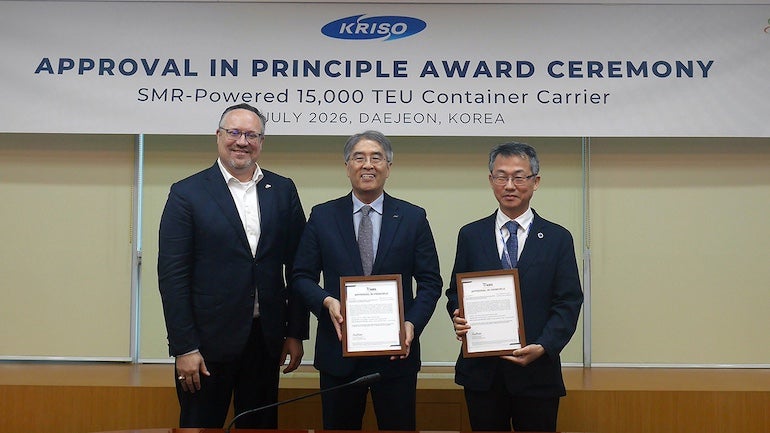
The American Bureau of Shipping (ABS) has approved in principle a conceptual design for a nuclear-powered 15,000 TEU (Twenty-foot Equivalent Unit – a standard unit of measurement used in the shipping industry) containership developed in collaboration with the Korea Research Institute of Ships and Ocean Engineering (KRISO) and the Korea Atomic Energy Research Institute (KAERI).
This transitions nuclear propulsion technology out of the military sphere and into mainstream global commerce. The KRW29bn ($19.5m) project was developed through a multi-party South Korean partnership linked to the national K-Moonshot programme – an ambitious, multi-billion-dollar national science and technology initiative launched by the Ministry of Science and ICT to leverage artificial intelligence (AI) and advanced engineering to solve 12 grand national challenges by 2035.
KAERI developed the core MARINA marine Molten Salt Reactor technology. KRISO & Samsung Heavy Industries collaborated on the high-speed hull form, structural systems layout, and automated power management control systems.
The vessel design is powered by two small modular molten salt reactors (MSRs) using liquid fuel salt operating at low pressures, virtually eliminating the risk of high-pressure explosion accidents. The Energy Storage System (ESS integrates an onboard ESS to store surplus energy and dynamically manage fluctuations in electricity demand. The design features a Neo-Panamax hull dimension optimised to transit the expanded Panama Canal while maintaining a high service speed of 25 knots.
By completely replacing traditional diesel engines, massive fuel oil tanks, and exhaust funnels, the design frees up considerable internal volume to maximise container storage space. The dual reactors are strategically positioned in the centre of the vessel to shield them from wave impacts and drastically reduce the risk of structural breach during a collision.
The Approval in Principle from ABS formally confirms that the technical soundness, safety framework, and engineering feasibility comply with international maritime safety codes. This follows a separate structural endorsement from the UK’s Lloyd’s Register. The consortium has already validated the ship’s behaviour using scaled model tests in deep-ocean engineering basins. They will now proceed into basic and detailed engineering design phases, aiming to finalise the ship-reactor interface for eventual full-scale commercial demonstration.
“Nuclear has the potential to fundamentally alter commercial shipping in vessel design, operating range and energy economics. ABS is focused on building the technical and safety framework needed to support that, and this AIP with KRISO and KAERI is a concrete part of that work,” said Patrick Ryan, ABS Senior Vice President and Chief Technology Officer.
The collaboration builds on ABS’s broader work with Korean partners to advance nuclear applications for marine and offshore assets, including a memorandum of understanding signed with KRISO in 2025 to cooperate on nuclear-powered ships and floating nuclear power platforms.
“SMR-powered ships are a next-generation technology that will determine the future competitiveness of the shipping industry, and securing design technologies suited to the marine environment is above all essential to making them a reality, said KRISO President Keyyong Hong. “KRISO will continue to enhance the marine applicability of nuclear-powered vessels through R&D in ocean engineering and international cooperation, and strive to help Korea lead related technologies and international standards.”
Jinyoung Cho, Senior Vice President of KAERI, noted: “KAERI will continue to refine the interface between the MSR system and the vessel, enhancing the design to address the unique operating conditions of ships, and pursue testing and demonstration of key technologies to support the commercialisation of SMR-powered vessels.”
Cho Jin-young, head of KAERI’s Advanced Reactor Research Institute, said, “This is an important milestone for the K-Moonshot project’s mission to develop a molten salt reactor-based SMR ship.” He added, “Based on the world’s best nuclear technology and shipbuilding industry competitiveness, it will become a foundation for leading the next-generation zero-carbon ship market.”


