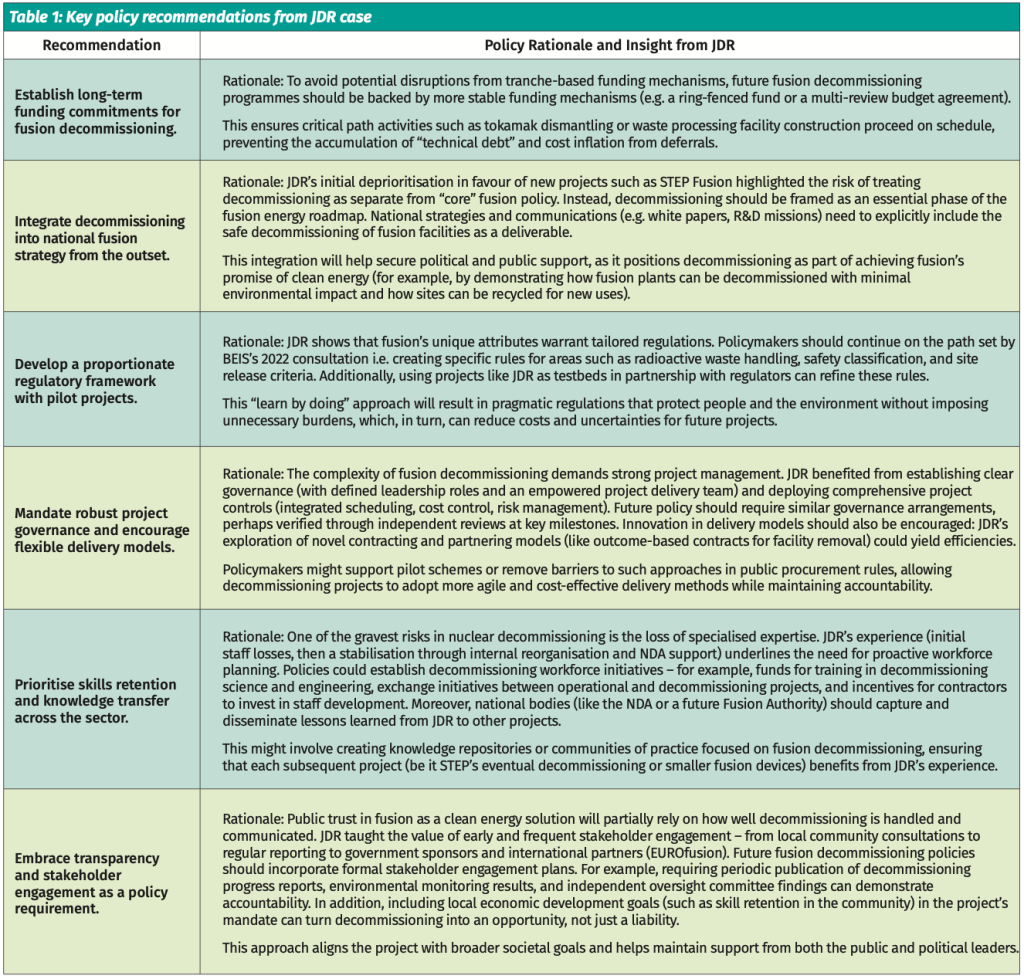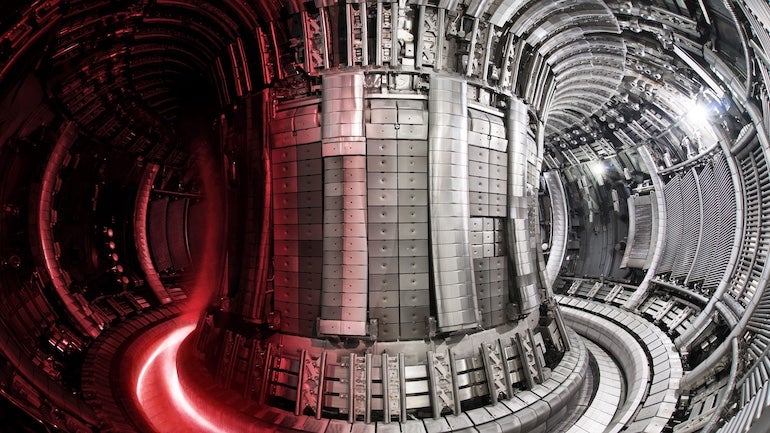
The Joint European Torus (JET) Decommissioning & Repurposing (JDR) programme offers important insights for shaping future fusion decommissioning policy. It is the first full-scale effort to dismantle a deuterium-tritium fusion research machine since the Tokamak Fusion Test Reactor (TFTR) at the Princeton Plasma Physics Lab was dismantled in 2002. Operated by the UK Atomic Energy Authority (UKAEA) for nearly 40 years, JET delivered its final experimental pulses in 2023 and then entered a decommissioning phase projected to last until 2040. Ahead of JET’s transition into decommissioning at the start of 2024, the UKAEA presented four strategic costed options to the UK’s Department of Energy Security and Net Zero (DESNZ), a reflection of the complexity not just to take apart the UK’s largest tokamak but also remediate the site. By late 2027, the DESNZ aims to identify a proportionate mechanism to ensure costs for decommissioning can be met by fusion operators. JDR’s progress can potentially help to inform and influence such a mechanism.
Policy factors
A key contextual factor is JDR’s tranche-based funding model, tied to periodic government Spending Reviews. Funding is allocated in multi-year segments, with budgets reconsidered each cycle. This has both positive and negative effects on the programme. Positives include developing an agility in planning and delivery; improving accuracy in budgetary forecasting (and thereby building credibility and reputation with policy-makers and key stakeholders); and entrenching a data-driven approach to cost-benefit analysis work to inform decisions around what to proceed with, to defer, or to cancel. However, there are also inherent risks, not least an inability to develop longer-term workforce planning; potential loss of institutional knowledge that would bring efficiencies and cost savings over an extended period; and reducing the likelihood of technological and scientific research covering multiple tranches. From a policy perspective, having a culture of comprehensive, transparent and honest communications between the delivery body and sponsors is essential. This helps to achieve a balance between short-term and longer-term funding requirements, minimise seismic shifts in strategic direction, and support consistency and workforce retention.
National priorities have also evolved, particularly with the UK’s commitment to build a prototype fusion power plant – STEP Fusion – by 2040. As part of its Net Zero and Innovation strategy, the government is investing £2.5bn ($3.4bn) over five years in fusion R&D, including £1.3bn ($1.7bn) for STEP and £932m ($1.3bn) for the UKAEA. In a fiscally challenging environment, this commitment – which continues a theme established by the previous government – reflects the belief in Whitehall that fusion can provide baseload power in the future and stimulate regional and national economies.
This focus on future commercial fusion has, at times, overshadowed the decommissioning of JET. However, policy must recognise that decommissioning is an integral life cycle stage, essential for regulatory compliance and capturing knowledge that will inform future fusion facilities.
Political and regional considerations also influence support. The decision to site STEP Fusion at West Burton, not Culham, aligns with successive government’s stated desires to create opportunities and prosperity across the country. This illustrates how fusion decommissioning programmes may face fluctuating political emphasis, making it vital for JDR to demonstrate the agility to align with shifting, as well as more static national objectives. This could include the changing priorities of an individual party or prime minister, as well as the more established goals related to net zero and regional economic development.
JDR involves a wide range of stakeholders. The UK Government expects the programme to deliver safely, efficiently, and cost effectively. Regulators require compliance with health, safety, and environmental standards; local communities and industry partners seek transparency and economic opportunity. JDR’s application of the Mitchell et al. (1997) stakeholder salience model showed that high power stakeholders also have legitimate and urgent claims, emphasising the need for sustained engagement. Future policy should formalise more expansive governance and engagement mechanisms, such as oversight boards or regular public reporting.
The policy implications of the JDR experience span across several themes: tranche based funding, political dynamics, regulatory development, stakeholder engagement, knowledge retention, and technological innovation.
JDR analysis and lessons for policy
JDR’s environment is strongly shaped by political priorities. Government focus on STEP Fusion and global fusion leadership has, at times, diminished the visibility of JET’s decommissioning. Policy statements and R&D investments underscore fusion’s importance to the UK’s long-term clean energy ambitions. JDR’s Political, Economic, Social, Technological, Legal, and Environmental (PESTLE) assessment identified shifting government priorities and spending constraints as high impact uncertainties requiring contingency planning. Economically, JDR faces challenges typical of nuclear projects: inflation, supply chain volatility, and the historical trend of nuclear clean-up projects exceeding initial budgets. Furthermore, it has been repeatedly demonstrated that short-term political concerns influenced by the electoral cycle will take precedence over the longer-term planning and delivery cycles associated with decommissioning. These factors reinforce that funding mechanisms must avoid short-termism. Deferring activities such as waste processing or delaying contractor mobilisation can lead to higher overall costs. A dedicated decommissioning fund — similar to arrangements used by the UK Nuclear Decommissioning Authority — would help prevent disruptive re-scoping and maintain stable progress.
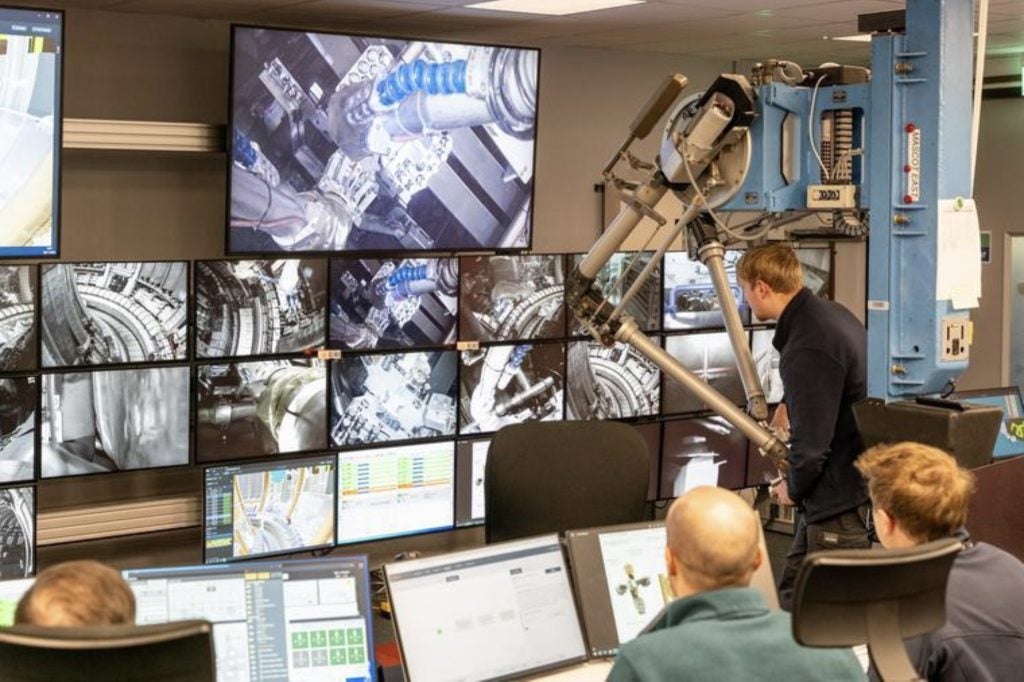
Technological pressures include the national focus on STEP Fusion, which redirected some innovation resources away from JDR. Originally intended as a “lead and learn” programme for remote handling, tritium removal, and waste minimisation, JDR has reduced R&D due to budget constraints. Policy should ensure that essential decommissioning R&D, particularly work that can deliver long-term safety or cost benefits, remains protected.
On the social side, human capital is critical. JDR’s SWOT analysis identified the risk of losing experienced staff due to retirements and transfers to other projects, as evidenced by the significant efforts required by the UKAEA to retain a cadre of subject matter experts after JET plasma operations ended. Knowledge retention has been a major focus for JDR with specific projects undertaken to retain knowledge. However, uncertainty in funding has made long term workforce planning difficult. Future policy should require explicit strategies for skill retention and development. Meanwhile, JDR’s strengths include the UKAEA’s deep operational expertise, strong safety culture, and existing site infrastructure that supports decommissioning activities. Opportunities include establishing the UK as a leader in fusion decommissioning, shaping proportionate regulatory approaches, and demonstrating circular economy principles. However, weaknesses include areas such as accountability, regulatory uncertainty, and competition for talent all complicate delivery.
Governance structures
Moving from operational culture to a decommissioning mindset required significant organisational change. JET’s historical culture was hierarchical and driven by research, whereas decommissioning demands agility, cross functional collaboration, and value-for-money decision-making. JDR has introduced integrated planning meetings, safety stand-downs, and more visible leadership engagement to successfully foster a unified identity. Governance structures have also been streamlined. Policy oversight should encourage programmes to demonstrate appropriate governance and transition plans.
Fusion decommissioning in the UK is governed under a proportionate, bespoke Environment Agency (EA) regulatory framework, distinct from fission licensing. JDR and UKAEA projects such as H3AT and LIBRTI will provide additional opportunities to develop policy, whether to do with machines or tritiated material, thus providing practical experience to inform future regulatory development, particularly around waste classification and site clearance criteria. Continuous collaboration between the project and regulators should be embedded in future policy, potentially through regulatory sandboxes or advisory committees.
JDR’s early investment in integrated project controls enabled rapid scenario analysis following the SR25 budget reduction. A detailed Integrated Master Schedule, comprehensive cost baseline, earned value management, and active risk monitoring allowed informed decision-making and transparent communication with stakeholders. External reviewers commended JDR’s project controls as a major strength. Given the complexity of fusion decommissioning, policy should require similar controls, including integrated schedules, transparent cost baselines, and periodic reviews.
Key success factors and the future outlook
Despite constrained resources, JDR is continuing to focus innovation on a limited number of high impact technologies such as improved information management, remote handling and waste treatment processes. Formal collaboration with the UK’s Nuclear Decommissioning Authority (NDA) and informal networking with our peer organisations within the decommissioning sector has accelerated knowledge exchange. Policy should support such partnerships and provide dedicated innovation funding streams protected from core decommissioning budget pressures.
JDR contributes to national net-zero objectives via environmental stewardship – by minimising waste, recycling materials, and recovering tritium to maintain fusion’s credibility as a clean energy source – and by enabling future technological development through timely and effective decommissioning. By releasing space and infrastructure at Culham, JDR creates the conditions for new research, industrial activity, and innovation to take place, similar to how site clearance at West Burton enables the delivery of STEP. While this land‑release argument applies less directly to legacy nuclear sites constrained by long‑lived high‑level waste, similar principles are relevant for sites without such burdens, where decommissioning can actively support regeneration and technological reuse. Policy strategies should therefore formally acknowledge decommissioning as a value‑creating activity within the UK’s energy, industrial, and innovation goals, rather than treating it solely as an end‑of‑life obligation.
Although JDR’s revised plan has increased delivery confidence, challenges remain. Delays mean that high hazard components will remain in place longer, increasing overhead costs and requiring ongoing system maintenance. Workforce retention will remain a priority. Should future Spending Reviews allow targeted investment to accelerate critical work, that would likely reduce long-term liabilities.
A 2025 Government Gateway Review rated JDR amber/green, recognising strong planning and risk management. JDR is also exploring innovative contracting models that may offer lessons for similar future projects.
The JDR programme demonstrates that successful fusion energy development requires the same robust end-of-life strategies seen in more established energy-producing settings. Lessons from JDR highlight the importance of stable funding, clear governance, regulatory learning, knowledge retention, and targeted innovation. Policymakers should integrate decommissioning into fusion strategy from the outset to ensure safe, efficient, and sustainable delivery across the full life cycle.