
Since its widespread emergence over the last decade, much of the nuclear industry has viewed AI with some scepticism. Discussions surrounding AI have broadly centred on productivity tools. Where it does have application, the thinking goes, it would serve largely as an administrative tool capable of searching documents, summarising reports or generating text. Within the nuclear industry, where regulatory oversight, engineering discipline and quality assurance remain paramount, such applications have naturally been regarded with a degree of caution. Safety-critical engineering demands deterministic answers rather than probabilistic suggestions, and no utility or reactor vendor is prepared to compromise decades of engineering practice simply because a new generation of software has emerged.
Dispelling that myth, a recently announced collaboration between the US Department of Energy (DOE), Idaho National Laboratory (INL), Microsoft and Everstar demonstrates that AI can already do considerably more. Using Everstar’s Gordian platform, the team converted a preliminary documented safety analysis for the DOE’s Generic High-Temperature Gas reactor into documentation structured around US Nuclear Regulatory Commission (NRC) licensing requirements. For a task that traditionally requires a specialist team working for four to six weeks, this exercise saw a 208-page document drafted in a single day. Perhaps more significantly, the system also identified missing technical information and found inconsistencies in the source documents rather than simply generating text.
Against that backdrop, the project represents an important milestone, not because it demonstrates AI writing documents more quickly, but because it illustrates how carefully engineered AI systems can begin performing meaningful technical work within one of the world’s most heavily regulated industries. However, for Everstar founder and CEO Kevin Kong, impressive though it is, this kind of licensing application is almost incidental.
“It is only the surface of what we do,” he tells NEi. For Kong, the real objective is far larger, as he explains: “We don’t sell one workflow or one point solution. We sell the ability to do nuclear-grade work at machine speed.”
Much of today’s discussion surrounding AI centres on replacing knowledge workers through large language models.
Kong argues that the assumption that AI is limited to finding, assessing and reproducing information more quickly fundamentally misunderstands both artificial intelligence and nuclear engineering. “AI is not one black box that does one thing well,” he says. “It is many different capabilities. Pattern recognition, language, reasoning, vision and action.” More importantly, nuclear engineering cannot rely on probabilistic answers. Engineering calculations must always remain deterministic. “AI coordinates the work,” Kong explains, adding: “It doesn’t perform deterministic physics calculations itself.”
Instead, Everstar has built what Kong describes as an orchestration layer capable of combining engineering codes, simulation tools, regulatory requirements, operating experience and design documentation into a single reasoning framework. The objective is not simply to answer a question but to reveal the complete decision framework surrounding that question. The result is a system that he says can understand how engineering decisions propagate throughout an entire nuclear programme and can lead to far more profound changes within the nuclear engineering sector. As an example, he posits an engineering team decides to increase the diameter of a reactor pipe by five centimetres. An apparently straightforward engineering change, this seemingly modest modification would traditionally trigger months of engineering reviews. Heat transfer calculations must be revisited, the thermal hydraulics change, material stresses require reassessment, the manufacturing capability must be verified, supplier availability changes, construction schedules shift, licensing implications must be reviewed—a whole raft of follow-on engineering work stems from this single modification. However, using AI, this becomes a different story as months of work can be compressed into the space of a few hours. Rather than merely highlighting documents to review, AI platforms perform much of the engineering work themselves, execute the required calculations through deterministic software, identify downstream impacts and produce the associated engineering and regulatory documentation. Perhaps equally as important, it identifies where information is still missing. “What used to take multiple teams over many months can now be compressed dramatically. The system performs as much of the work as it can, then it tells you exactly what information is still required,” Kong explains. This distinction separates engineering AI from conventional generative AI in which large language models excel at summarising existing information. Engineering decisions require something fundamentally different.
The Everstar platform combines regulatory documents, engineering standards, design codes, proprietary customer data and validated physics models into what Kong describes as long-horizon reasoning. Rather than answering isolated questions, the platform traces consequences across multiple engineering disciplines simultaneously.
Where a design modification might affect manufacturing, licensing, procurement, operations and maintenance, previously understanding these interactions depended largely upon individual experience and numerous specialists. According to Kong, AI provides what he calls “a single pane of glass” across those decisions.
Perhaps surprisingly though, Kong believes AI’s greatest contribution today is not generating new engineering work but identifying mistakes already embedded within existing documentation. The company now supports approximately 10% of the operating US nuclear fleet, identifying procedural inconsistencies and documentation errors that human reviewers had overlooked for customers, including Southern Company, NuScale and others. “We’re now finding better rigour and correction of human error,” Kong says. In one example, he notes that maintenance procedures contained copied references to incorrect plant equipment. This apparently minor clerical error can trigger unnecessary work orders and significant operational inefficiency. According to Kong, the platform has already identified errors capable of creating an additional six- and seven-figures in operational costs through unnecessary maintenance activities, duplicated work orders and procedural inconsistencies. Indeed, recognising the benefits of the system one unnamed utility has, Kong says, progressively expanded its use of the system from reviewing hundreds of operating procedures to more than 100,000. “We’re finding fatal flaws in documentation simply because people relied on human judgement,” he observes. AI is thus not just making existing engineering and associated documentation faster; it is also improving the quality of the engineering.
Licensing is only the beginning
While the DOE demonstration remains an important validation of the platform given the generated documents were independently reviewed for technical accuracy, consistency, completeness and regulatory compliance – for Kong, any questions about whether AI can be trusted are becoming outdated.
“We’re well past needing validation,” he says, noting that attention is now shifting towards how broadly AI can be deployed across the nuclear sector in which licensing is just one application within a much larger engineering ecosystem. As Kong observes, the same reasoning capabilities that support regulatory submissions can also assist engineering design, operational procedures, quality assurance and future manufacturing. However, while much of the focus of new build constraints is on licensing reform, Kong believes this misses the real barrier to timely development. “The NRC is moving much faster right now,” he says, adding: “Regulations are not your bottleneck.” Instead, he identifies three key structural challenges: “The engineering, the labour, the supply chain, that’s what doesn’t exist in the Western sphere.” Kong argues that even if every advanced reactor received regulatory approval tomorrow, the industrial ecosystem required to manufacture and deploy them simply does not yet exist at the required scale.
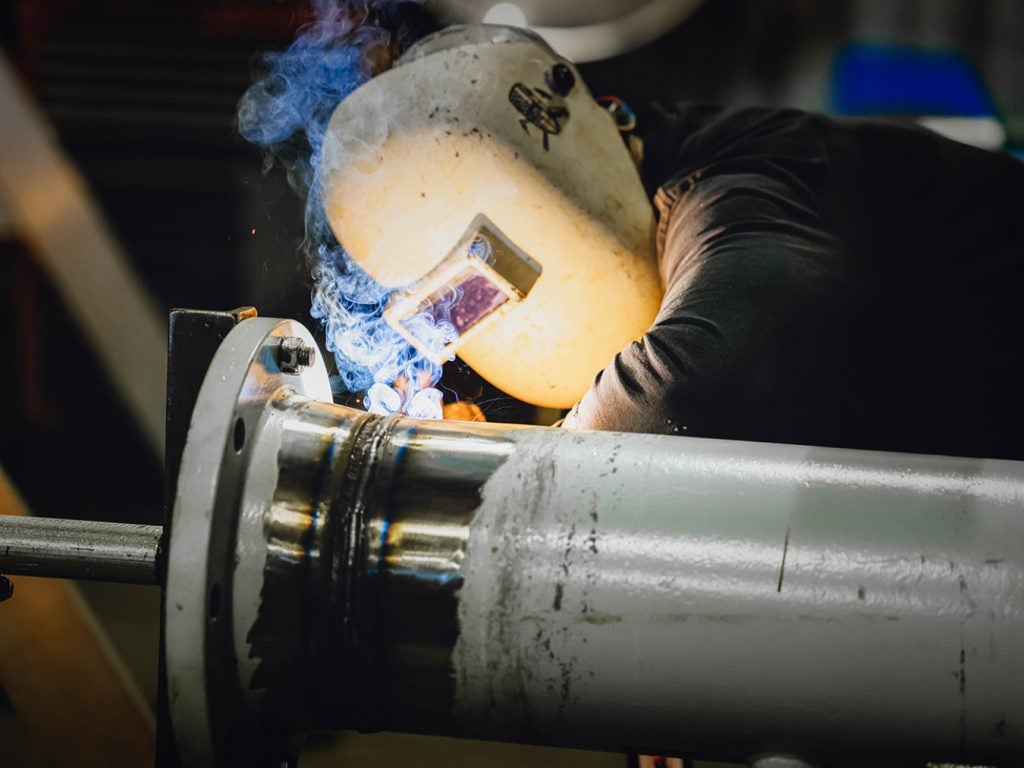
It is recognition of this fundamental bottleneck that is behind the company’s longer-term strategy. Rather than engineering software, the company instead intends to extend AI infrastructure across the full reactor lifecycle. Kong notes that heavy industrial production remains one of the least automated sectors of the economy and large structural modules such as pressure vessels and reactor components continue to depend heavily upon skilled human labour. He sees significant scope for AI tooling in diminishing this bottleneck in areas such as autonomous welding, for example.
While nuclear component manufacturing offerings differ from traditional industrial robots, which operate within highly structured production lines, using computer vision, LiDAR and AI reasoning, robotic systems can understand and operate within complex three-dimensional environments. “Such systems can identify weld seams, determine torch geometry, adjust heat input and compensate dynamically for changing conditions,” Kong says. In effect, they are designed to replicate expert human nuclear welders. This is a significant development given Western nuclear industries already face an acute shortage of skilled trades and need to rapidly ramp up the workforce if tripling nuclear capacity by 2050 is to become a reality. Demand forecasts suggest hundreds of thousands of additional skilled workers may be required if such ambitious reactor deployment targets are to be achieved, and conventional training routes alone may prove insufficient. As Kong says: “It takes three years of apprenticeship to become a nuclear-grade welder. You don’t grow those humans on trees.” Under these circumstances, automation becomes essential rather than optional. Nonetheless, human expertise remains indispensable where AI-enabled manufacturing allows experienced specialists to supervise increasingly capable robotic systems instead of performing every task manually. Kong is emphatic that human expertise remains central. In his vision, experts define engineering requirements, AI accelerates execution, and experts validate the results.
This also mirrors the approach demonstrated during the DOE licensing exercise, where AI generated the documentation before experienced nuclear specialists performed detailed review. Rather than eliminating engineers, AI allows them to spend less time assembling information and more time making engineering decisions.
AI as industrial infrastructure
Beyond helping to address the availability of skilled personnel, Kong also envisions even more applications for AI engines. He sees highly automated manufacturing facilities producing reactor components that are currently constrained by global supply chains as a logical step forward. Rather than manufacturing every component, the company intends to focus specifically on critical bottlenecks such as large forgings, structural modules and other components, but the objective is to use AI to remove potential supply chain constraints before they become the limiting factor for reactor deployment. “The factory floors and the robots will all be operated using our AI,” Kong says, outlining a world in which computer vision identifies weld seams, sensor fusion interprets the surrounding environment using LiDAR and other inputs and AI systems, determine torch position, weld angle and power settings while avoiding collisions with neighbouring equipment. The objective is not laboratory demonstrations, but autonomous production of large nuclear-grade structures measured in tens of metres rather than centimetres. He explains that prototype systems are already entering physical testing following extensive simulation work.
While such a manufacturing environment is undoubtedly ambitious, Kong views sophisticated AI-enabled automation as unavoidable if Western nations intend to rebuild large-scale nuclear construction capability. Every year without sustained reactor construction erodes industrial capability further, sees supply chains weaken further, experienced workers retire, and specialist manufacturers leave the sector. Meanwhile, construction costs continue to rise, prolonging projects as a result. “The nuclear renaissance is not happening by default,” Kong says, adding: “I don’t think it’s a 90% probability.” Indeed, he estimates its likelihood at considerably less unless decisive action is taken. “The Western world is not moving down the learning curve,” he warns. Nonetheless, Kong is equally clear that no single company can deliver a nuclear renaissance alone. He argues that governments, suppliers and industry must coordinate investment around shared priorities.
Looking further ahead, Kong believes the convergence of engineering AI, autonomous manufacturing and industrial automation ultimately creates an entirely new deployment model for nuclear energy. In the scenario that factories become progressively more efficient, construction schedules become increasingly predictable, engineering decisions become data-driven rather than document-driven, and manufacturing continuously improves through accumulated operational learning.
For Kong, the objective is to deliver standardised nuclear plants with the speed, repeatability and cost reductions associated with modern manufacturing rather than traditional megaproject construction. Whether that vision ultimately materialises remains uncertain, but it is increasingly clear that AI’s role within nuclear engineering is rapidly expanding beyond document automation.
Certainly, the DOE demonstration shows that AI can already compress weeks of gruelling licensing work into just a few hours. Ultimately though, licensing may prove to be the easiest problem to solve on the road to building a highly functional industrial nuclear ecosystem in which AI becomes the nuclear operating system. In this future, AI connects design, analysis, manufacturing, quality assurance and construction into a single industrial platform able to build nuclear power at scale.


