
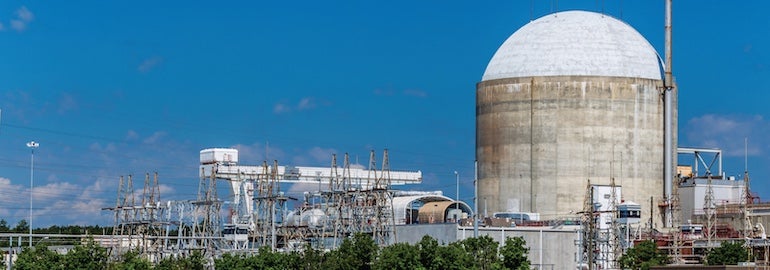
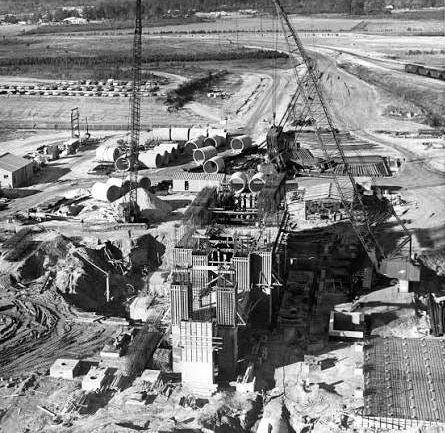
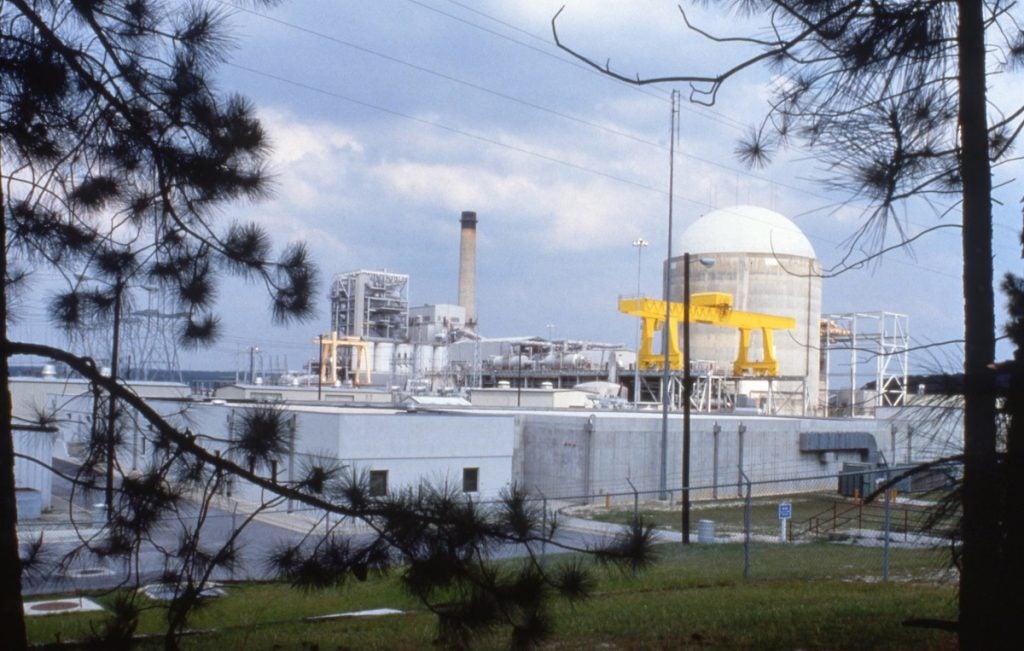
When the HB Robinson nuclear plant in Hartsville, South Carolina, US, was commissioned in 1971 it was the first commercial nuclear power plant (NPP) in the south-eastern US and the largest NPP in the world. It had taken just over four years to build, from the start of construction in April 1967.
In April 2026, when the Nuclear Regulatory Commission (USNRC) issued a second licence renewal for the plant, it highlighted another milestone: it was described by the USNRC as the “fastest licence renewal review in agency history and the first completed under new federal timelines aimed at accelerating nuclear energy decisions”.
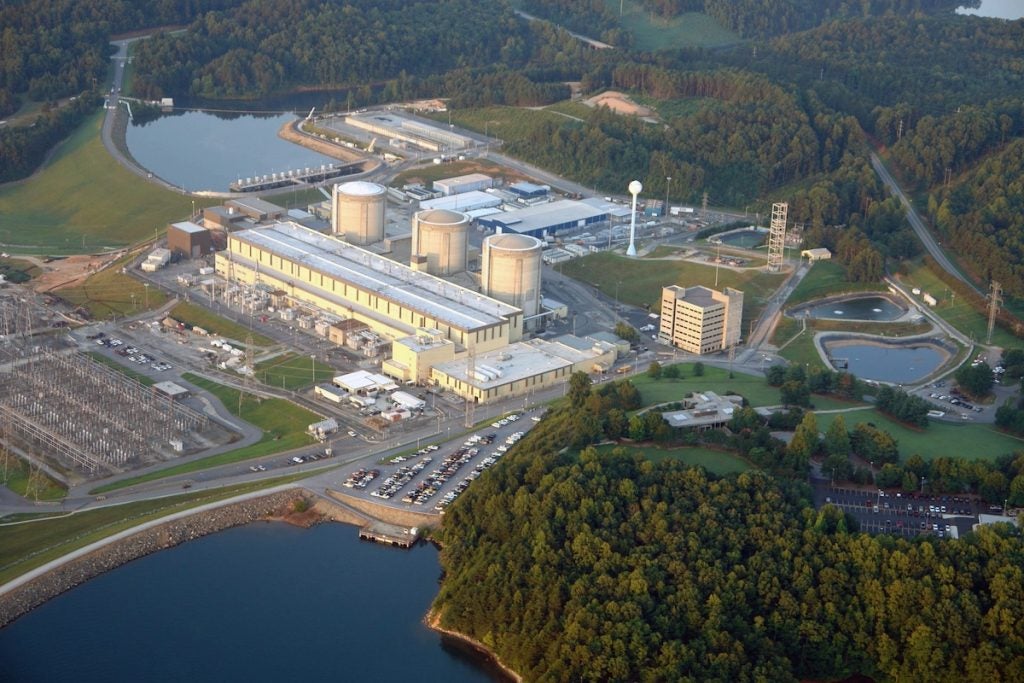
HB Robinson is a three-loop Westinghouse pressurised water reactor (PWR) rated at 759MWe and 2339MWt. The plant’s single PWR is operated by Duke Energy Progress and it is the second nuclear facility in Duke Energy’s fleet to receive a second licence renewal. Oconee Nuclear Station received its second renewal in March 2025. Duke Energy’s nuclear fleet provides around 51% of customers’ energy needs in the Carolinas. Under the Atomic Energy Act of 1954, the NRC staff issue initial operating licences for commercial power reactors for 40 years, but this term was based on economic and antitrust considerations rather than on technical limitations. Regulations allow for licence renewals and there are no limitations in the Atomic Energy Act or regulations on the number of times a licence may be renewed. Each renewal extends the initial 40-year licence for up to 20 years of operation. Given the initially expected 40-year service life, some plant or equipment may have originally been engineered for that period. The NRC’s subsequent licence renewal (SLR) safety review has to verify that the applicant has identified ageing effects that could impair the ability of structures and components (SCs) within the scope of SLR to perform their intended functions, and to demonstrate that these effects will be adequately managed during a period of extended operation. The NRC issued HB Robinson with its initial operating licence on 31 August 1970 and renewed the operating licence on 19 April 2004. Under that initial licence extension it would close by 31 July 2030. The second 20-year renewal extends the plant’s authorisation to operate to July 2050, in which case the South Carolina plant will have generated power for 80 years.
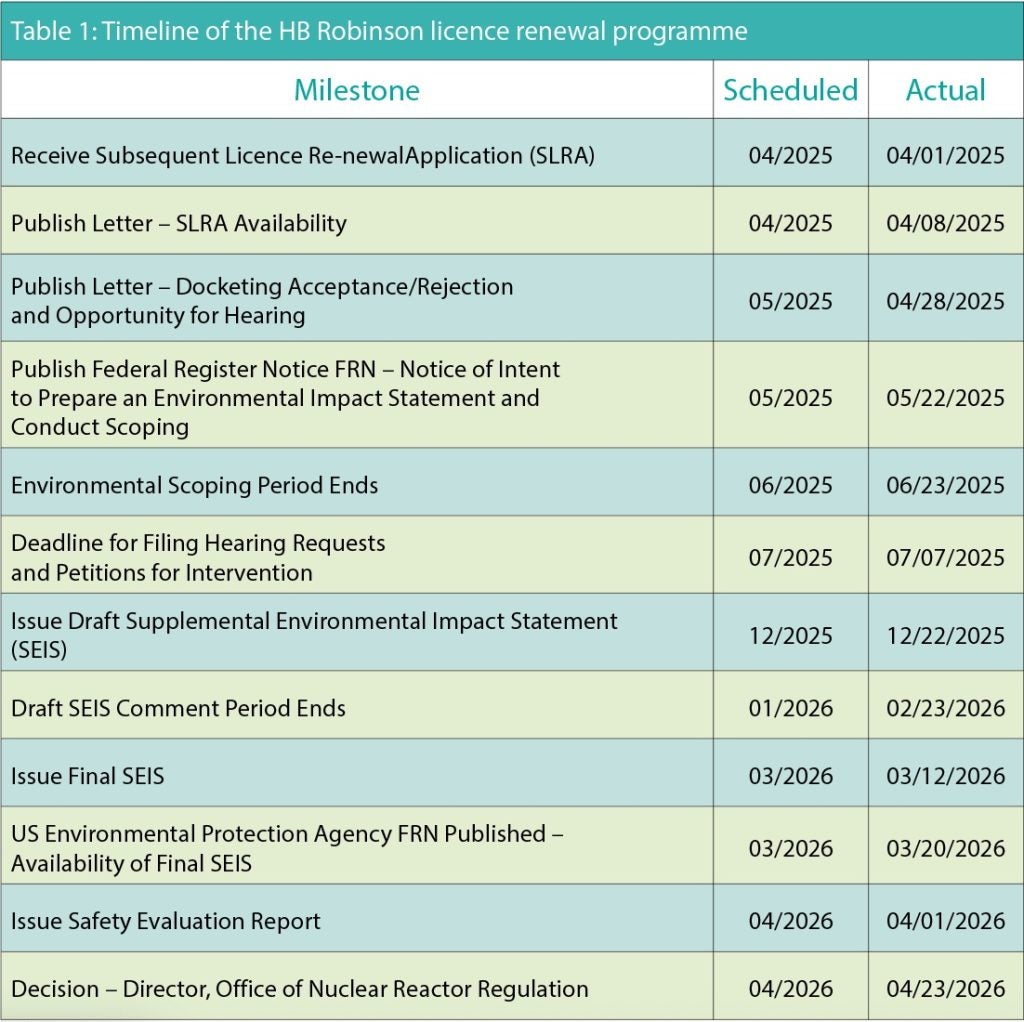
The review was completed within the 12-month time frame established by Executive Order 14300 (see tables), cutting six months from the NRC’s previous 18-month schedule. NRC said it had achieved this partly by conducting its review on parallel tracks, issuing a final supplemental environmental impact statement in March 2026 and a safety evaluation in April this year. NRC chairman Ho K Nieh said: “By focusing on essential factors for sustained nuclear power plant safety and applying lessons learned from past renewals, our team was able to work efficiently while maintaining their commitment to enabling timely safety decisions.”
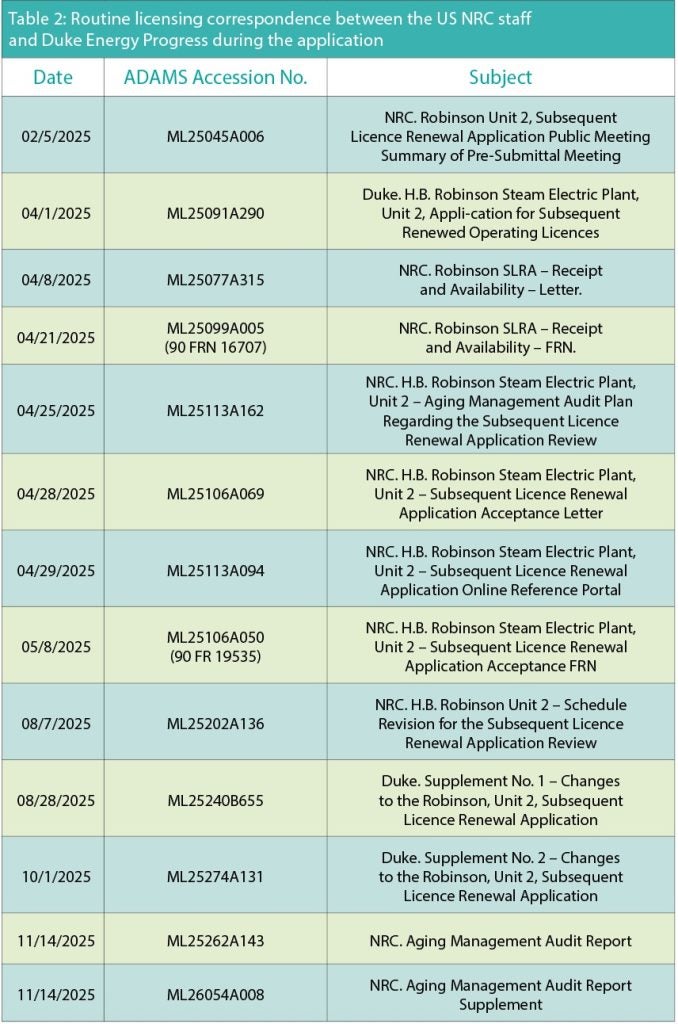
Duke used the process defined in the 2017 Generic Aging Lessons Learned for Subsequent Licence Renewal (GALL SLR) Report, which summarises NRC staff approved ageing management programmes (AMPs) for many SCs. The NRC said: “If an applicant commits to implementing these staff approved AMPs, the time, effort, and resources for subsequent licence review application SLRA review can be greatly reduced, thereby improving the efficiency and effectiveness of the SLR review process.” The report is also a quick reference for applicant and staff reviewers.
Renewed licence
Both initial and subsequent licence requirements for power reactors are based on two principles:
- The regulatory process is adequate to ensure that the licensing bases of all currently operating plants maintain an acceptable level of safety with the possible exception of the detrimental ageing effects on the functions of certain systems, structures, and components and a few other safety related issues during the period of extended operation.
- The plant specific licensing basis must be maintained during the renewal term in the same manner, and to the same extent, as during the original licensing term.
Active equipment is adequately monitored and maintained by existing programmes and is not subject to an aging management review (AMR), because ageing effects can be readily identified and corrected through existing programmes.
A licence renewal applicant must identify SCs subject to an AMR, which are those that perform an intended function without moving parts, or without a change in configuration or properties, and are not subject to replacement based on a qualified life or specified time period. The applicant must demonstrate that the effects of ageing will be adequately managed and the SC functions will be maintained during extended operation. The NRC staff evaluated the applicant’s AMRs for components subject to one in six SC categories:
- Reactor vessel, internals and reactor coolant system
- Engineered safety features
- Auxiliary systems
- Steam and power conversion systems
- Supports for containments, structures, and components
- Electrical and instrumentation and controls.
An example of the licence application examination was concerned with the Dry Agent Suppression System. This gaseous fire suppression system is designed to support safe plant shutdown and is used in specific switchgear relay rooms and in the Hagan Relay Room adjacent to the control room. Components of the fire suppression system are passive and long-lived, so they are subject to an AMR.
Extensive review by the NRC staff was followed by a virtual audit with Duke staff to discuss fire protection scoping and screening topics. The staff discussed breakout session audit questions, interviewed Duke personnel and examined supporting documentation. During the discussion, Duke staff addressed NRC staff’s questions about whether various Dry Agent Suppression System components were within the scope of SLR and subject to an AMR. These components included:
- Clean agent fire suppression system storage bottle
- Pressure regulator
- Accumulator
- Valve body
- Clean agent distribution manifold.
These components are replaced based on condition monitoring in accordance with approved facility procedures and are treated as consumables; therefore, they are not subject to an AMR. However, they remain part of Robinson’s maintenance programme, which includes periodic functional testing at the required frequency.
Duke staff indicated that the Robinson clean agent system does not include pressure regulator or accumulator. However, their valve body and distribution manifold are required for compliance with fire protection regulations and subject to an AMR. Clean agent cylinders for the Dry Agent Fire Suppression System undergo regular inspection and replacement as required by NFPA 2001 and therefore are not subject to an AMR.
The NRC staff concluded that HR Robinson appropriately identified the Dry Agent Suppression System components within the scope of SLR and the system components subject to an AMR.
In its final report the NRC staff compared 48 AMPs (nine new and 39 existing) with the NUREG 2191 GALL-SLR Report. It found 15 consistent with GALL-SR, 28 consistent with enhancement, three consistent with exception and one consistent with exception and enhancement. One was not applicable. One example is the Buried and Underground Piping and Tanks programme. The staff examined 19 enhancements to this existing programme.
Several enhancements refer to additional inspection:
- An inspection method that has been demonstrated to be capable of detecting cracking when inspections of uncoated stainless steel piping are performed.
- Inspect controlled low strength material backfill for cracking that could admit groundwater to the external surface of the embedded pipe.
- Additional inspections when measured pipe wall thickness, projected to the end of the subsequent period of extended operation, does not meet the minimum pipe wall thickness requirements due to external corrosion.
- Visual inspections of buried steel piping in the fuel oil system at least once every ten years. Visual inspections of at least one ten-linear-foot section of buried stainless-steel piping in the primary and demineralised water makeup system at least once every ten years.
- Visual inspections of at least two ten-linear-foot sections of underground coated steel piping in the condensate or service water systems at least once every ten years.
- Visual inspections of at least one ten-linear-foot section of underground uncoated stainless steel piping in the auxiliary feedwater, chemical and volume control, condensate, primary and demineralised water makeup, or service water systems at least once every ten years.
- Visual inspections of the concrete encapsulated components in the north service water header.
Renewing the licence
A licence renewal application must include an Updated Final Safety Analysis Report (UFSAR) with a summary description of the applicant’s programmes and activities for managing the effects of ageing. Time limited ageing analyses must be identified and updated for the period of extended operation, demonstrating that these analyses will remain valid, that the analyses have been projected to the end of the period or that the effects of ageing will be adequately managed.
The requirements for licence renewal are described in 10 CFR Part 54. One section, ‘Contents of application – technical specifications’, requires that the SLRA include any changes or additions to the technical specifications that are necessary to manage ageing effects during the period of extended operation. Duke stated that no changes to technical specifications are necessary for issuance of a subsequent renewed operating licence and the NRC staff found that this statement adequately addresses the requirements.
An item is considered to be open if the NRC staff have not determined that the item meets all applicable regulatory requirements. After reviewing the SLRA, including additional information the staff identified no open items. An item is considered confirmatory if the staff and the applicant have reached an acceptable resolution that meets all applicable regulatory requirements but, at the time of the issuance of this SE, the staff had not received the necessary documentation to confirm the resolution.
After reviewing the SLRA, including additional information, the staff found no confirmatory items exist that require a formal response from Duke. After reviewing information submitted up to 1 October 2025, the NRC staff deemed two licence conditions appropriate:
- Following the staff’s issuance of the subsequent renewed licence, Duke has to include the UFSAR supplement (containing a summary of programmes and activities for managing the effects of ageing and an evaluation of time limited aging analyses) in its next periodic UFSAR update
- Duke is required to complete future activities described in the UFSAR supplement no later than six months before the beginning of the subsequent period of extended operation and must also notify the NRC in writing when it has completed those activities. Unless modified in accordance with 10 CFR 50.59, the programmes and commitments described in the UFSAR supplement remain in effect during the subsequent period of extended operation.


