
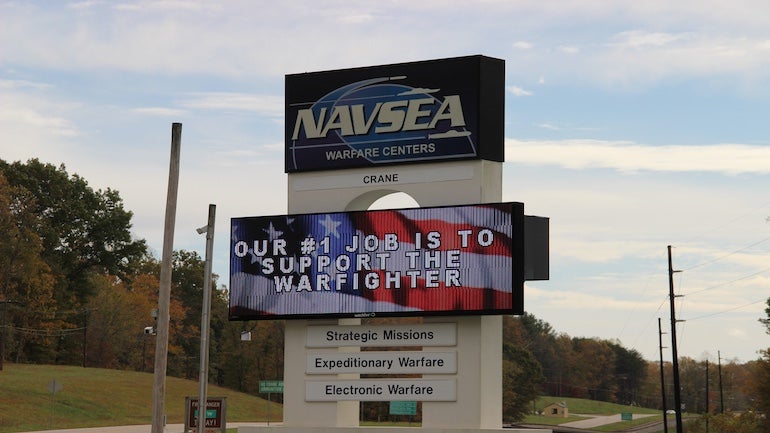
The US Department of War (DOW) plans to install a Micro Modular Reactor (MMR) at Naval Weapons Station (NWS) Crane in Indiana by September 2028. This action implements President Trump’s May 2025 Executive Order 14302, Deploying Advanced Nuclear Reactor Technologies for National Security and Reinvigorating the Nuclear Industrial Base, which aims to restore American nuclear leadership globally, remove barriers to innovation, and rebuild the domestic nuclear workforce.
NWS Crane is the third-largest naval installation in the world. The base conducts research, development, testing and engineering related to military systems, with a focus on electronic warfare, strategic missions and expeditionary warfare.
MMR installation will be executed through the Army’s Janus Program, in coordination with the Department of the Navy, the Department of War Innovation Unit (DIU), the Office of the Assistant Secretary of War for Critical Technologies (OASW(CT) and the State of Indiana. This cross-service effort brings together the Army’s role as the Department’s executive agent for installation nuclear energy, the Navy’s operational mission at NWS Crane, DIU’s access to commercial innovation, and the Department’s critical technology enterprise.
DOW said this “marks the first step in a larger, unified Department-wide effort to deploy safe and secure nuclear power for national security”. The MMR installation will provide reliable, around-the-clock power independent of the commercial electric grid, capable of sustaining critical operations under the most demanding conditions. As the first power-producing reactor installed in Indiana, this project expands US power generation capacity and modernises the energy infrastructure needed to serve local communities and advance missions critical to national security.
OASW(CT) is leading the coordination of key stakeholders across the Department to integrate and execute the Crane project under the Janus Program. “At Critical Technologies, we start from a simple first principle: a technology matters only when it reaches the mission,” said Mike Dodd, Assistant Secretary of War for Critical Technologies.
He added: “Our standard is to field and deploy capability within 24 months or less. President Trump’s Executive Order gave the Department a clear mandate to move advanced nuclear power from promise to deployment. We turned that mandate into a focused sprint within our Contested Logistics Critical Technology Area to deliver this capability on time and on target, strengthen the American nuclear industrial base, and secure a decisive advantage for our warfighters.”
The Department will continue to work with Federal, state, and local partners throughout the required safety, environmental, regulatory, and installation processes. DOW said nuclear safety, physical security, cybersecurity, and responsible stewardship of taxpayer resources will remain central at every stage.
The specific commercial supplier for the for Crane has not been publicly named by DOW. The official announcement explicitly outlines that while the reactor will be commercially owned and operated, no specific vendor has been selected. Eight different advanced nuclear companies remain qualified to compete for military microreactor projects.
The Janus Program in August finalised $2.2bn in agreements across five primary private contractors to construct and deploy more than 20 microreactors at five Army bases. These include Antares Nuclear (Fort Bragg – North Caroline), BWXT Advanced Technologies (Fort Campbell- Kentucky), General Atomics Electromagnetic Systems (Fort Hood – Texas), Radiant Industries (Fort Benning – Georgia) and Westinghouse Government Services (Fort Drum – New York).
The selected private vendor for NWS Crane is expected to be finalised as the project progresses through the mandatory safety, environmental, and regulatory review phases ahead of the September 2028 deployment target. The choice of Crane was primarily driven by a need meet Trump’s ambitious deadline to deploy a first reactor on a military base by 30 September 2028.
“Time had priority for us… looking at site selection,” Michael Dodd, told reporters. “The site selection was less about, ‘are we going to connect it to an AI data centre or a DE [directed energy] system or power parts of the critical infrastructure,’ [than] ‘where could we actually meet those timelines?’.” He added: “We needed a delegation that was going to lean forward and work with us very collaboratively in order to do that. Indiana and the governor and our delegation were just tremendous.”
He admitted that, in the race to deliver on deadline, some major technical issues remain to be determined. “You may be getting a little bit in front of where we are in the process,” he said when asked about the advanced design. “We have not released yet the Commercial Solutions Opening … or begun any sort of source selection, down-selecting…. Our announcement … is really first and foremost that we’re going to meet the president’s executive order [deadline]…. “We know from an R&D standpoint where these companies are in terms of their ability to deliver an SMR [small modular reactor]. We think we’re going to get there by ’28.”
He stressed that just getting agreement on a site is a big achievement, after decades of stymied nuclear power projects across the United States. “This is not a simple thing…. We have made it impossible to build a nuclear reactor…. You have to get regulatory approval for those things, and that’s not been an easy process in this country.”


