
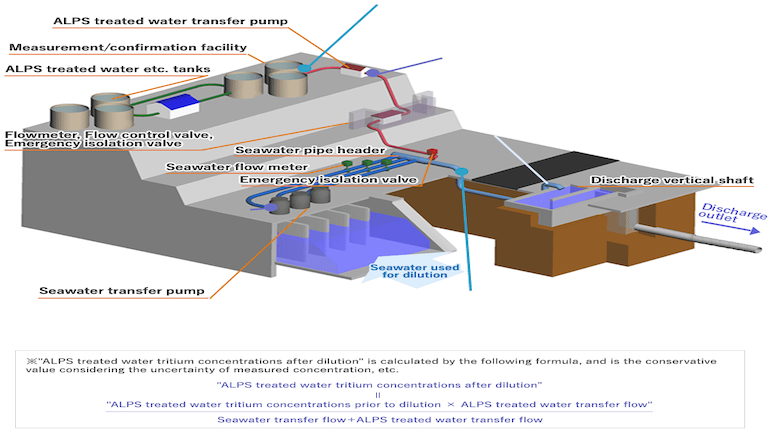
Tokyo Electric Power Company Holdings (Tepco) has begun another discharge to the sea of nuclear-contaminated wastewater from the damaged Fukushima Daiichi NPP – the 23rd such release since the operation began in 2023. Tepco said about 7,800 tonnes of wastewater containing approximately 1,200bn becquerels of radioactive tritium will be released into the ocean. The discharge, the fifth round in fiscal 2026, is scheduled to continue until 18 September.
The International Atomic Energy Agency (IAEA) confirmed that the tritium concentration in the Advanced Liquid Processing System (ALPS)-treated water is far below Japan’s operational limit and consistent with international safety standards.
The ALPS system removes 62 types of radionuclides, except for tritium (3H), a radioactive isotope of hydrogen. In addition, carbon-14 (C-14), potassium-40 (K-40), strontium-90 (Sr-90), iodine-129 (I- 129), and some isotopes of caesium (Cs) and plutonium (Pu) remain in the water, albeit in smaller quantities.
According to Tepco, the storage tanks at the Fukushima Daiichi plant still hold about 1.235m tonnes of nuclear-contaminated water.
As part of its ongoing safety review, IAEA independently tested samples from the latest batch before it was released into the ocean. Analysis at the site showed that tritium levels were far below Japan’s operational limit of 1,500 becquerels per litre and met international safety standards.
Japan has so far discharged roughly 173,000 cubic metres of ALPS-treated water in batches since August 2023. The IAEA has confirmed that the tritium levels in the first 22 batches were far below the operational limits set by Japan. IAEA continues to maintain a presence at the site and to carry out ongoing monitoring and verification activities throughout the discharge process.


