
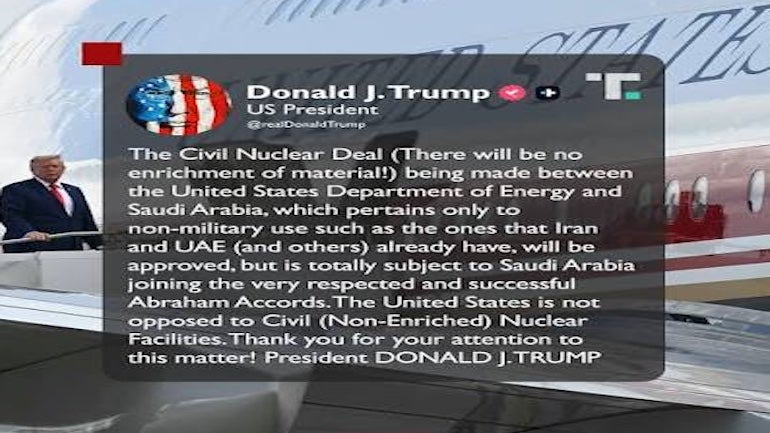
US President Donald Trump, in a post on Truth Social, walked back the terms of the recently signed civilian nuclear cooperation agreement with Saudi Arabia. Trump said the agreement is “totally subject to Saudi Arabia joining the very respected and successful Abraham Accords” namely on Saudi Arabia formally recognising the state of Israel.
This was a condition insisted upon by previous US administrations, which Saudi Arabia had refused to accept. It was Trumps’ decision to drop this condition which enabled Saudi Arabia to sign the agreement, which had enabled Saudi Arabia access to an enrichment facility on its territory. However, Trump’s post also said: “There will be no enrichment of material!” adding that the United States supports civilian nuclear energy without uranium enrichment, citing countries that operate nuclear power plants using imported fuel.
This change of policy is reportedly due to pressure from Israel and its supporters in the US congress, as well as from those who criticised the original deal arguing that it undermined non-proliferation safeguards.
Trump’s remarks clarify the terms of the agreement signed on 22 July by US Energy Secretary Chris Wright and Saudi Energy Minister Prince Abdulaziz bin Salman. The accord, concluded under Section 123 of the US Atomic Energy Act, establishes a framework for up to 30 years of civilian nuclear cooperation and positions American companies to play a leading role in developing Saudi Arabia’s nuclear energy infrastructure.
White House Press Secretary Karoline Leavitt confirmed the administration’s revised position, saying the agreement would not proceed unless Saudi Arabia joins the Abraham Accords. She described the deal as consistent with Trump’s “America First” agenda, arguing that it would create jobs for US companies, expand American energy exports, and strengthen strategic partnerships while maintaining strict non-proliferation standards.
Israeli Prime Minister Benjamin Netanyahu’s office said: “Saudi Arabia’s joining of the Abraham Accords would be an historic leap forward for peace in the Middle East.” Agriculture Minister Avi Dichter, who formerly headed Israel’s Security Agency, wrote on X: “A civilian nuclear programme isn’t what Israel wants to see, but it seems that it doesn’t have the ability to prevent it.”
Saudi Arabia is unlikely to accept these new conditions, given the tense geopolitical situation in the region and the renewed exchange of military strikes between the US and Iran. Laura Rozen, an independent journalist covering foreign policy, quoted a Saudi source as saying the deal was not subject to alteration. “It was signed. So nothing to renegotiate,” Rozen quoted the source as saying. “Tweets don’t overturn signed agreements.”
Netanyahu has long sought a normalisation deal with Saudi Arabia and to include it within the Abraham Accords first brokered by Trump in 2020. The United Arab Emirates, Bahrain and Morocco are among the countries which have signed the Accords. However, Saudi Arabia has consistently insisted that a prerequisite for it joining the accords is recognition of Palestinian statehood or at least significant progress toward that goal.
The agreement must still undergo a mandatory 90-day congressional review period before it can legally take effect, giving lawmakers ample time to debate the conflicting terms.


