
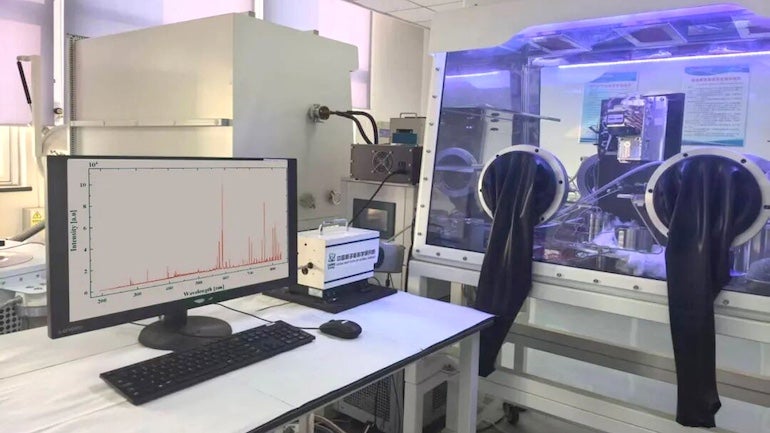
The China Atomic Energy Institute (CIAE) has reported significant progress in the development of instruments for online monitoring of sodium fast reactor coolant. The institute’s specialists created a prototype of a device based on laser-Induced Breakdown Spectroscopy (LIBS). For the first time in world practice they carried out a quantitative analysis of trace concentrations of oxygen and iron – key controlled impurities in liquid sodium – using this technology. The development was published in the Journal of Analytical Atomic Spectrometry.
Sodium fast reactors are one of the priority areas for the development of Generation IV reactor technologies in China. One of the most important tasks of ensuring their safe and effective operation is prompt and highly accurate control of the content of impurities in the liquid sodium used as a coolant.
The laser-induced emission spectroscopy method enables analysis to be carried out without preliminary preparation of samples, combining the processes of sampling and measurement in a single system. As a result, the technology has significant advantages for continuous monitoring of the coolant of sodium fast reactors.
However, carrying out a quantitative analysis of micro-impurities in high-temperature liquid sodium is a complex scientific and technical task. The accuracy of measurements is significantly affected by the high chemical activity of liquid sodium, the formation of sodium aerosols and splashing of the melt.
To solve these problems, specialists from the Institute of Reactor Engineering at CIAE developed the online monitoring system based on the LIBS method. The installation is the first to use an innovative method of directed gas purging, which effectively eliminates the influence of sodium aerosols and melt splashes on measurement results.
In addition, using the capabilities of an accredited laboratory of the China National Accreditation Service for Conformity Assessment (CNAS), the researchers independently solved one of the most difficult problems – developing technology for producing standard samples of liquid sodium with micro-concentrations of impurities. This made it possible, for the first time to construct calibration dependencies for determining the content of controlled impurities in liquid sodium using laser-induced emission spectroscopy.
The next stage of the project will be the creation and testing of an engineering prototype of the device. This is expected to provide significant support for the modernisation of coolant analysis and control systems for fast neutron reactors with liquid metal coolant, and will also form the necessary technological groundwork for promising new generation integrated sodium fast reactor projects.


