
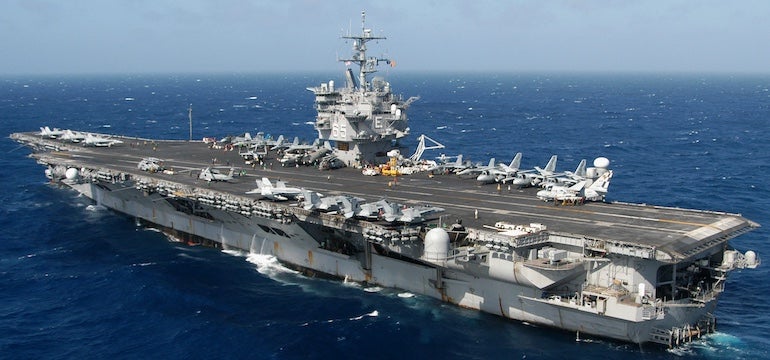
The US Navy has awarded a $418m contract to Vermont-based NorthStar Maritime Dismantlement Services for the dismantling of the world’s first nuclear-powered aircraft carrier, the USS Enterprise (CVN-65). The final cost of the work turned out to be approximately $118m less than had previously been estimated. Work will take place in Mobile, Alabama, and is expected to be completed by September 2030, following a re-competed contract after a 2026 court-ordered protest.
NorthStar originally won the dismantlement work in June 2025 with an initial contract worth $536.7m, partnering with Modern American Recycling & Radiological Services in Mobile to handle the physical teardown. Waste Control Specialists in Andrews, Texas took on disposal of the low-level radioactive and mixed hazardous waste at a federally licensed site. However, a rival bidder protested against the decision, arguing that a malfunction on the government’s procurement website had blocked their proposal from being submitted until several hours after the deadline. The US Court of Federal Claims upheld the complaint and ordered the Navy to reopen the entire award process.
NorthStar won the contract again, but this time with a 22% lower bid. The Navy structured the deal as a firm-fixed-price contract, meaning NorthStar agreed to complete the entire job for that set amount regardless of final cost.
The USS Enterprise, commissioned into the fleet in 1961, was the only aircraft carrier in history to be equipped with eight nuclear reactors. This gave the carrier exceptional capabilities but has significantly complicated its eventual decommissioning.
Over the course of more than five decades of service, the aircraft carrier played a role in key events in US naval history. It was on combat duty during the Cuban Missile Crisis, carried out combat missions in Vietnam, supported the evacuation during the fall of Saigon, and, following the 9/11 terrorist attacks, was repeatedly deployed in operations as part of the Global War on Terrorism.
The carrier was officially decommissioned in 2012 and by 2017, all nuclear fuel had been completely removed from the ship. However, it remained at the Newport News Shipbuilding yard in Virginia for many years afterward, while the Navy investigated the safest and most cost-effective method for its disposal.
Some experts advocated preserving it as a museum exhibit and in 2021, the American Nuclear Society granted it the status of a “Nuclear Historic Landmark”. However, the US Navy concluding that, because the eight reactors were so deeply integrated into the hull’s structure, it would be impossible to safely dismount them while keeping the ship suitable for display in a museum.
Once work begins in Mobile, all materials stripped from the aircraft carrier will be sorted. Ordinary steel and other safe structural components will be sent for recycling, while hazardous materials will be specially packaged and transported to licensed storage facilities and enterprises designated for handling such materials. These include the low-level radioactive waste remaining after dismounting the reactor plants.
It is expected that approximately 35,000 tonnes of steel recovered from the dismantling will be reused. Some of this is planned to be used in the construction of the ship’s successor – the Ford-class nuclear-powered aircraft carrier USS Enterprise (CVN-80). The US Navy said the dismantling of the USS Enterprise will serve as a pilot project of sorts, allowing the Navy to refine the technologies and procedures needed for the future decommissioning of all Nimitz-class nuclear-powered aircraft carriers – ten vessels currently serving in the fleet that will need the same process once they reach the end of their service lives.
Every lesson NorthStar’s team learns cutting apart the Big E, every cost overrun avoided or safety protocol refined, becomes the blueprint the Navy will lean on when it eventually has to figure out what to do with a dozen more retired reactors it can no longer simply tow out to sea and sink.
The final disposal plan for Enterprise was a long and complicated process. The carrier had eight reactors and numerous compartments contaminated by radiation and therefore could not be used as a target ship in a SINKEX or live-fire training sinking exercise. The Navy set up a new office to organise the disposal of Enterprise and the coming retirement of the Nimitz-class carriers.


